The Cutprice Guignol

The Ninth Year: The Haunting of Swill House

Category: Uncategorized

The Worst of 2015

Outside of my incrasinagly suicidal Doctor Who reviews, I feel like I don’t review enough bad television nowadays. Christ, it was only a couple of years ago that I spent the winter holed up eating crisps and shouting at the Food Network; sometimes heaping praise on TV (or the new Star Wars movie) gets tiring, and I want to tear into something with all my bottled-up vitriol. So here’s a run-down of the worst pieces of pop culture I’ve seen this year, old and new. Merry Christmas one and all!

Worst Pilot-The 100
tumblr_n58jrrl3881t7xz1ko2_500

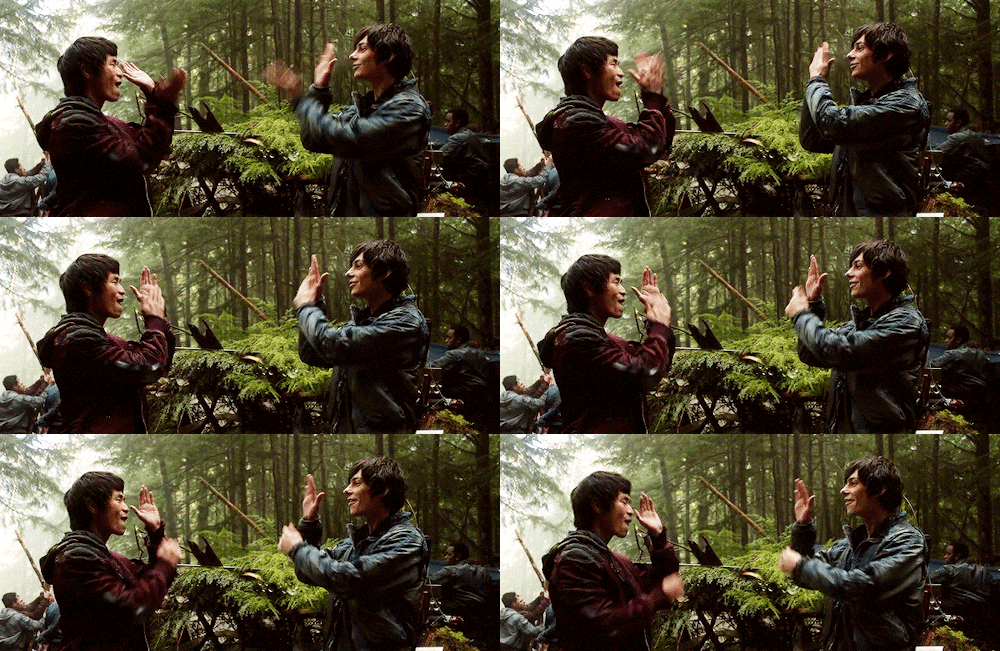
It’s not like any other young adult sci-fi franchise about at the moment and frankly they’re insulted you even asked.

Look, I know that everyone loves this show now, and even I can admit that it got better (not enough to convince me to watch an entire season, but still), but my God was this a staggeringly bad opening. The premise- in which one hundred children are dropped back down to Earth after a global evacuation for reasons that failed to imprint themselves on my memory- stank of cashing in on a recent young adult sci-fi boom, and wasn’t helped by the gawky nature of the premiere. The symbolism was as subtle as a marble bust to the back of the head, the dialogue ferociously awful, and the “characters” drifting off into the distance like the scent of a retreating bin lorry. It took me two goes to get through the whole thing.

Most Inexplicable Failure-Breakout Kings

I’ve never been super into procedural shows, but following my love affair with the brilliant How to Get Away with Murder, I decided to give this one a go. It had one of the Macpoyles from It’s Always Sunny in the main cast, for Christ’s sake! But then I actually watched it, and decided to assume for my own sanity that it’s some sort of derangedly po-faced satire on the genre. Following a bunch of inmates matched with police officers to try and capture escapee prisoners, it’s got every dumb renegade-cop-show cliché you could probably imagine, but doesn’t even have the good manners to make them any fun. I refuse to understand how or why this was considered a good idea.

Biggest Disappointment-Houdini
tumblr_nbcpjpw9gz1qd9agqo1_250

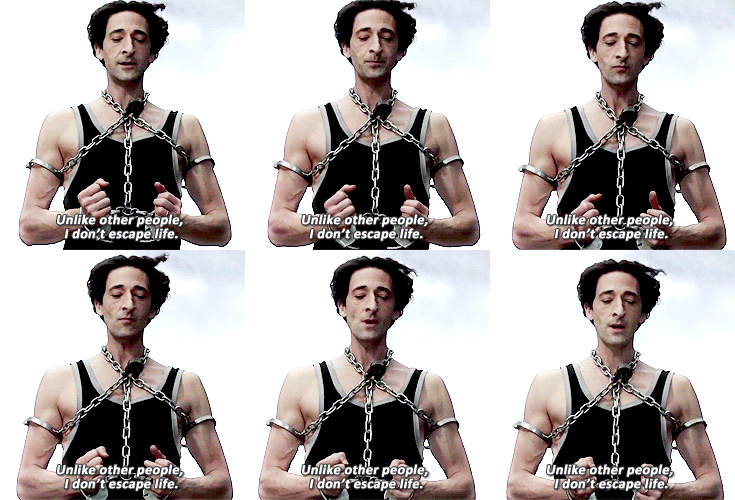
I ESCAPE THE FATAL LURE OF GOOD TELEVISION

I wrote about this miniseries before, mainly to rant on the historical accuracy (or complete lack thereof), but I think it’s also worth pointing out that this show-which should have been a fascinating biography of one of the most interesting figures of the last century, played by the always-brilliant Adrien Brody, rarely allowed itself to get beyond (somewhat appropriately, I guess) shallow spectacle. And was paced dramatically badly.

Worst Movie-Avengers: Age of Ultron

Of all the films I saw in the cinema this year, this was the one that just straight-up sucked the hardest. I think I tried to be reasonably diplomatic in my review, but as the film has faded in my memory all I can really remember is a jumbled bunch of samey action sequences and allowing my brain to get soothed into a coma by the sound of James Spader’s lovely, lovely voice. In a year with a few cracking blockbusters, AoU was one of the worst examples of the genre I can remember in recent memory. Except my nemesis Man of Steel, of course.

Most Unwatchable Scene of the Year
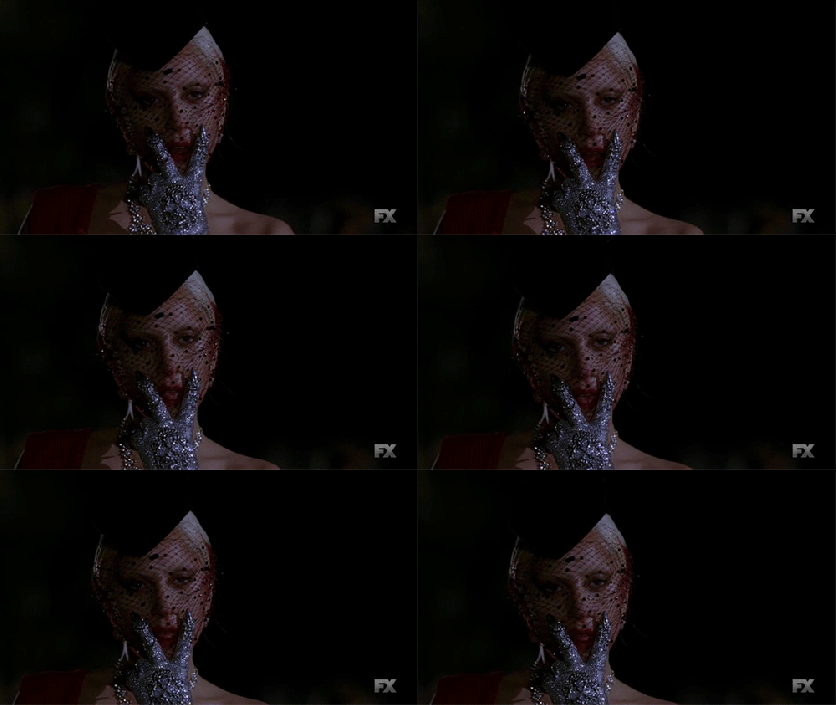
tumblr_nvvwvspbj51qdqllqo1_500

An accurate representation of the season to date.

American Horror Story’s violent spike sodomy. All the ugh.

Worst New Show-Scream Queens

After I watched the first couple of episodes, I kind of dismissed this with a shrug that it didn’t do it’s horror was particularly well handled and forgot about it. But I eventually caught up, and the whole thing had just become a manifestation of Ryan Murphy’s raging id; violent candy hues, intricately horrible violence, and uncomfortable doses of ironic racism at every turn. I mean, this got bad, and not even entertainingly bad- embarrassingly, avert-your-eyes awful. #GetLeaMicheleBacktoBroadway2K15

Worst Performance of the Year
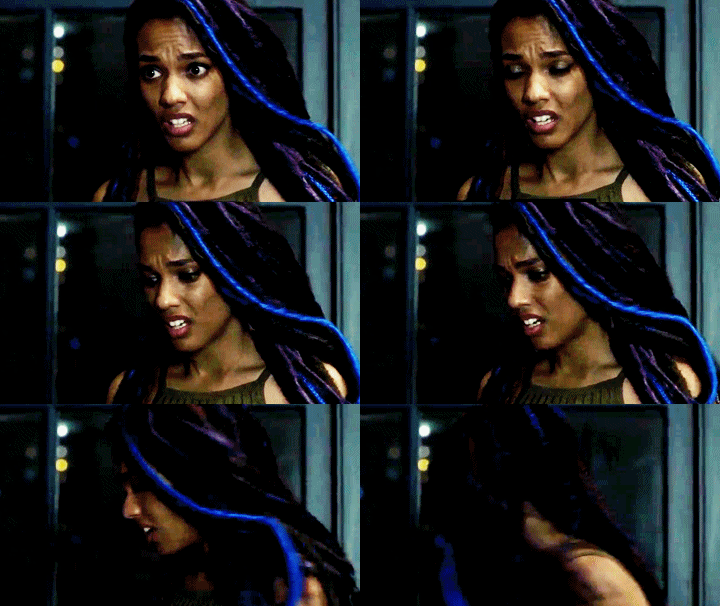
tumblr_npr09krh8d1spaqz2o3_400

I’M ACTING AS HARD AS I CAN

I seem to have gotten all snobby about performances this year, and lots of my reviews have taken time specifically out to rip on certain actors. The two most egregious failures that come to mind are Frank Dillane in Fear the Walking Cashcow, playing a pirate except without all the characteristics that make a pirate fun or cool, and Freema Aygeman in the otherwise superb Sense8 (a small nod has to go to Jenna Coleman’s texted-from-the-inside-of-a-tunnel turn in this year’s Doctor Who, too). John Barrowman in Arrow should probably take the biscuit, but he looks like he’s having too much fun to care.

Worst Episode Ever

The Girl Who Died. The Girl who Murdered the Show I Loved, more like.

So, what were your worst (and best) episodes, characters and shows on TV this year?


Star Wars: The Force Awakens Spoiler-Free Review

So, I saw the new Star Wars movie last night.

That might not sound like a particularly earth-shattering statement, but for me, it kind of is. I’ve spoken before about my passionate, probably dangerous love, of the entire Star Wars franchise (yes, even including the prequels) on this blog, but I don’t think anything I could type here would accurately sum up the bone-shivering levels of excitement I felt when I sat down in the cinema yesterday afternoon. I’ve watched all the trailers for The Force Awakens multiple (MULTIPLE) times, analysing every frame and tearing up every time I saw the Millenium Falcon, and, for me, The Force Awakens was always going to be the best film of the year, whether or not it was actually any good. It’s a new Star Wars movie, for Christ’s sake- a new STAR WARS movie. Nothing at all could dim my levels of blind excitement for this film, not bad reviews, not fandom cynicism, not people gracelessly reminding me of the prequel trilogy, nothing. My expectations were so staggeringly high, all The Force Awakens could do was match them.

And it did.

I think it’s easy to forget, when you’re a Star Wars fan the way I and many other people insist on being, that the Star Wars movies-even the original trilogy-are intensely flawed. The dialogue is wobbly at best, the performances (aside from Harrison Ford’s Han Solo, which is basically down to flawlessly perfect casting) are decent but rarely ground-breaking, occasionally dipping into outright terrible, and the stories are often peppered with inexplicable plot points (Leia and Luke’s steamy incestual make-out session springs to mind). But the success of the original trilogy, and what little good there is in the prequels, comes from being able to capture a certain bombastic tone. A New Hope, for example, is a flawless adventure movie, two hours of obscenely entertaining nonsense that captures you from the first enormous chord of John Williams’ career-best suite through a gloriously simple story set in world thick with dashing rogues, mysterious powers, and political intrigue. As far as I’m concerned, it’s the ultimate blockbuster, and that was the best thing that The Force Awakens could evoke.

And evoke it it did. In fact, the plot had strong echoes of a New Hope that will make themselves evident to anyone who’s familiar with the original movie, but The Force Awakens had more than that. Where the prequels had gone wrong- focusing on dull characters and drudging political stroylines- the seventh part of the Star Wars franchise crisply sets up a galaxy struggling to right itself after the emergence of the Empire 2.0, throwing us straight into the action with a handful of strong, interesting new characters who demand your attention and endless speculation. With an almost aggressive focus on real effects (SEE THESE THINGS RIGHT AT THE FRONT OF SHOT SEE HOW THEY’RE REAL YOU SEE DO YOU SEE?!), we’re instantly guided back into the always-welcome Star Wars universe.

Of these new characters, Kylo Ren, played by Adam Driver, is my favourite, maybe because I was already coming to this movie with a very high opinion of him as an actor but probably because Ren is one of the best villains the whole franchise has ever seen (especially after the  hilarious mishandling of Anakin’s prequel character arc). And there aren’t really enough good things to say about newcomer Daisy Ridley as Rey, whose sharp, witty, compassionate performance continues in a long line of fantastic leading women in the franchise. John Boyega as Finn, with his compelling backstory, was about as charming a leading man as you could hope for in a franchise in which both Harrison Ford and Ewan Mcgregor have starred, and Oscar Isaac as the best pilot in the galaxy didn’t seem able to wipe the excited grin from his face for the whole two hours. I only have a shrug to offer on the subject of Domnhall Gleeson and Andy Serkis, both of whom I assume will get plenty of time to expand on their villainly in later movies.

Of course, the stars of the original series made a comeback too, with Harrison Ford, Carrie Fisher and Mark Hamill all returning for various amounts of screentime. Among them, Harrison Ford is still my favourite, just as morally ambiguous as ever, but Carrie Fisher proves once again why she’s the feminist icon of my movie-watching career. I saw some reviews snivelling about how The Force Awakens pandered too much to fans of the original trilogy, but frankly, they couldn’t be more wrong- there’s just enough to connect the seventh instalment to the one before it without letting it get bogged down in nostalgia, and besides, this is a continuation of that story. It would feel like cheating if they dropped everything that the original trilogy worked so hard to achieve, and tapping into that mythology gives the film an instantly deep backstory. Which is not to say there isn’t a little fanservice here and there- the introduction of the Falcon caused a ripple of excitement across the whole cinema-but after ten years of waiting, I’m not going to begrudge that.

Above all else, though, The Force Awakens is one of the finest blockbusters in recent memory, and believe me, I’ve seen ‘em all. Careful pacing, a sharp vein of humour, and good balance of brilliant action and actual storytelling mark this out as a worthy successor to it’s predecessors, and for that alone, The Force Awakens deserves your custom. Well, we’ve got two more movies to come yet, so you may as well get on board now.

Labour Pains: Women, Horror, and Reproduction

So, since it’s nearly Christmas, I’ve been watching some horror movies (and yes, those things go together perfectly logically) and other assorted spooky paraphernalia. And I’ve started noticing a few patterns emerging with the way horror treats it’s female characters.

I don’t think it’ll come as news to anyone that horror, as a genre, doesn’t necessarily treat it’s women super well. Not to say there aren’t some exceptions-plenty of movies do well in providing female characters who are just as nuanced as their male counterparts (Cabin in the Woods, Grave Encounters, Lords of Salem, just off the top of my head). But beyond the usual final-girl tropes, I can’t shake the feeling that horror movies just have a problem with female bodies in general.

lords-of-salem-movie-page-3

Sheri-Moon Zombie in Lords of Salem

And, yeah, I can hear it now- it’s not as if men get off without being stabbed, shot, eaten, or stabbed with a spear mid-way through sex. But women are much more often victimised for their femaleness than men are for their masculinity.

I mean, periods alone have a long and deeply unpleasant tradition in horror history as it is. Menstruation in horror is often used as a way to signify sexual maturity, and generally that comes with the nasty side-effect of turning the woman in question into a raging serial murderess when all she needs is some tampons and a lie-down- from the seminal Carrie (1976), which opens with our protagonist getting her period for the first time and ends with her destroying an entire town, to Excision (2012), where AnnaLynne McCord’s character deliberately loses her virginity while on her period to try and satiate her erotic obsession with blood.. The titular character in Ginger Snaps (2000) is attacked by a werewolf specifically because the smell of blood from her first period attracted it, and Dog Soldiers (2002) has a female werewolf referring to her metamorphosis as her “time of the month”. Basically, if a women in a horror movie gets her period, get out of there, because chances are she’s about to go on a violent killing spree. These movies, along with many others, directly connect menstruation with an often uncontrollable urge to wreak havoc, which is, at best, only 30% true.

excision_onset_june29_194

AnnaLynne McCord in Excision, which is spectacularly good and deserves to be far more known that it currently is. GIVE ME AN EXCUSE TO TALK ABOUT THIS MOVIE PLEASE.

I don’t think I need to underline how many times teenagers, and women in particular, are punished for having sex in horror movies- films like Jennifer’s Body (2010), which features a teenager forced to lure her classmates with sex in order to feast on their innards due to the fact that she lied about still having her virginity, specifically pinpoint women’s sexuality as something demonic. It Follows (2014) lands in the same ballpark, with a teenager girl being stalked by a murderous vision because she slept with the wrong guy. I couldn’t really write this article without acknowledging this exists, so jump over to here if you’d like to read more about it.

megan20fox20jennifers20body20movie20image

Megan Fox in Jennifer’s Body. This movie is somewhat better than you think. 


And, what comes after sex? Babies. The demon pregnancy trope  and it’s implications have been discussed at great length elsewhere, so I’m going to focus in on a couple of specific movies that take it one step further- firstly, Grace (2009), which revolves around a woman who’s foetus is killed in the womb. She insists on carrying it to term, only to birth it and find out that it’s actually alive- but with a terrible appetite for blood. The film very specifically focuses in on the practical biological impulses of motherhood- labour, pregnancy, breastfeeding, and so on- and subverts them into something unthinkably horrible. In French New Wave horror Inside (2007), a woman loses her husband in a car accident while pregnant, and, just before she is due to give birth, is terrorised by another woman who is intent on acquiring her unborn foetus through scissor caesarean (seriously, you should watch it, it’s fantastic).

inside02

Alysson Paradis in Inside. You have no idea how long it took me to find a screenshot with less than full gore in it.

In both movies, whether literally or metaphorically, the woman in question is being victimised for her ability and willingness to carry and birth children, punished with insane levels of violence or tortured by impossible moral questions for her decision. This can be applied to a bunch of other movies that use demon-pregnancy trope- there are so many films that employ the idea I don’t think I could list them all here- A Nightmare on Elm Street 5 (1989), Devil’s Due (2014), Dawn of the Dead (2004), Ju-On 2 (2004), It’s Alive (1974), and, of course, the one that started them all, Rosemary’s Baby (1969), to name a handful. That’s not to say that the men who feature in these movies get off scott-free- usually the opposite, in fact- but their deaths have less to do with their biology than their female counterparts.

I’m not necessarily criticising every horror film that utilises one or more of these tropes- in fact, I think there are more than a few movies that explore femininity, motherhood and pregnancy in the horror with really interesting results (Most notably 2014’s The Babadook, which you absolutely should have seen by now). But it does get a little bit tiring, in a genre that I love so much, to see women’s biological processes so often depicted as something twisted, demonic, or uncontrollably evil.

Doctor Who: Torturous Account Rounds Down Irrelevant Season

I was never sure if I had a cut-off for Doctor Who. In quality, I mean- I sat through Kill the Moon with my eyes rolling so hard that I thought they might get permanently wedged towards the back of my head, and I dragged myself through what felt like the physical assault of The Girl Who Died, and I kept watching. I truly believed that nothing could shake my faith in Doctor Who so badly that I would basically have come to terms with the fact that I would never want to watch it again. But, as it turns out, I have my limits. And that limit was pranced over in this week’s season finale, Hell Bent.

hell2bbent2b-2b04

As soon as I saw the guitar I knew we were in trouble

I honestly don’t know where to begin with this nonsensical garbage, so I’ll start by harkening back to a quote from Jenna Coleman, explaining the show to Conan O’Brien a few months back: “Don’t apply logic, ever.” This, to me, is one of the biggest problems about this season, and about Capaldi’s run in general: many of the plots don’t make logical sense. And yes, I know that this is a show about an alien flying through time and space in a phone box, but every science fiction world should have it’s own internal logic, through which the stories do actually make sense. This season of Doctor Who failed dismally at so many turns to do that, and Hell Bent was the worst offender of the lot. This episode failed in providing logical character motivation, logical development, or a fucking coherent plot on top of all of that.

As you can probably tell, the script for Hell Bent-written by Moffat himself- was a staggering disaster. The direction, the acting, the look of everything, it was fine- but the script was a pointless, flabby waste of time that offered no real answers but swanned off all smug with itself at the end up anyway. The plot was so bitty and broken that I have no interest in trying to string it together here, keen as I am to crush this episode into a tiny cube in my brain to make way for more important things like how to peel an orange, but suffice to say it was fuckery of the highest order.

landscape-1448810038-doctor-who-hell-bent-04

Where to begin with the logic-fails? You might think rule one is “The Doctor Lies”, but it’s actually “Moffat Retcons”. First, how can Rassilon be the mightiest force in all of Gallifrey, only to be usurped and mutinied-on within minutes of his arrival on screen? Why did the Doctor shoot someone, when he’s always been passionately against using violence as a method of resolution? How come Clara’s continued existence hasn’t broken time and space, considering that she was meant to die at a fixed point in time? If the Doctor has his memories of Clara wiped, how can he remember enough to tell her about their adventure together? Why was Clara so insistent on her death and the Doctor letting go of her, only to jaunt off to fly through time and space with Ashildr at the end of the episode? On top of that, ARE WE EVER GOING TO GET A RESOLUTION TO THE ORSON PINK PLOT?

gallery-1448810235-doctor-who-hell-bent-08

I dug the costumes a lot, all that said- one of the few even acceptable parts of this episode.

Then there was the pointless time-wasting- I’m sad to say that most of the stuff on Gallifrey felt utterly without reason, especially the endless time they spent wandering around the dimly-lit rogues’ gallery while the Doctor warbled on about…well, that’s a good question actually, because it had nothing to do with the plot or themes of the episode. To bring the Doctor back to Gallifrey for the first real time in the whole of New-Who’s run, and that have it serve as barely-relevant background for a plot that had to do with the Doctor bringing Clara back to life felt like a slap in the face after having it as a distant shadow over the show for so long. All of that plot revolved around the Doctor finding a way to travel back in time to save Clara between her final heartbeats, and surely there was a better way to do it than by invoking Gallifrey’s name in vain?

Oh, and let us not forget the “resolution” to the Hybrid arc. It staggers me that someone, somewhere, sat in the DW writer’s room and went “what if we make up a creature, a creature so powerful that it will apparently stand in Gallifrey’s ashes, one that we build to all season and purposely invite endless speculation around with a parade of would-be candidates, and then, and here’s the twist, it turns out that it’s nothing? Wouldn’t that be revolutionary storytelling?” And, in all fairness, I didn’t see the end of the Hybrid plot boiling down to “Maybe it was the Doctor and Clara, maybe it was Ashildr, but who cares when we’ve got a Tardis shaped like a goofy 50s-themed diner!”. I wrote earlier in the season that I was firmly sick and tired of Moffat’s habit of ending potentially interesting stories with a smug “gotcha!” and this was the worst of the lot, because the story didn’t even really get a resolution. It sort of wetly disappeared into nothing, like a fart in a bath. I threw a bottle against the wall when Missy was revealed last season (where was she, by the way?),  and I almost punched a hole in it with this jaw-droppingly lazy “tell”.

d2

But Hell Bent hinged on, above anything else, me buying Clara as the Doctor’s soulmate. And I don’t. Nor have I ever. Clara is another in a parade of Moffat’s wise-cracking, know-it-all women without much to differentiate her from Amy or River, and I never really, really brought the relationship between her and Capaldi’s Doctor. If this episode had come during Matt Smith’s run, it might have been a touch less infuriating, but here it was violently awful. The Doctor breaks his codes-codes that are integral to his character, like not committing murder or messing with time- just to serve the episode, and when you’e writing an episode where the characters do whatever you need them to in order to push the plot along, you’re penning an anthology, not a series.

Clara asks him to let her die; his not respecting that is some condescending bullshit. And the “devastating” ending I was promised- where the Doctor wiped his memories of Clara, except didn’t really, because he could remember her- made me long for the days when Martha took a stand and left the Doctor for her own good. Essentially Hell Bent reversed the polarity of the Donna plot, and someone made it even worse than that already was. I used to think that some of RTD’S writing was unforgivably schmaltzy, but I take back every bad word I’ve ever said about him after this almost offensively awful drivel. When the Doctor can just save anyone he chooses, when death doesn’t actually stick, all the stakes for the show are gone. And it makes the Doctor look particularly evil in retrospect, when you think about all the people he could have saved had he really wanted to. When Clara has died so many times before, forgive me if I’m not exactly chewing my nails wondering how this one will turn out.

20150826-dw2bs9b8-192056

“If we bow, we can keep our faces off-camera and pretend we were never involved with this mess.”

All in all, Hell Bent was a catastrophe- overwrought, underwritten, poorly plotted and embarrassingly cheesy, a series-worst episode that rendered season nine even worse than it’s dull predecessor. It’s only saving grace was the return of the sonic screwdriver, and even that felt like finding a penny coin at the bottom of a barrel of steaming horseshite. I don’t know if I’ll be bothering with the Christmas special, or indeed season ten, but time heals all wounds- maybe Capaldi can take me back to before I watched this episode, considering that all logic has been thrown to the four winds at this stage. I’m thoroughly looking forward to getting back to my New Who recaps (which will start back next week, with the superb Father’s Day from season one), and leaving this mess firmly behind me, so if you’re looking to continue your Who coverage in between seasons, please do join us. I’ll have you yet, Moffat, if the rest of the anti-fans don’t get there first.


Doctor Who: Terrific or Awful? Really, Doctor is Sensational

So, I’ve been browsing the forums (Gallifrey Base is basically my second home) and I’ve been seeing a lot of…mixed opinions about night’s episode, Heaven Sent. To say the least. Some people seem to think it’s a pointless wreck of an episode, one that basically could have been skipped out and replaced with taking us straight to Gallifrey (because, yeah, after more than two years we’re finally addressing that plot point), and some think it’s a staggering work of genius unparalleled in Capaldi’s run to date. And for once- for once– I’ve found myself on the side of defending a controversial episode.

gallery-1448361809-doctor-who-heaven-sent-05

Look, I loved this. I loved this passionately and almost without restraint. A fifty-four minute special, directed by my hero Rachel Talalay and written by Steven Moffat, I know that this wasn’t perfect, but it was audacious and smart and featured a frankly staggering performance from Peter Capaldi whose endless talent (did you know that he’s got an Oscar?) was finally matched by the strength of the script. After a season that’s mostly ended up on the wrong side of patchy, Heaven Sent finally pulled up it’s bootstraps and produced something compelling, clever, and emotionally impactful. At least to me.

It’s nice, for a change, to have a lot to say about an episode that I actually liked, as the other episodes I’ve rated this season (Under the Lake, Sleep No More, and The Zygon Invasion, in that order) have been good in such a way that doesn’t require me to say much about them (even if my thousand-word reviews would suggest the contrary). They’ve just got a decent story, some good performances, and a finale that doesn’t feature a violently annoying plot twist instead of an actual resolution. But Heaven Sent had more than that.

gallery-1448361658-doctor-who-heaven-sent-02

The episode revolved around the Doctor, trapped in a time loop, as he’s dumped in the middle of a mysterious castle in the middle of the sea and forced to fight for his life (anyone else getting Fort Boyard vibes?) against a creature that moves slowly but simply never stops coming. It’s a cool, horror-centric premise to set an episode around, and one that was genuinely frightening at points: a couple of good jump-scares and a general air of doom marked this out as one of the few actually scary episodes of the last few years, and that’s something I can firmly get behind. The direction was gorgeous, too, and made the most of the circular premise of the plot, turning the long corridors and shifting rooms into an endlessly repetitive nightmare that sums up how I feel about a lot of Moffat’s run to date.

And yeah, I can give this one to Moffat, much as I still have my problems with a lot of his writing this season. It was a smart script that stopped just short of getting too hammy or cheesy, even if I could have done without him ripping off Sherlock with the mind palace nonsense. It also, somewhat tragically, featured Clara’s best performance this season, in which she basically stood with her back to the camera and wrote things on a board the whole time. It also gave Capaldi a chance to run the full gamut of emotions, from fear to exasperation to grief and back again, and man, did he deliver- it’s occasionally easy to forget that Capaldi really is a tremendous actor, and it’s a real treat to see him get the chance to thesp his velvet coat off. Seeing the Doctor suffer in a visceral, violent way is something we don’t see in every episode, and the images of him, bloodied and scarred, dragging himself up the stairs so he could sacrifice himself once again hung around uneasily in the back of my head for a while after the end credits.

HEAVEN SENT (By Steven Moffat)

And yes, I accept that there are flaws in this episode. If he had his confession dial the whole time, did that mean he had a portal to Gallifrey that he didn’t bother to use? Why didn’t they just take him straight to Gallifrey as opposed to having him dick around in a castle for a whole episode? And seriously, have we just forgotten about the events of Listen completely? Are they ever going to be resolved? But the audaciousness and strength of this episode made it worthwhile, at least for me, and I’m glad to see Moffat trying something a little bit different. After the curiously low stakes of this season- Clara’s death last week, which felt particularly pointless, stands as the biggest example- things are finally going somewhere. The Doctor is back on Gallifrey, and, according to him, “The Hybrid is me” (I swear to God, me and the Consort spent about an hour talking about how this didn’t make any sense until I woke up in the middle of the night going “CHRIST, LADY ME, OF COURSE”). Things feel big and important, and I can get behind that.

heaven-sent-promo-pics-15-570x380

Alas poor Davies, I knew him well…

You don’t need to remind me, if you’ve been following these reviews for any length of time, that I felt precisely this way about last season’s Dark Water, only to have my hopes shattered by the basically shite Death in Heaven, so I am fully expecting the series to balls up it’s finale. But for now, I’m happy- after a series of lazily contrived stories, Heaven Sent finally felt like it was going somewhere, and I can get behind that.

Don’t think I didn’t notice that thunderously out-of-place incidental music, though. I’ll have you yet, Moffat.

Feminism in Time and Space, Part Three: Doctor Who and Repetitive Women

So, this is the last part in my blog series about Doctor Who and all things feminism-related. I hope you’ve enjoyed it, and thanks for reading along! This week, I’ll be looking at the fallacy of the strong female character in Doctor Who.

7254669-low_res-e1414414299527

For starters, I find the phrase “strong female character” a bit…ugh in itself. Because it suggests that a strong female character is something notable and different, which isn’t wrong, but still kind of depressing to think about. I can’t remember the last time someone referred to a “strong male character”, because it’s just a given that a show will have solid roles for it’s men more often than not. And, more and more often, that phrase has come to mean a very specific thing- a woman who seems superfically powerful but actually has very little else going on underneath. But still, in all the diatribes I’ve read and heard about Moffat’s era of Doctor Who and how it isn’t, in any way, at all sexist, many people make reference to this concept, arguing that Steven Moffat has filled his series with powerful and significant women characters.

And to some extent, that’s certainly true. Women have a constant presence on the show, whether as assistants (Clara, Amy) or as recurring characters (River Song, Madame Vastra). And that’s great. But lot of the women on Doctor Who seem to fall very squarely into the trap of creating female characters who basically echo each other.

ns6ep8b1

Let’s start with a look at the three most significant women in Moffat’s run- River Song, Clara Oswald, and Amy Pond. River Song encountered the Doctor as a child, fell in love with him, and pursued him through time and space until they got married. Clara Oswald encountered the Doctor as a child, took off with the Doctor as an adult, and jumped into his time stream to scatter herself all through his many lives. Amy Pond encountered the Doctor as a child, became obsessed with him after he vanished, then fell in love with him when he eventually returned for her. Not to mention the newly-introduced Ashildr, from this series, is brought back to life by the Doctor as a child and every time she encounters him begs him to take her on adventures with him. Are you seeing a theme here? Because I’m seeing a theme here.

Despite the fact that Amy, Clara and River seem outwardly different (let’s ignore the fact that they’re all saucy, quippy, flirty, etc), their personalities revolve around one man. For all these women, their entire lives have revolved around the Doctor, and their stories just don’t exist outside of him. Even in a couple of standalone episodes- notably the Girl in the Fireplace- the female characters meet the Doctor as a child then spend the rest of their lives pining for him. Compare this to the Davies years, where Martha actually left the Doctor and pursued her own life when she realized her feelings for him were hurting her, and it seems worryingly repetitive.

p02180gl

And speaking of worryingly repetitive, remember that episode with the tightly-attired, usually older, ruthless woman who turns out to be using her non-threatening exterior to mask inner evilness? Oh, sorry, I should be clear- I was talking about Ms Delphox in Time Heist. Or was it Miss Kizlet in Bells of Saint John? Maybe I meant Madame Kovarian.  Or Madam Gillyflower in The Crimson Horror. Sorry, no, Missy. I’m not saying that there haven’t been repetitive male character tropes either, but this one seems a particularly telling one to bash over the head, especially when you consider that it also turned up in some of Moffat’s other work (Jekyll and Sherlock.

What I’m trying to get across here is that, yes, while Doctor Who does feature women in lots of different roles doing different things, when you strip away the exterior, what’s going on underneath is extremely repetitive. I can appreciate, to an extent, what the show is doing with it’s women now, I think it’s fair to ask for a little bit more variety. And I’m not just talking about keeping the Daleks out of just one series.


Doctor Who: Thin Adventure Revels Despite Inconsistent Surroundings

So, since watching last night’s episode Face the Raven, I’ve found myself kind of stuck about what to say about it. Clearly, it’s an important episode-maybe the most important episode of the season so far-but at the same time it felt strangely unaffecting, and I couldn’t figure out if that was a good thing or a bad thing. And, oh, before I begin, SPOILERS. SERIOUSLY. DON’T READ THIS IF YOU HAVEN’T SEEN THE EPISODE. Don’t say I didn’t warn you.

dw9_e10-81-1200x800

As I suspected, this week saw the (ostensible) end of Clara Oswald, which makes it a tricky episode to review. I started reviewing Doctor Who on this blog when she arrived in the series as a regular-my very first recap was The Bells of Saint John– and I’d quite like to go back and look at Clara as a character and look at how her arc has and hasn’t worked, considering how much of an investment I’ve put into her story. But that would do a disservice to what was an interesting episode, so let’s first take a look at the meat of Face the Raven, written by Sarah Dollard.

The episode kicked off as Rigsy (the excellent Jovian Wade, back from last season’s shrug of an outing, Flatline) ended up with a tattoo on his neck that was counting down to zero. He calls up the Doctor and Clara, and the three of them head off to discover that the person behind the tattoo is none other than Ashildr. She’s running a kind of refugee camp for displaced aliens, one of whom Rigsy apparently killed, and she’s sentenced him to death by the Pigeon of Doom (or a raven that imbibes their soul, whatever). Clara offers to put herself in his place, believing the Doctor will be able to get her out of the whole inevitable-death scenario, but he can’t and she ends up buying it. Not before, of course, Ashildr reveals the whole thing was a trap to lure the Doctor and that she never had any intention of killing Rigsy in the first place.

p037z6f3

Much as I enjoyed this episode as I was watching it, I felt like it did….struggle somewhat, what with the giant, huge, episode-dominating plot point that lands in the middle of the story. Clara’s death goes off like an atom bomb and flattens almost everything around it, making it hard to look at the episode as an independent entity: I will say that I am liking Maisie Williams more and more with every passing episode and Dollard came up with a strong script that did well in filling out the background in the limited time it had to do so, but there’s only really one thing worth talking about in Face the Raven.

Okay, so let’s think a little bit about Clara. I think, if this is her exit (which I strongly doubt, but it’s certainly coming in the next two episodes, so let’s run with it for now), she’s been by far my least favourite assistant. I never quite felt like I had a grip on Clara as a character, even in the two and a half season she’s been around. I’ve been saying, ever since the start of season eight, that she’s spent most of Capaldi’s episodes doing whatever the plot requires her to do as opposed to having anything really consistent of her own to hang on to, and that’s been a huge problem with her character.

DW9_E10-21-1200x773.jpg

And I think it’s her nebulous nature that makes it difficult to genuinely feel affected by her death this week. Which is not to say it wasn’t handled well (aside from the four-angle smash-cut of the actual moment of her death, which was spectacularly badly judged)- in fact, I’d wager that it’s the best her and Capaldi have been together in his entire run, and she was given a quiet dignity and bravery by the script and Jenna Coleman’s solid performance. But it just felt as if once again she was doing what the Doctor’s story needed her to do, and that’s irritating. (Also irritating: another fucking pointless reference to Clara getting off with Jane Austen. I wrote an article on sexuality in Doctor Who a few weeks ago so it was fresh in my brain, so that line had my eyes spinning like fucking marbles, but I digress).

Yes, I get that the series had been trying to show that she was reckless and believed herself to be invincible, and was constantly putting herself in more and more danger after the death of Danny Pink (BY THE WAY: does Danny Pink still not have some kids to spawn, if we are to take what happened in Listen seriously?). But none of it felt…what’s the right word here? Earned? Consistent? Real? Yes, real-when Clara was revealed to be a series of splinters in the Doctor’s timeline back in series seven, that made a lot of sense to me, because she’s always seemed more like a fast burned-out sliver of a character than a real person. Her reckless and pointless death fits pretty well with how I’ve always interpreted her as a character, but only because it always felt as if she was a bumped-up episode companion who way overstayed her welcome.

hqdefault

And, let’s face it, she’s been around too long. There’s a tacit agreement amongst my band of Doctor Who fans that Clara probably should have headed off in the Christmas special, as she felt like a hangover from Matt Smith’s manic, excitable young Doctor and never really fit too well with Capaldi’s dour style. I’m thoroughly looking forward to a new companion who’s original to Capaldi’s Doctor, because, in all honesty, Clara has seemed out of place since Deep Breath. And I don’t intend that to be a criticism of Jenna Coleman, who’s usually been quite solid, but I’ve never wanted rid of a character more than Clara.

And that, ultimately, is why Face the Raven didn’t hit me with that much of an impact. I’ve been waiting for Clara to leave the series pretty much since the start of season eight, and it’s difficult to feel sad about losing a character I was glad to see go (which, to stress again, was nothing to do with the script or the acting, both of which were at season-highs in this episode). And the problems with Clara don’t fall on this episode, they fall on the two and a half seasons leading up to it.

2EADC20C00000578-3328701-image-a-22_1448142087598.jpg

What I am looking forward to, though, is how this affects the Doctor in the next few episodes. Though I know Jenna Coleman will be back in the season finale, we also know that she’ll be gone by this year’s Christmas special, and her utterly pointless death surely has to weigh heavy on the Doctor who basically led her by the hand into her fate. Capaldi has never been more impressive than when he was quietly explaining to Ashildr that she should steer clear of him, even though Clara had made him promise mercy on the person who killed her, and I want more of that. Plus, next week looks really interesting, and I’m thoroughly looking forward to seeing how the next couple of episodes unfold.

You best not be planning a fake-out with Clara, all that said. I’ll have you yet, Moffat.

A Wanker’s Literary Reaction: The Clone Wars

So, I don’t think I’ve ever written much about Star Wars on this blog, and that’s pretty shocking when you consider how much of my brainspace the sci-fi series usually takes up.

The very first movie I ever remember seeing was The Phantom Menace (which I still contend is a really good movie, and by far the best of the prequel trilogy), and my obsession blossomed from there on. And I’m serious about that obsession: I’ve read a bunch of the extended universe novels, I’ve played all the Star Wars games I can get my hands on, and I’ve marathoned the movies three times. Which doesn’t sound like a lot, but if you’ve actually tried to marathon them yourself, you’ll know how horrifyingly time stretches out in front of you when you’re half an hour into Attack of the Clones (A FILM IN WHICH CLONES NEVER ATTACK). I would not be exagerrating in the least if I said that I have found myself seriously tearing up over every new Star Wars trailer that’s been released in the last year. I fucking love Star Wars, and will happily take to task anyone who dares suggest otherwise.

khlxgic

And recently, I’ve started watching The Clone Wars. Well, I tried it a few years back when I first got Netflix, but soon drifted off it because my willpower is pathetic in the face of all the shitty b-movie horrors that Netflix is home to. But I’ve properly taken it on in anticipation of the release of The Force Awakens, and man, have I been missing out.

I was initially kind of put off by the fact that this was ostensibly a kids series, but seriously, don’t let that stop you from knuckling down and absorbing five seasons of this shit if you’re a real Star Wars fan. There’s no doubt in my mind that the series is better than Attack of the Clones and Revenge of the Sith combined, which isn’t really saying much-

-but seriously, this is where all the action you wanted from those movies vanished to. The Clone Wars is basically an anthology show with all the disparate threads tying back into the story of the war between the Republic and the Imperial troops, and lavishes the viewer with new characters, plot arcs, and locations- basically, a chance to properly explore the Star Wars universe.

And there are so many things to love about this show. Firstly, the characters that made the jump from the movies- such as Yoda, Obi-Wan, Anakin and Padme- are all at the very least as good as their big screen counterparts, and often loads better. Anakin actually has all the charm and rogueishness that Hayden Christensen’s solid oak performance surgically removed from the character in the films, and his banter and companionship with Obi-Wan makes the end-up of their relationship even more poignant.And, of course, any character that you thought looked interesting wandering about in the background of a random scene in the films gets their own episode, a conceit that helps open up the universe and create a giant, sprawling ensemble that can fit around almost any story.

anakin-obi-wan-and-clone-troopers-clone-wars-obi-wan-kenobi-23780129-700-394

Ewan MacGregor as a cartoon is kind of goofy, to be fair.

The villains from the movies, most notably General Grievous and Count Dooku, get some back story that actually makes them, you know, threatening and interesting and ruthless. Anakin also gets a padawan, in the form of the wise-cracking Asohka, that stops him from descending into critically brooding territory.

And that’s another thing about the series that I love. Much as I will contend that both Amidala and Leia are fantastic characters and badass heroines in their own ways, it still stands that there are only two really significant female characters out of the six Star Wars movies. In The Clone Wars, there are more than I can count- Asohka is excellent and far more charming than her description makes her sound, and then there’s temperamental Sith warrior Asajj Ventress, not to mention a bunch of cool female Jedi side characters who get just as many awesome action sequences as their male counterparts. There’s a particular episode in season one that revolves around a showdown between two female Jedi and a female Sith, and it feels wrong that it’s staggeringly new and different.

ahsoka3

Ashoka, hangin’ with some clones.

There really aren’t enough good things to say about this series- the animation is gorgeous, the voice acting is excellent (David Tennant won an Emmy was his work on the series), the action is thrilling, and the whole thing is basically an invitation that no Star Wars fan could turn down. What are you waiting for?

Feminism in Time and Space, Part Two: Sexuality and Representation

I swear to God I am rubbing my hands together right now, because this is a topic I’ve wanted to get to for a long, long time: Steven Moffat’s dealings with LGBTQ representation on Doctor Who. Now, I’ve written loads before about bisexual representation (or lack of it) on TV, and it’s something I always look out for in new shows, because bisexual characters-that is, characters who identify as bisexual and aren’t reduced down to their sluttiness, greediness, or, um, lying-ness-are pretty thin on the ground. But Steven Moffat has plenty of characters that don’t fit on either end of the binary, so let’s take a look, shall we?

While this is going to be about Doctor Who for the most part, I’d like to touch on a couple of his other shows that are relevant to this discussion. The first is Coupling, a so-so sitcom following a fictionalised version of Steven Moffat meeting a fictionalised version of his wife. They have a recurring group of friends, one of whom not-Steven is dating at the start of the series- when he tries to break up with her, she tells him she’s bisexual to titillate him into staying. Her “bisexuality” is played for laughs throughout the series, and then, in the final episode, someone shows her some naked ladies, she’s utterly horrified, and her ruse is shattered.

No relevant pictures for that paragraph, but just LOOK at how early-noughties this title card is.

And then, of course, there’s A Scandal in Belgravia, the Sherlock adaptation of the superb Conan Doyle story A Scandal in Bohemia. In the original tale, Irene Adler becomes the only person to outsmart Sherlock and gets away scott-free. In this version, she’s a dominatrix who spends a good chunk of her screentime naked, and she identifies as a lesbian. Despite that, however- despite the fact she says she’s only attracted to women- Steven Moffat’s self-insert  Sherlock is just so sexy and charming and clever that she falls in love with him and gives the whole game away. How they managed to write a story more regressive than one penned over a hundred years ago is beyond me, but there it is. Not to mention the hi-larious running joke of people assuming Sherlock and Watson are a couple, which Watson must quickly and vehemently deny lest those strangers think he likes men, rue the day.

So, you know, the problems I’m talking about here are not limited to Doctor Who. Far from it. But let’s get into the nitty-gritty of representation in the series.

Bring back Donna 2K15

Firstly, Steven Moffat has confirmed that both the Doctor and River Song are “happily bi”, which is cool, and I’m pleased to hear someone actually use the term for once (even if he did follow that up by saying that bisexuals didn’t need representation because they were having “FAR TOO MUCH FUN” and were to “BUSY!!” to watch TV, but let’s skim by that for now). But the fact is that, watching the show, the references he points to as proving their bisexuality- such as an offhand comment from River about fancying everyone in the crew except one, and her making reference to kissing Cleopatra- are always kind of…brushed over? Sure, the Doctor kisses men once or twice during the series, but it’s never as much more than a joke. Neither River nor the Doctor actually find themselves seriously attracted to a person of the same sex without it being breezed past with a barely-audible “No homo though” every time it comes up. Steven Moffat had to confirm their sexuality outside the show, which proves that what he’s doing inside the show is, at the very most, leaving people confused (but I’m sure they’ll make their mind up when they just meet the right episode and settle down, huh?).

And let’s talk about Clara, who has, on a couple of occasions made reference to being attracted to women. The first time, she’s Oswyn, and comments on her crush on a girl, only to quickly dismiss it as a phase; earlier this season, she spoke about Jane Austen being a “fantastic kisser” (right, sure, give Shakespeare his own episode but relegate Austen down to off-screen kissy-kissy faces). Some people have deduced from this that Clara bisexual, and they’re welcome to this interpretation, but to me it feels like a gross kind of pandering- sure, we’ll mention these things, but we’ll never talk about them again, see how the impacted Clara, let alone actually get an episode dedicated to them. Amy flirts with another version of herself, but it’s mostly shown to be a massive turn-on for her male partner Rory. Again, it’s there, but it feels more like a punchline that an actual attempt at representation.

To be fair, I’m bisexual and I’m SUPER into myself so maybe this is accurate.

I’d be doing a disservice if I didn’t make mention of Madame Vastra and Jenny, an openly lesbian couple who join the Doctor on some of his adventures. Broadly, this is obviously good news, as having a long-term loving gay relationship on a show like Doctor Who is excellent for representation. But then again, let’s not forget that the show paints them as generally bickering, with Vastra’s straying eye and Jenny’s still-servant status. And, of course, the fact that the show had Jenny forcibly kissed by the Doctor (who knew she was both gay and in a relationship) before she shared an on-screen smooch with her partner. So, sexual assault comes before lesbian kisses. Good to know where the hierarchy is.

Look, I tried to find a picture of their first kiss but the search just returned a lot of fanart porn and frankly I’m just not up to sifting through it today.

Look, in some ways, I really appreciate that the show is trying to depict non-binary sexuality, and I think they have succeeded before. Even though Captain Jack Harkness (who appeared for the first time in a Moffat episode, but was created by Russel T Davies) kind of fits the hyper-slutty mould for bisexual characters on TV, he’s probably one of my favourite non-binary characters ever because he’s funny and brave and a bit of a sleaze (I worship at his altar in this review of Torchwood, if anyone cares). But since then, the show has treated non-binary characters like a novelty, who’s straightness is the only aspect of their sexuality worth exploring or even seriously discussing. And, considering we’ve got the whole of time and space to explore, I’d happily chop in another Dalek episode for one that actually took a look at the wide range of sexualities Moffat promises us are on his show.

What We Want from the TV Star Trek Reboot

No, not THAT Star Trek reboot.