The Cutprice Guignol

The Ninth Year: The Haunting of Swill House

Doctor Who Recaps, Episode Four & Five: Aliens of London/World War Three

Welcome back to another merry week of Doctor Who-less than a month till the new series! Are you excited? I’m profoundly not, partly because Moffat (I’ll have him yet) has announced that there will be a good number of two-parters in season nine, which would have been great news, oh, about four years ago. Ever since the terrible Living Flesh or whatever episodes from a couple of seasons ago, two-parters in New Who have increasingly seemed more like space-fillers than space adventures (it’s okay, I’ve already killed myself over that attempt at wordplay). Which is a tenuos enough link to get us into our next recap, which covers the first ever two-parter of the rebooted show- Aliens of London, and World War Three (we’re doing double-handers in one review, because these recaps are already stretching out in front of us like that neverending corridor in Time Bandits). And you know what that means, don’t you? We’ll be spending a couple of episodes with the inhabitants of Raxacoricofallapatorius (and yes, I knew that one off the top of my head, or at least you can’t prove otherwise)- better known as the Slitheen. As ever, check out another take on these episodes over at Red Whine.

Look, I know that these episodes are…divisive, at best. Even I can concede that they’re probably the weakest episodes of season one. But Christ almighty, at least when this season was bad, it was still fun (see: the arduously pretentious season 8 shocker Kill the Moon). The Doctor brings Rose back to her own time again, only to find that she’s actually been gone for a year- and as Rose reconciles with her distraught, badass mother, Jackie (who, in this episode, becomes thw first mther to slap the Doctor in the face), and her boyfriend, Mickey, something somewhat surprising happens.

Aliens! Or, at least, alien. In one of the best red herrings I’ve seen before or since, an alien spacecraft carrying a pig-like creature-

Ugh, this thing really freaked the fuck out of me on re-watching. Is that a real pig’s head? Ugh ugh ugh.

-smashes through London. As the authorities hustle to figure out what’s going on, the Doctor deduces that the spaceship was actually launched from earth, and that the creature is just a pig-albeit it one modified with alien technology. UNIT (appearing in the new series for the first time, hurrah!) recruits the Doctor to help them figure out what’s going on, as the mysteriously missing Prime Minister is replaced by an MP who isn’t quite what he seems.

Let’s be clear here: this episode is mainly just a collection of moments that I find amusing. Matt Baker, from my generation of Blue Peter (if you’re not British and you don’t know what that is, this clip should pretty much sum it up for you) appearing briefly baking his “very own edible spaceship” as the Doctor flips through channels, Jackie laying the smackdown on the Doctor for stealing away her daughter, and, of course, the introduction of Harriet Jones (MP Flydale North), one of the most gloriously well-realized supporting characters of Davies’ run.

The actual substance of the episode- farting aliens crammed into human body suits trying to take over parliament- is pretty awful when you actually think about it, but hinges on whether or not you find this-

-on any level intimidating, amusing, or even watchable. I think they’re pretty far from actually scary (I mean, look at those fuckers- they look like some nightmare version of a Baby Born doll), but fuck it, I’m a big fan of using real effects over CGI and I like the fact that for the most part, these things actually exist for the characters to interact with. Some effort went into the design, and even if having them fart away while wearing the skin of their human conquests diminishes their fear-factor somewhat, the show was still finding it’s feet as family viewing and I’m not going to begrudge it some toilet humour. And anyway, Doctor Who has a long and glorious tradition of cramming hapless actors into pretty shit rubber suits in the name of a story, so why should we start getting snobby about it now? Case in point:

If we can consider a show with the green bubblewrap monster a classic, then I’m sorry, but we have no right to be deriding the Slitheen, who are Michael Myers, Golden Freddy, and the notion of death itself rolled into one compared to this.

And I also dig this episode because it’s set on Earth, and we get to spend some more time with Rose’s friends and family. Whenever these episodes roll about with any of the assistants, all it serves to underline is that otherness the Doctor has from the rest of their lives, and how impossible it is to integrate those two things entirely. It’s also nice to see Rose interacting with other humans, for a change, and particularly with Harriet Jones, with their conversations existing apparently only as proof that Moffat cannot write women anywhere near as well as Davies can (seriously, give me five words to describe Clara off the top of your head. No disrespect to Jenna Coleman, who’s great, but Rose actually has, you know, a fully-formed character as opposed to a thousand lines about her short skirts) and to annoy me with the knowledge that we have to deal with Stephen Moffat’s bullcrappery for another two years at least.

But, my non-sequitor ranting aside, I like this episode, despite it’s faults. It’s a good, silly romp that underlines all the things I enjoy about Doctor Who at it’s most silly- an inherent recognition of it’s daftest, the enthusiasm real-life serious people-

(for those not acquainted with him, this is Andrew Marr, a well-respected political journalist and broadcaster, starring in a brief cameo in this episode)

-in getting involved with a story this dumb, and a cast of warm, well-rounded supporting characters joining the Doctor and his assistant in saving the world. And, since there was no room for it anywhere else, I’ll round of the episode by pointing out that this is the second episode is as many weeks to introduce a main cast member of Doctor Who spin-off Torchwood, in the form of Tosh, the doctor who examines the alien pig-man at the start of the first episode (in fact, canonically, she’s a computer expert and is covering for her hungover doctor colleague Owen, but basically what I’m saying is go watch Torchwood because it’s more fun that you think, okay?).

A prize for the best caption for this picture.

Join us next week so I can masturbate furiously over the utter, unparalleled glory of Dalek, the very first episode of New Who to introduce one of the Doctor’s most notorious villains.

Greedy, Lying, or Slutty: Straight-Passing and Bi-Erasure

I was reading an article recently- this article, to be precise- which was centred around the fact that the author believed people who’d only dated members of the opposite sex shouldn’t be allowed to identify as “queer”. And it got me thinking, as things like that often do, about straight-passing and bi-erasure (and the erasure of other, non-mono sexualities, though I’ll be discussing my own experiences specifically).

Look, here’s the low-down: I’ve been in a monogamous relationship with a member of the opposite sex for what feels like a staggeringly long time now. There’s no doubt that the majority of people who glance over my life would assume I was straight, especially if I forgot to wear my “I’M BISEXUAL, ASK ME HOW” badge that day, and I can’t blame them for thinking so. But the fact of the matter is that I am not straight, no matter how much various people would like me to believe I am, and when people describe me as such they’re saying something that doesn’t account for an important part of my sexual and romantic life. But does the privilege I get from passing as straight make up for the fact that I regularly get a big part of my personality ignored? That is the question.

Thing is, I totally understand the urge to keep straight-passing people out of LGBTQ+ spaces. When I see posts declaring that bisexual people with opposite-sex partners shouldn’t be allowed at pride, when I see people rolling their eyes at “fake bisexuals” who they believe are wearing queerness as a status symbol, when I hear people brushing off the right of non-monosexual people to engage with queer culture, I get it. I do. Because queer spaces are, in a lot of ways, one of the few places where hetereonormativity isn’t so, well, normal, and having someone prance in with their opposite-sex partner, looking to all the world like a straight couple and benefiting from all the privileges that brings, seems counter-productive. So I understand where this desire to keep straight-passing bisexuals out of these spaces comes from, and in some ways I find it hard to begrudge anyone that desire, even if the B in LGBTQ stands for “bisexual”, not for “bisexual with the appropriate level of gay for my tastes.”

But then, there’s the problem of bi-erasure. Let’s be clear here: bi-erasure is a thing that exists, both in the media and in real life, where bisexual people are simply seen as monosexual (into one gender) depending on the partner they’re with (or greedy, or lying, or slutty, or…you get it). And by slinking away into a corner and trying not to engage with LGBTQ+ spaces because I’m worried I won’t be seen as queer enough, or I’ll be seen as invading somewhere that isn’t for me, I’m contributing to that, in the same that allowing people to think I’m straight (because it doesn’t always feel appropriate to be all “I LIKE GIRLS THO”. And sometimes, believe it or not, my sexuality isn’t relevant to the interaction I’m having) does the same thing. But then, what’s the alternative?

The alternative is being open and willing to talk about my sexuality with people, which is something I’ve been trying to do over the last few months. I’m not straight, and allowing people to think I am is untrue. But part of the problem there stems from the effect bi-erasure has on society- far more often than you would imagine, people who claim to like and have a modicum of respect for me tell me that bisexuality doesn’t exist, as if that’s something that a) makes even a jot of sense or b) isn’t infuriating as fuck. And then had people defend them for saying that, in a way they would never defend homophobia or transphobia or the like. I’ve had people- otherwise decent, liberal people, mind- call me a liar and a slut.

Or, of course, I have to quantify my bisexuality- how many women have you dated? Have you done x arbitrary sexual act with a woman? Funnily, whenever I was dating a woman, I was never asked to prove my hetreo side, because, you know, of COURSE I must want the dick. Christ, sometimes just mentioning the fact that I’ve dated women or what-have-you in a related conversation is enough to play into the stereotype some people have in their heads of bisexuals performing for attention. Either I say nothing and I’m categorised inaccurately, or say something and immediately fall into a bisexual stereotype in the head of the person I’m telling. I can’t win.

As I’ve said before, I’m never going to argue that my status as a straight-passing bisexual is as difficult or problematic as many other members of the non-hetreosexual, non-cis world (especially as a female bisexual, as my sexuality is often written off as performative lesbianism for the male gaze). But the problem remains: either keep my mouth shut, pass as straight, and contribute to a culture where bisexuals exist only as stereotypes, or open my mouth and potentially back up those stereotypes.

How I Slut-Shamed Your Mother

So, I’ve written before about How I Met Your Mother, because it was one of the first sitcoms I truly loved- sure, it might have paled in comparison to Frasier and Happy Endings and Suburgatory and Frasier (did I mention Frasier?) in recent years, but it’s still my baby and I adore it. I last watched it when the final season was airing in 2014, and I kind of forgot about it after that atrocious ending. A few nights ago, the Consort and I were looking for something to do (besides writing Doctor Who reviews, shameless plug), and we decided to watch a few of our favourite episodes of HIMYM. And both of us came away feeling kind of…urgh. I’d never before realized just quite how fucking grim one of my favourite comedies actually is.

I picked a shot with headless women in the background, because SYMBOLISM.

If you’re in any way acquainted with the show, you’ll know that Neil Patrick Harris, the King of my heart and also of this version of Sugar Daddy from Hedwig and the Angry Inch, plays breakout character Barney Stinson, a hyper-horrible pick up artist who treats women entirely as conquests to be slept with then discarded through any means necessary. Obviously, that’s pretty gross as it is, but generally the audience is encouraged to laugh at his pathetically grim attempts to pick up women, not with him. But then there’s the way he talks about women-hos, sluts, hefties, amongst a variety of other terms, all of which the studio audience howl along with. Guys, guys, look how funny it is that he consistently treats women like shit for engaging in casual sex or not conforming to society’s idealised version of them! And that ends up blurring the line uncomfortably between laughing at his convoluted “plays” to hook up with women, and laughing at the women he takes in with them for being so easy. Equally, there are a couple of episodes where less-than-perfect men are derided for, you know, having a sex drive and wanting to be treated like a normal human being.

If every single tertiary female character didn’t look and act like this, I might feel better about the whole thing.

His character might be a caricature, but the use of these terms isn’t, as evidenced by the fact the rest of the characters regularly describe women like that too. But who can blame them, considering the fact that almost every secondary female character on this show is treated like a dumb slut? They’re consistently stupid, drunk, gullible, vulnerable people, just waiting for our main character to swoop down on them, manipulate them, fuck them, and dump them. Or they’re prudes, torturing our innocent male characters with a lack of sex, (seriously, that plotline turns up an embarrassing amount during the series) which is equally awful. I’ve written before about how sitcom’s compressed time frame often cause sexist/racist/whatever-ist stereotypes, but none have done so as consistently as this. Especially when you compare them to the tertiary male characters, who get actual funny plotlines and don’t have to have their tits out to be shown on camera.

To be fair though, Kyle Machlachlan has a recurring role in the series so I love everything about it and it’s perfect.

But hey, I hear you cry, they have two female lead characters on this show (three if you count the titular Mother in season nine), so they can’t be that bad, can they? Well, yeah, I’m not going to dispute the fact that Robin (played by Cobie Smulders) and Lily (played by Alyson Hannigan) are as well-realized characters as their male counterparts, but they’re regularly shown as part of the Not One of Those Girls trope- they drink, they smoke pot, they enjoy sex, and they’re just as happy to describe women as “bitches” or “sluts” as their male counterparts. It’s okay to deride them, the show seems to tacitly argue, because even though they engage in a lot of the behaviours the derided “hos” do, because they shame other women for doing it, too. There’s something uber-grim about women shaming other women for their behaviour- Christ, it took me months to get rid of the involuntary twitch of disapproval whenever I met a woman who was engaging in behaviours I’d been taught weren’t “ladylike”-but here it’s used to show how cool and down these women are. Ladies, take note: dudes will like you if you call other women dumb sluts!

They’re not like those other girls, because the show often makes jokes of Lily’s high sex drive, or has the men encouraging them to perform lesbianism for them, or other characters calling them sluts for hooking up with people “too soon”. And it’s doubly a shame, because HIMYM has done some awesome stuff with it’s women characters- an infertility plotline was handled fucking beautifully, and the way the show treats their careers as just as valid as the male character’s is heartening. But let’s not forget that one of the biggest plotlines of the series revolves around Barney and Robin, and how he manipulates her by lying to her, dating someone she doesn’t like to make her jealous, and telling her they could never be together, only for her to fall at his feet when he proposes and have it treated as the most romantic thing in the world. For everything good they do with their women characters, they undermine it by holding up manipulation, unwanted persistence, and outright cruel behaviour as something women should look for in a man (and something men should be doing to get women).

Josh Radnor, who plays main character Ted, makes decent riffs on Woody Allen films now. Skip Liberal Arts, go for happythankyoumoreplease.

But when it comes down to it, this is a show that consistently shames women for their sexual behaviour, while it holds up men’s conquests as a victory. And that’s a shame, because it’s a really excellent comedy show- which is not to say that I suddenly don’t find it funny, but, with whole episodes revolving around how Barney has cruelly manipulated women into sex and then discarded them, it’s difficult to laugh along quite as heartily. God-dammit, How I Met Your Mother.

Doctor Who Recaps, Season One, Episode Three: The Unquiet Dead

When this episode first aired, I was straight-up banned from watching it. As a child with a dangerously vivid imagination, driven to weeks of sleepless horror by episodes of Grisly Tales for Gruesome Kids, I totally, in retrospect, understand why my mother didn’t let me watch it when it first came out. At the time, however, I was furious, and vividly remember acquiring the scariest, most lurid details of The Unquiet Dead from my classmates in the playground, piecing together the story and filling in the blanks in my head until it became an untinkably horrible bastion of nightmares far worse than anything the episode actually produces. It wasn’t until a couple of years later that I actually saw the third episode of season one, and even now it holds a special kind of midnight-movie horror to it-I still feel slightly nefarious, like I did reading Goosebumps under my covers by torchlight after I was meant to be in bed, watching this episode that I was so totally banned from seeing at the time.Well, that, and the fact that this is the first bonafide classic episode of New Who.

This episode is one of the best ghost stories Doctor Who ever pulled off, because they’re usually so intent on going “IT’S NOT GHOSTS, BUT A SPACE EXPLORER MOVING IN SLOW MOTION/ALIENS/INSERT MOFFAT-IAN PLOT TWIST HERE” in later episodes. But this episode, revolving around a mysterious series of re-animations taking place in a Welsh funeral home, is just a straight, Dickensian ghost story- which is appropriate, because Mr Dickens himself crops up to join Rose and the Doctor for the first of many a Victorian adventure (Look, they have to get as much wear as they can out of those costumes, alright? That’s why they shot a whole episode on the abandoned BBC Robin Hood set).

Ugh, I’m OBSESSED with Rose’s costume in this episode. Billie Piper is a goddess. Speaking of which, have you been watching her in Penny Dreadful? She’s cracking, and the show is a great high-camp rollick through sexual deviance, Eva Green, re-interpreted literary characters, and Timothy Dalton’s muscular ‘tache.

This episode, for those counting, is the first appearance of Gwen, who would later (well, an ancestor of Gwen’s, whatever, Russel T Davies don’t need no continuity and wanted to wring a bit more from Eva Myles’ contract) take on a lead role in Torchwood, television’s B-movie. And she’s a pleasure in this episode, playing a maid at the funeral home who’s psychic skills are exploited by her employers to find the corpses who’ve wandered off through the city, fulfilling the last engagements they had arranged in life. One of these corpses winds up turning up at a Charles Dickens’ (played by a genuinely brilliant Simon Callow) reading, and Rose gets snatched by the proprietors of the home after she sees too much, and the story launches into a rollicking, scary, good-humoured romp that revealed just how well New Who dealt with it’s history.

I had the serious hots for this version of Dickens back in the day. By which I mean, when I watched this episode two days ago.

As someone with a degree in history (an accidental one, but who’s counting), these episodes are usually my favourite Whoscapades (Stop trying to make Whoscapades happen, Lou). You can take these episodes on purely a surface level and enjoy the zombie-ghost action, but there’s plenty in there for those who happen know a bit more about the time period, with clever and affecting nods to things like Dickens’ tumultuous personal life and his disdain towards the occult. But either way, it’s great fun to see the Doctor turning into a swooning fanboy when he ends up in Dickens’ carriage, trying to remember the name of that scary short story he once read (side note: here’s a really good adaptation of that short story on Youtube, if you’re looking to scare yourself shitless later tonight, because it’s Sunday and that’s what you should be doing). There’s a fun earnestness to this episode, which is written by God-amongst-men Mark Gatiss, which is packed full of excellent puns (“I do love a happy medium”) and sassy Rose quips.

The zombie exhibit is one of the most popular at Cardiff’s Zoo.

This is also the first episode where we meet the truly fallible Doctor. Without giving too much away, he fucks it; despite Rose’s protests, explaining it away as a different morality, he encourages Gwen to sacrifice herself to allow the ghosts into our reality. And it turns out that their motivations were not as pure as he had thought. The Doctor here is desperately trying to fulfill the role of the hero he had been unable to during the Time War, but instead ends up killing an innocent woman in the process in an ending that makes someone other than the Doctor the hero. Things turn out as well as they could, but the Doctor wasn’t the one who made it happen, and that’s an interesting concept to throw into the mix at this early stage of the series. He admits he can’t save Rose, when the two of them are cornered by Welsh zombies (the WORST kind of zombies. Don’t ask me how I know) in a slightly shocking scene that underlines the lack of control the Doctor really has. The episode ends on a melancholy third act, as Dickens leaves the Doctor and Rose, suddenly full of new ideas for his writing and set on reconciling with his estranged family, only for the Doctor to reveal that he dies only weeks later. It’s a bittersweet ending to a lively, fun episode, and one that leaves a very different taste in the mouth that the bad-guys-get-their-due of the first two outings. If you haven’t seen New Who, or believe you have no reason to, this is the place to start to convince yourself- it’s far more than the kid-centric sci-fi ramblings than the show often gets characterised as, especially in it’s earlier seasons, and if you’ve got any fondness for horror, alt-history, or Christopher Eccleston getting compared to a navvie, then this is for you.

CHEEKY SEANCE BANTZ

Join us next week for the first Slitheen two-parter, and my desperate attempts to justify why I’m apparently the only person who doesn’t think it’s utter shite. As ever, enjoy a different take on this episode over at Red Whine.

Hannibal: A Love Letter

Hannibal is love, Hannibal is life. An obituary for one of the best shows on TV.

Best and Worst Trailers from Comic-Con 2015

Nerd-baiting with the Comic-Con 2015 trailers. Suicide Squad looks awful and I’ll hear no different!

Grace and Frankie: Heartfelt Comedy with Teeth

I will never not love Lily Tomlin

For the Love of Anime

Look, I know I’m late to the anime game. My only knowledge of the genre came, for a long time, entirely from the hilarious and incisive parody series Yu-Gi-Oh Abridged which I’m in the midst of rewatching and killing myself over. Then I stole all of the Death Note manga from my brother (Sorry Dan) and found myself pretty entranced by the ridiculous high-concept sci-fi/fantasy battle between good and righteous evil. I sought out the anime, and it was those fantastically well-executed episodes that brought me to see what the anime genre had to offer. As someone who’s been obsessed with TV for so long, and Western TV specifically, it’s kind of refreshing to come to a genre where you have to idea what the tropes are or what you’re expectations will be. I’m sure many hardcore anime fans will dismiss my mainstream picks, and if they do, please go write your own damn list. No, seriously, do, because I want to read it and find more awesome anime to watch. So, without further ado, let’s talk about the three best anime I’ve seen so far, and why you should watch them whether or not you’re an anime fan already.

  1. Neon Genesis Evangelion

Phew, where to begin with this one? I’ve touched on the topic of this show before, in a post about madness of TV, and I think that still pretty much sums up why I find this show so interesting: it’s just an all-out exploration of mental health disasters, told through the lens of giant robots fighting aliens. Set in a post-apocolyptic Tokyo where mysterious beings known as “Angels” launched periodic attacks on the city, the story revolves around fourteen-year-old Shinji, who’s brought in to defence organisation NERV to pilot one of their prototype weapons, a giant robot known as an Eva. What starts out as a beautifully animated if slightly off-beat sci-fi epic soon descends into outrageously perceptive journeys through each character’s psyche and how it’s been impacted by the horror of the situation they’re facing. I love it particularly for the excellent female characters, but also for it’s utter insistence to make the audience shift in their seat at least four times an episode, with rapid-fire changes of tone and suddenly stark animation.

Oh, you came for the giant fighting robots? BAD LUCK MOTHERFUCKER

The story behind the show’s creation-which included a massive cut in budget that forced the animators to use mostly still frames and prototype sketches in the last few episodes-gives a lot to it’s distinctive animation design, but be warned: you will need a cup of tea and a lie down after the opening credits alone.

What happened at 0:55? Did someone fall on a button or something?

2. Attack on Titan

I’ve watched this anime three times through in the last two months, as well as foisting it on my friends and assorted family. This could have been created for me: an alternate-history sci-fi (Yes!) surrounding the last dregs of humanity walled off from the world in a giant enclosure meant to protect them from attacks by the man-eating Titans. While things have been quiet for a while, when the Titans launch another attack on the city, the population must fight back, and the story follows three teenagers as they train up to take on the Titans and regain some of the autonomy they lost. The visual style, of the medieval-style city matched with super-futuristic weaponry, is genuinely mind-blowing, and marks out the action sequences as some of the most exhilarating and breathless moments I’ve ever seen in any medium. It’s dense with plot, intrigue, and layered characters, and also the only character from a cartoon I’ve ever had a crush on:

Look, he has a really deep voice in the sub, so ignore the fact that he looks like a fourteen-year-old.

And you know how much I love genuinely scary villains? Well, the Titans are some of the most utterly creepy, unstoppably scary bad guys I’ve seen anywhere. Sometimes, you can keep your nuanced ghost stories and intricrate psychological thrillers- all I need to scare me is a giant, unstoppable creature with an inexplicable lust for human flesh. Look, here comes one now!

I can’t be the only one who gets the heebie-jeebies watching this, right?

3. Psycho-Pass

Maybe I’ve not made it clear that I love sci-fi, but I LOVE sci-fi. My first introduction to it was a book of short stories by Philip K. Dick, and this anime is a love letter to his take on the genre- dark, gritty, thoughtful, and not afraid of being a little tongue-in-cheek. In a dystopian future, justice is not based on whether you’ve committed any crimes, but how high your propensity is to commit them. If you’re psychological state is deemed dangerous, you’re in trouble. Some of these people deemed psychologically unstable become Enforcers, recruited to police teams to help think like the unstable people they’re trying to catch. The story follows new recruit Inspector Akane, and her dealings with the suffocating system, as a mysterious villain starts influencing normal citizens to commit horrific acts of violence.

I can’t stress this enough: this guy is one of my favourite villains in recent history. So fiendish! So pretentious! So evil!
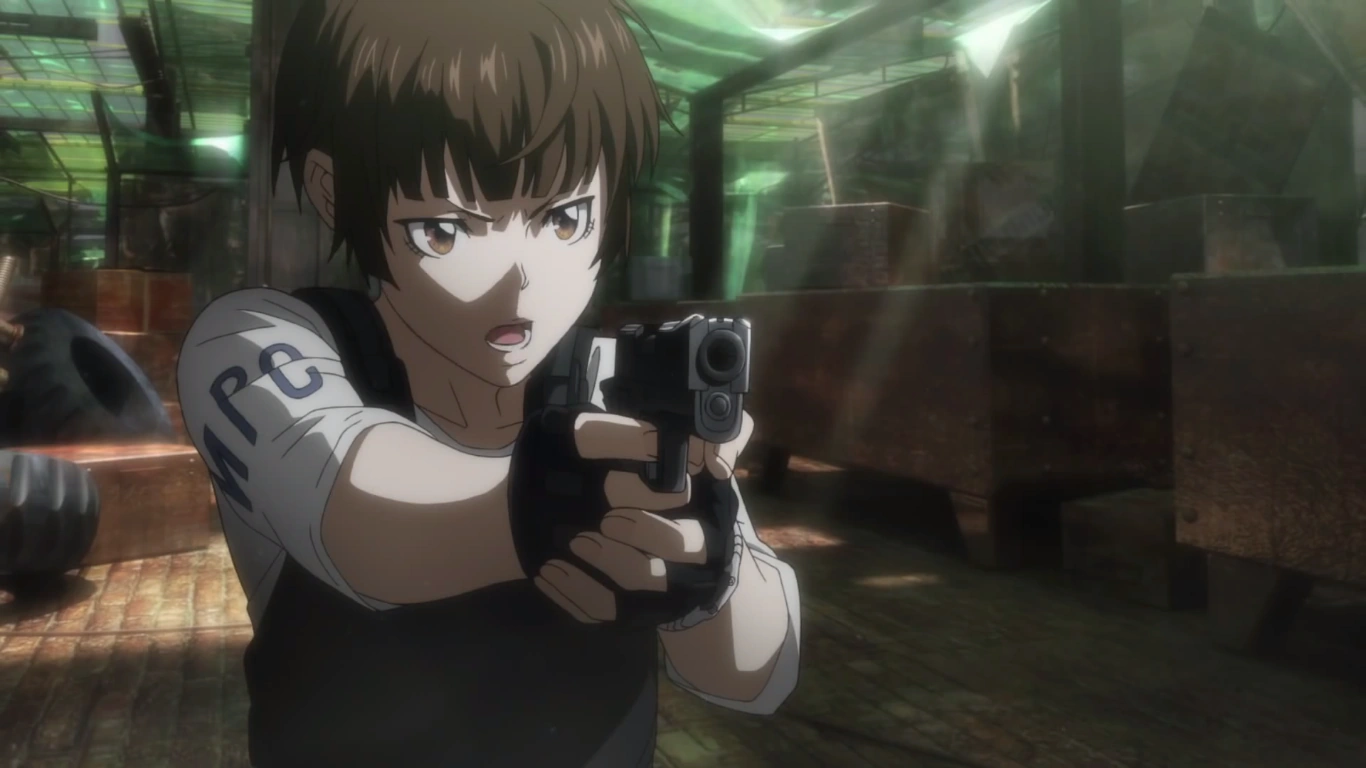
They say most good stories should be summed up a few words, but this one leisures in adding layers and layers to it’s universe. A neo-noir police procedural, it takes some cues from the superb Hannibal, with brooding Enforcer Kogami tussling mentally with arch-nemesis, the master criminal Nakashima. It’s one of those shows that delights in pushing boundaries, testing just how far they can go with their big themes- the price of safety, the meaning of justice, and the danger of an isolationist system- without letting their nuanced ensemble get lost in the mix. I love the sharp, slightly cynical sense of absurdity Psycho-Pass displays, because it reminds me of Terry Gilliam’s Brazil, with all it’s sugar-coated horribleness (if you haven’t seen that movie, by the way, stop reading this, and watch it now). It paints in broad strokes, but it manages to conjure up some impressive character arcs despite the fact that most of it’s brutalized women somehow end up with their boobs out (whoops).

Inspector Akane and her arc are an example of how the best thought-out character arcs can reflect the central themes of a story. AND they didn’t even have to make her someone’s love interest to justify her existence on the show!

So, that’s my list- what’s your’s? What anime should I watch next?

Doctor Who Recaps, Season One, Episode Two: The End of the World

So, hello, and welcome to the second week of our cross-blog Doctor Who extravaganza as we take a look at the second episode of the season, The End of the World. Read a whole different take on the episode-by a strident Tennant fan- over at Red Whine. As before, if you want to join us on this ill-advised adventure through recapping (and also time and space), drop me an email an the Contact Me tab above.

Let me dive right in and start by saying that part of what I dig so much about this episode- aside from the fact it stars the once and future King of Doctors- is that we jump from saving the world in last week’s episode to watching it burn in the background all the way through this week. As a child (and, to an extent, an adult) who was petrified by the thought of the earth being destroyed in some catastrophic event (all those scaremongering Discovery Channel “documentaries” about asteroids and ice ages? Aimed directly at the kind of child I was), this episode scared the fucking bejeesus out of me, and still makes me feel kind of weird to this day. Something about seeing Earth burning out of existence- and having that basically forming the scenery of the episode- is really unsettling, and I can get on board with Rose’s assertion that this might not be the best way to make your second date go with a bang (A big one. PUNS).

“Oh, but he’s not in this episode!” I hear you cry. And I lift a finger to your lips, and shake my head sadly for your lack of pathetic insider DW knowledge.

The plot of this episode revolves around some space dignitaries-in the form of some living trees, the Face of Boe, and Lady Cassandra, the last human alive, who also happens to be, well, a giant piece of skin stretched out between two poles:

Whenever I lose weight, it’s this line that pops into my head and I immediately eat twelve donuts and a croissant because I’m fancy.

Yeah, if you thought “Terry Gilliam’s Brazil” when you saw this, you get twenty points too, because the Doctor Who props department like searing horrifying images into the memories of innocent children. After it’s revealed that a nefarious plot to bump off the guests is afoot, it’s up to Rose and the Doctor (and some living trees, but we’ll get there) to figure out what to do next. I like the simplicity of the plot, mainly because it allows for this episode to become mostly scene-setting, filling out the universe that we’ll be travelling through with this Doctor and providing a good bit of genuinely science-fictiony relief from the Earth-bound episodes on either side of it. One of the best things about this series of Who from a writer’s perspective must have been introducing this universe to whole bunch of new viewers (like me) who had no idea what to expect, and it shows, with real effort put in to making this as casually out-there as possible. Just some sentient trees wandering about, confusing me with how attractive they are. No biggie.

Insert “getting wood” joke here

I tell you what, too- I love this episode for the fact that it sets the vaguely sinister tone for the whole of season one. Now, it might be because I watched them when I was a terminally impressionable child, but I still think the most frightening episodes ever all belong to the first two seasons of New Who, and The End of the World is no exception. As the radiation given off by the dying earth threatens to burn our heroes alive, the whole spaceship set-up moves from dazzlingly inventive and quirky to claustrophobic and deadly, with a handful of guest-stars meeting grisly ends-whether burning alive, exploding in the heat, or being irradiated to death, it’s not just the bad guys who wind up dead.

Not just the bad guys, but the ENTIRE WORLD.

And the Doctor’s callous reaction to the villain of the piece-allowing them to burn in their own trap- marks out Eccleston’s ability to bring something a bit unsettling to his Doctor. From this episode onwards, you don’t want to end up on his bad side, and that’s an important part of the characterisation for the Doctor which is still being explored in Capaldi’s episodes today (by the way, is anyone else feeling less than enthused about the return of the series in just over a month? Until something changes- preferably finding a new showrunner, at fucking last- I’m just expecting a re-run of the off-puttingly patchy season eight, and, terrifyingly, a two-parter written by the creator of the painful Kill the Moon). If the first episode is about filling out Rose’s character, this is about giving us a look into the Doctor. The episode might end with them waltzing off to get chips, but we’ve had a glimpse into the effects of the Time War on our hero (Gallifrey and it’s fate are referenced for the first time in this episode, as is the excellent Bad Wolf season plot, for those keeping score at home).

Unf dat smile tho

The End of the World isn’t the best episode this season had to offer, not by a long shot. But it’s a gratifyingly simple story, filled with plenty of genuinely memorable characters (so good, in fact, that the villain who be brought back for the season two opener) and a pretty dark tone that keeps it from landing in “forgettable” territory. But honestly, who cares, because next week we’ve got the first bonafide New Who classic, in the form of the only episode of TV I was ever outrightly banned from watching, The Unquiet Dead. Stay tuned!

Yeah, insider jokes are the name of the game this week.

On Celebrity Culture and Abuse

I’m going to go ahead and stick a trigger warning here for discussion of domestic abuse.

You know Sean Penn, right? That guy who beat the ever-living shit out of his wife, was charged with domestic assualt, and then got an Oscar? Maybe Roman Polanski is more familiar to you, as the guy who took a plea bargain back in 1977 that laid out his unlawful sexual intercourse with a thirteen-year-old child? We gave him an Oscar, too, and a Palme D’or, even after he fled the USA to avoid be imprisoned for his crimes. Ozzy Osbourne was happy chatting to an interviewer about the time he was arrested for trying to murder his wife, Sharon, but he’s still just that wacky rocker guy to most. Charlie Sheen, sitcom star and internet meme, was charged with third-degree assault on his then-wife, Brooke Mueller, but we remember him for his Emmy-winning turn in Two and a Half Men. Chris Brown continues to see his songs chart, even as the harrowing pictures of his one-time girlfriend Rihanna crop up online, depicting her black and blue face after he assaulted her. This are my cut-offs. These are the things that I will not support someone after hearing. You might have different standards, but it’s always good to remind ourselves that the people the media idolizes for us aren’t always worth idolizing.

I’m talking about the misogyny and general nasty undercurrent in our media that allows us and encourages us to embrace these men to our screens. We, as a culture, have found a way to forget the violence many of our treasured cultural icons have committed against people, especially women. We hold our desire to be entertained above the right of the people they abused not to see their attackers idolized. And it’s not about justice, it’s about the fact that, time and time again, we’re happy to ignore the flagrant ways celebrities abuse their power, to hire them, to watch them, to promote them, even to go as far as holding them up as humanitarian icons. I don’t know about you, but that makes me feel a little gross. Either our cultural memory is that short, or we’re simply willing to hold the notion that Sean Penn once left Madonna tied to a chair after roughing her up for hours on end so that he could go out and buy more booze and that we still want to see his movies in our heads at the same time. I’m not sure which is worse: the fact that we might just have collectively forgotten, or that we remember and it just doesn’t register high enough on our “things that matter” list to stop us wanting to see his mannered, average performances.

And look, I’m not saying that it’s pleasant, having to think about what and who you’re supporting when you just want to watch half an hour of television or a couple of hours in the cinema. But that’s the problem- it’s easier for the media to stamp down on these issues, to try and blot them from our cultural memory, than it is to question why it’s okay to hand a self-confessed sex offender who never saw a day of prison one of the highest cinematic trophies in the world. We prefer to remember Sean Connery as James Bond, not as that guy who said that hitting a woman was fine if she was “being a bitch”, because it’s easier not to muddy the waters of our one-dimensional vision of him with the fact that he’s a piece of shit.

And I know it’s a shitty, awful, saddening, infuriating thing to think about, but we have to consider who we’re supporting when we choose what to see and who to spend our money on. I think it’s up to you to decide who you want to support, because we all have different cut-offs for what constitutes unforgivable behaviour, but also to try and wade through the media’s effort to negate the bad things that their highest-grossing celebrities have done. We’re taught to consume our media mindlessly, but only by questioning what and who we lend our time and money to will we weed out those who are abusing the power we’re giving them, and encouraging us to forget their unpleasant histories.