“A Blind Fool, Which Of Course, I Am Not”: The Case of Helen Duncan and the Spiritualist Trial of the Century
by thethreepennyguignol
On 14th January, 1944, over a drug store on Copnor Road, Portsmouth, a small group had gathered in what was known as the “Master Temple Psychic Centre”. And there, they believed, for the small price of twelve shillings and sixpence, they were going to witness a woman bring forth a spirit from the world beyond.
Such a gathering was not unusual in the evening hours on Copnor Road; Ernest Edward Homer, who owned the building, and his wife, Elizabeth Jones, ushered in the crowd of a dozen or so to witness the paranormal power of noted psychic Helen Duncan as she made contact with the dead. The group was filed into a small room where Duncan sat, lit only by a single red light, just a few yards from where her audience would observe her. A curtain was closed around her, and, at last, a figure in white appeared behind her. A husky voice emerged from the near-darkness, addressing a man in the front row. But the man, unlike so many who had attended Duncan’s seances before, was not a believer in the supernatural – but a naval Lieutenant who had grown suspicious of Duncan’s so-called abilities after she had shared confidential information about the sinking of the HMS Barham several years earlier. The investigation would lead Duncan and others involved with the event to be amongst the last people in Britain to be tried under the 1735 Witchcraft Act – in a trial that would become a cause célèbre for the spiritualist community.
Helen Duncan was born Victoria Helen Macfarlane in Callander, Scotland, on 25th November 1897. Her apparent supernatural abilities made themselves known early in her life, as she terrified fellow schoolchildren with dire prophecies of the future; in 1916, after spending some time working at Dundee Royal Infirmary, she married Henry Duncan, a war veteran who was supportive of her belief in her psychic skills. However, it would not be till 1926, by then a mother of six, that she tuned her alleged clairvoyancy to a new frequency – one that would allow her to rake in some much-needed cash.
The spiritualism industry was one that had taken root in Britain during the Victorian era in the previous century, with high-profile figures including Lord Tennyson and Queen Victoria herself reportedly attending seances and other spiritual events. It waned briefly in popularity in the early 20th century, but, following the First World War, grieving family members who had lost loved ones in combat helped bolster the industry once more as they sought contact with the deceased as a balm for their grief. By 1930, some 250,000 spiritualists were operating in the UK – and many, like Duncan, were charging for their services in contacting the dead.
Duncan held seances during which, she claimed, she was able to materialise the spirits of the dead by regurgitating them in the form of ectoplasm (a then-recent addition to the spiritualist belief system, ectoplasm is a substance purported to emerge from a medium during a seance, usually disintegrating on exposure to light or human touch). Her dramatic performances (which would primarily take place in near-darkness) would see a figure in white taking shape, after which a voice would call out to one of the gathered audience to identify themselves as a deceased friend or relative.
It didn’t take long for Duncan to attract the attention of spiritualists and sceptics alike, perhaps most notable of the latter being Harry Price, a psychic researcher and noted figure in the history of the British paranormal. A small piece of the so-called ectoplasm that Duncan produced during her seances was procured for Price, which Price swiftly had tested by a local doctor. It revealed a concoction of “white of a new-laid egg, ferric chloride, phosphoric acid and stale urine mixed with gelatine, hot margaric acid from olive oil”; as Price noted, now “the reader knows what ghosts are made of.” In 1931, Price offered Duncan a significant fee to engage in a number of test seances in London, which Duncan accepted, though it proved of little more scientific substance than her ectoplasm. In a series of four seances carried out in 1931 at the National Laboratory for Psychical Research, Price declared himself “deeply impressed… impressed with the brazen effrontery that prompted the Duncans to come to my Laboratory in an attempt to “put over” their stuff on our experts; I was impressed with the amazing credulity of the spiritualists who had sat with the Duncans for six solid months, and with the fact that they had advertised her “phenomena” as genuine.”
Price and his crew revealed Duncan’s deception in great detail – a hand that had appeared from beyond the ether was, in fact, a rubber household glove, the “spectres” were lengths of cheesecloth contorted into various shapes, and a child’s ghostly face was nothing more than an image cut from a magazine and affixed to the fabric before the seance began. During the fourth and final seance, perhaps sensing that the jig was up, Duncan, upon being asked for permission to X-ray her stomach to confirm that she was not imbibing the ectoplasm before the ritual began, became irate. When her husband approached her to calm her down, she “jumped up and dealt him a smashing blow on the face which sent him reeling…without the slightest warning, she jumped up, pushed Mrs. Goldney aside, unfastened the door, and dashed into the street, where she had another attack of alleged hysterics and commenced tearing her seance garment to pieces”, thus bringing the investigation to an abrupt close. “If the reader can visualise a woman weighing more than seventeen stone, clad in a one-piece black satin garment, locked to the railings and screaming at the top of her voice,” Price surmised, “he will have a fair idea of what we witnessed that evening.”
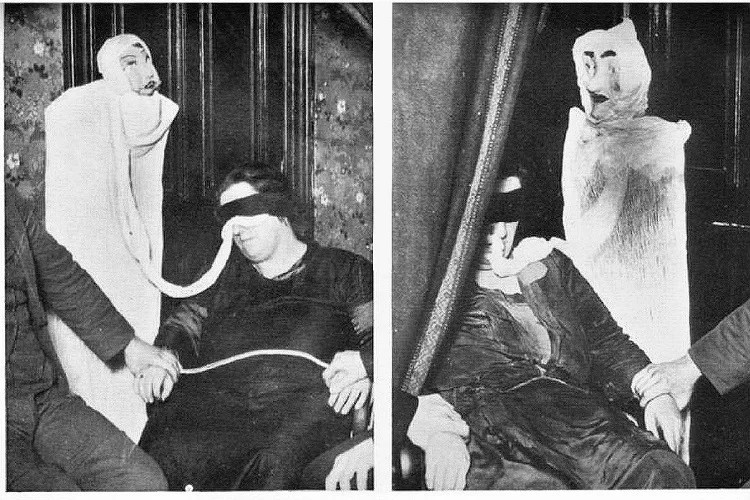
Despite Duncan’s obvious fraudulence, she continued to practice – though the incident in 1944 was not her first tangle with the authorities. During a performance in Edinburgh in 1933, the spirit of a child named Peggy appeared before the assembled crowd – only for one of the attendees to turn on the lights and reveal that “Peggy” was, in fact, a white vest. Duncan was charged with fraudulent mediumship by the Edinburgh Sheriff Court and fined £10 for her misdeeds.
But this did not act as a deterrent to Duncan’s trade, especially after the beginning of the Second World War in 1939, when thousands of British families found themselves grieving the loss of the war dead, both at home and abroad. While the exact details of where Duncan practiced between her Edinburgh conviction and 1944 arrest are hard to pin down, she was next officially noted to be plying her trade out of Portsmouth, England.
In a small room – dubbed the Master Temple Psychic Centre – above a shop owned by Ernest Edward Homer, Duncan performed a number of seances organised in part by Homer and his wife, Elizabeth Ann Jones, alongside Duncan’s so-called “agent”, Frances Brown. During these seances, Duncan would sit behind a curtain while “Albert”, her spirit guide, would mediate between the living and the dead by announcing the arrival of certain spirits. Homer, for his part, claimed genuine belief in Duncan’s abilities, remarking on an encounter with a six-foot-tall bearded male Australian spirit who had appeared to him during one of these seances, formed out of ectoplasm produced from Duncan’s mouth, whose accent and appearance he did not believe Duncan would have been able to fake. Just to be on the safe side, though, Homer and his wife confiscated torches at the door of their seances, as a sudden flash of light could cause great injury to Duncan if one of the crowd became nervous and wanted to get a better look at what was going on. Disturbing the medium during a seance, it was claimed, could cause the ectoplasm to snap violently back into their body and lead to grievous bodily harm or even death.
With the war in full swing, Duncan was regularly called upon to provide families with explanation of the fates of their enlisted loved ones. In one recounting of such a seance, an attendee at the Master Temple Psychic Centre described Albert announcing the apparition of a young man who had lost his arm in a horrific incident during the war – a young woman present stepped forward, believing she knew him. She was invited to touch the man behind the curtain, feeling the stump of his arm through the cloth, though Albert claimed he was too badly mutilated to speak. In November 1941, Duncan claimed to receive contact from the spirit of a sailor who had been aboard the HMS Barham – who told her that the ship had been recently sunk, and the crew lost. The Barham, a battleship that had been part of the British navy since 1915, had been sunk by a German U-boat off the coast of Egypt in early November 1941, and most of her crew had perished. In the interest of protecting morale and hide the loss from the enemy, though, the Board of Admiralty concealed the news of the sinking, with next of kin only informed of the loss several weeks after the incident had taken place.
Which meant that Helen Duncan’s claims to have been visited by one of the deceased sailors who had been aboard was of great interest to national security. Either the information had been leaked and somehow reached Duncan, who was now sharing it under the guise of contact with the dead – or spirits from the beyond were putting about information that directly contradicted the interests of national security. Either way, the matter had to be dealt with, and Duncan, unbeknownst to her, came under the watchful eye of the British navy in the following years.
This culminated on 14th January, 1944, when Lieutenant Worth and Lieutenant Fowler attended one of Duncan’s seances on Copnor Road in Portsmouth, with the intent of putting to rest any question of her alleged skills in contacting the world beyond. The two lieutenants took their seats in the small crowd, and, as the seance began, a ghostly white figure appeared behind Duncan. Mrs Homer, the wife of the man who owned the building, indicated that the name of the figure was “Albert”, and he was Duncan’s guide through the nether realms who would announce the arrival of other spirits as they came to him behind the curtain. Lieutenant Worth asked the apparition if the spirit of his aunt was present; the figure answered, in a husky voice, in the affirmative. Which, as Worth’s aunt was very much alive at the time, was less than convincing. However, the spirits from the beyond were not done with Worth yet – another figure appeared behind the curtain, this time announcing itself as Worth’s sister. When Worth replied that he only had one sister and that she was alive, the spirit insisted that his mother had secretly had a premature female child and this was the voice reaching out to him now, actually. Worth had seen enough.
Worth, believing that Duncan was a fraud, reported her to local police, leading to the attendance of Constable Cross to a seance on 19th of January. During this seance, when a white, shrouded figure appeared from behind the curtain that Duncan was sitting, Cross lunged towards it and grabbed it – only to find that it was none other than Helen Duncan herself beneath the sheet. As he informed her that he was a police officer and that she would be arrested, she proclaimed that she had fallen deathly ill and called for a doctor. A search was conducted of the premises, where a mocked-up tally of the death toll of the HMS Barham was discovered, accounting for her knowledge of those lost in its sinking – later, the leak would be identified as the secretary of the head of the British Navy, which had led to the information reaching the general public, including Duncan, sooner than intended. With the leak confirmed to be strictly of earthly origin, authorities were keen to prosecute Duncan and her co-conspirators for their misleading claims of mediumship.
Duncan, Brown, Homer, and Jones were initially charged under the 1824 Vagrancy Act, but, perhaps due to their apparent involvement in leaking secure military information, authorities sought an opportunity to bring the case before a jury. Which led them to the virtually-defunct 1735 Witchcraft Act – in its fourth section, it declared that “if any Person shall….pretend to exercise or use any kind of Witchcraft, Sorcery, Inchantment [sic], or Conjuration, or undertake to tell Fortunes, from his or her Skill or Knowledge in any occult or crafty Science, to discover where or in what manner any Goods or Chattels…[they] shall, for every such Offence, suffer Imprisonment by the Space of one whole Year.” Duncan and her co-conspirators were charged under this act, along with several other charges for public mischief and fraud, and the case went to trial in late March of 1944, led by prosecutor John Maude.
Duncan’s trial, perhaps unsurprisingly given the relative popularity of spiritualism at the time, became something of a cause célèbre for those who believed in the veracity of her powers. For some, it was an opportunity to put the matter of psychic ability to the test in a court of law, and to either meaningfully prove or disprove the truth of these spiritualist beliefs. Barrister Charles Loseby, a former Member of Parliament and chairman of the Leicester Psychical Society, served as Duncan’s defence through the seven-day trial, and announced at the top of his defence that he would show “in reality…that it is scientifically proved that there is a spirit world knocking on the door of this place”. With Duncan barred from displaying any of her abilities to the jury, Loseby had to prove the veracity of spiritualism and Duncan’s particular skills within it over the course of a seven-day trial if she and her cohorts were to avoid imprisonment – no mean task, by any measure.
In an attempt to prove the existence of a world beyond which Duncan could access via her powers, Loseby interviewed several others who claimed to have connections with this world beyond – with mixed results. Charles Robert Burrell, a dockyard labourer and medium, was called to the stand to testify in support of “a completeness between the spirit world, those who have passed on, and those that remain here”, a belief which he keenly subscribed to, describing the role of a medium “to prove without doubt the continuity of a life beyond”. Loseby finished his questioning Burrell with a flourish, asking if, upon attending Duncan’s seances, that he had told another attendee that he “had been greatly impressed and quite convinced” of her powers , to which Burrell responded “I was not at all impressed” by the showing on the first night he had seen her perform. Loseby had more luck with George Mackie, a self-proclaimed psychic and one-time wing commander who believed that Duncan had manifested the spirit of his late mother during one of her seances; Mackie remarked that the visit had been a “confirmatory thing” for him, and, as he told the prosecution, that any attempts at fraudulent mediumship would not have gone unnoticed by anything other than a “blind fool, which of course, I am not”.
Because Duncan’s arrest had brought with it nothing in the way of physical evidence – no cheesecloth ectoplasm to show to the jury – the case was reliant entirely on witness testimony, which proved challenging as the majority of those who had witnessed Duncan at work were already credulous about her abilities. Some present at the seance insisted that they had seen genuine evidence of apparitions brought forth by Duncan. Rose Cole was adamant that she had spoken with the spirit of her late friend Mrs Allen, who had reached out a terribly swollen arm to greet Cole; when the prosecution suggested that the swelling may have been the result of “ample proportions” and not of Allen’s fatal illness, she brushed it off at once.
But even those present proved difficult for Loseby to shake loose convincing testimony from – when Loseby examined Amy Jennings, a witness present at the seance on the night of the 19th when Duncan was arrested, and asked if “a big heavy woman, a big fat woman, Mrs Duncan, if you’ll forgive me” such as Helen Duncan would have been able to convincingly mimic the spritely young spirit that allegedly appeared at the seance, she replied “yes”. Upon examination of the police constable Cross who had attended the fateful seance, he proclaimed that it was “plain to everyone in the room” that Cross had been “frightened” by what he had seen at the event, leading to his arrest of Duncan, which Cross roundly denied. Loseby later accused Cross of inventing the sheet that he had described seeing Duncan trying to conceal after the lights were turned on, suggesting that his “terrified manner” had led him to avoid carrying out a full search – for what it’s worth, another police officer at the scene delicately implied that Duncan may have “secreted the sheet in another part of her body” which would have required a medical professional to remove it.
But Loseby’s defence proved inadequate, and, after deliberating for just twenty-five minutes, the jury found Duncan (along with the other three defendants) guilty. Duncan, upon hearing the verdict, collapsed over the dock and exclaimed “Oh! I have done nothing!”, which, it could be argued, was precisely what she had been found guilty for. During sentencing in early April, the court recorder remarked that “whether genuine manifestations of this kind are possible, the verdict of the jury here does not decide…the jury found that the methods adopted by you…amounted to fraud.” It was also note that “there are many people, especially in war-time [sic], sorrowing for loved ones. There is a great danger of their susceptibilities being exploited, and out of this yearning for comfort and assurance there are those ready to profit.” Duncan was sentenced to nine months’ imprisonment, Frances Brown for four months, and the Homers were bound over (a formal agreement of good behaviour).
But the influence of the Duncan case did not end there. Headlines in major newspapers declared the conviction under the Witchcraft Act, and, by 1944, the notion of a witch having any kind of influence in British courts seemed hopelessly behind-the-times. Then-Prime Minister Winston Churchill, upon hearing of the conviction, wrote a irritable memo to the Home Secretary demanding to know just how much the indulgence of this “obsolete tomfoolery” had cost the state when there were far greater matters to attend to. By 1951, the Witchcraft Act was replaced with the Fraudulent Mediums Act, intended to target those who used their purported psychic abilities to defraud people.
Duncan was released after her nine-month sentence, and, despite assurances that she would not return to her previous psychic practices, she began performing seances again shortly after her release. She died in 1956 shortly after one of these seances; her supporters claimed that her death had been caused by the sudden snapping of ectoplasm back into her body when she was disturbed by authorities, but, given a by-then long-documented history of health problems, it seems likely that she succumbed to ongoing physical maladies. To this day, believers in Duncan’s abilities seek a pardon for her 1944 conviction, describing Duncan as a “Medium Martyr”.
Duncan’s trial, more than eighty years later, is still one of the most important cases in British legal history with regards to the supernatural – and, despite Duncan’s evident fraudulence, a fascinating look into the way that people seek a balm for their grief at times of great loss. And proof, above all else, that you should always question exactly what ectoplasm is made of.
You can also check out some of my longform historical articles below, if you’d like to read more articles like this one:
“Seduced by Indecency”: The “Carnal Lust” and Faked Death of Joan of Leeds
The Myth, the Murders, and the Matter of the Bloody Countess Báthory
The Impossible Case of the Pimlico Poisoning
Palatable Poison: Radclyffe Hall, The Well of Loneliness, and Lesbian Sex and Love on Trial
The Quiz Show Scandals of the 1950s (And How They Changed American Television)
Sources and References
Contemporary Newspaper Reports – 1 – 2 – 3
The trial of Mrs. Duncan – transcripts
Malcolm Gaskill – Hellish Nell
Harry Price’s report on Helen Duncan
Graeme Donald – Loose Cannons: 101 Things They Never Told You About Military History

