The Sprawling Horror Collaboration of the SCP Foundation
by thethreepennyguignol
So, for Halloween season this year, I wanted to write a little about one of my favourite mediums for modern horror – the internet. I’m going to be sharing a few articles about various ways horror has taken shape online, starting right here, with a look into the SCP. Stay tuned for some more pieces in this vein (ooh, gory) over the coming week if that’s something that interests you, and check out a couple of my other articles on the subject here and here, too!
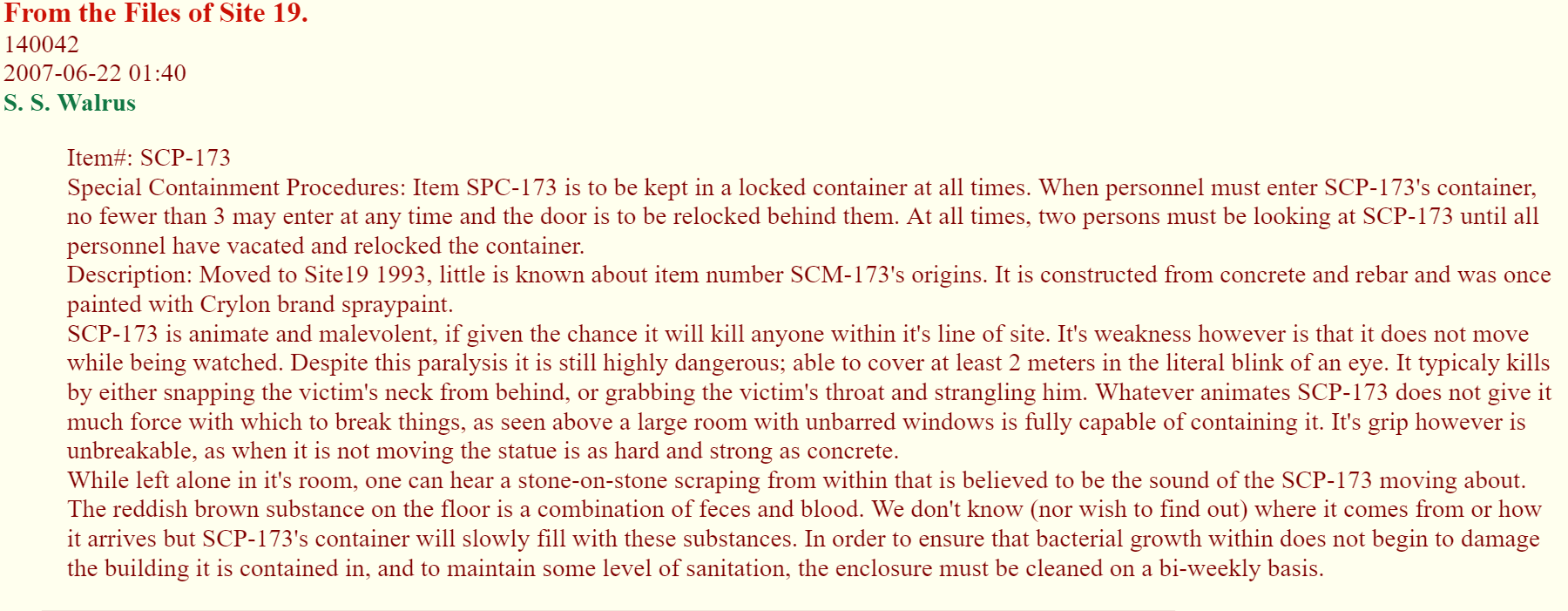
In June 2007, an anonymous user posted a few hundred words of horror fiction to the site’s paranormal forum (known as /x/). What started as an inventive horror short eventually developed, over the course of the following eighteen years, to become one of the biggest collaborative writing projects in history – as well as one of the single most influential pieces of internet horror ever created.
The short, titled From the Files of Site 19, described in rather academic terms the nature of a being known as SCP-173. This creature at first glance seems to be a large, vaguely humanoid statue made of concrete and rebar and covered in spray-paint – the short urges personnel not to enter its container in groups of less than three to ensure their own safety. It warns that, when it’s being directly observed, it poses no threat, but when it escapes the viewer’s line of sight, it becomes “animate and malevolent”, and will kill victims remorselessly by snapping their necks. The story was accompanied by the image of a sculpture by Japanese sculptor Izumi Kato, claiming to show the creature in its unmoving form.
This short soon caught the imagination of users of the anonymous board, and several others invented their own creatures suitable for containment without the vaults of the fictional SCP (variously described as standing for Special Containment Procedures and Secure, Contain, Protect). By January 2008, across five large threads on 4Chan, new original “SCPs”, as they became known, were added to the roster – but soon, users grew frustrated by the limits posed on their work by the site, and the SCP Foundation officially made the jump to an early wiki page known as EditThis. While the community was initially relatively loose and unfocused, with a standard writing style for the SCP Foundation yet to be formally established, by the following year, the group moved to a new site and began a more rigorous editing process for the introduction of new entries into the SCP canon.
It was from this point onward that the SCP as we know it now began to really take shape. An editor for the site described their mission as one focused on “involvement…a ]sic] openness to new ideas” without losing the original vision for the SCP stories as parts of a cohesive whole. Each new entry into the SCP was assigned a number, once it had been deemed of high enough quality to become part of the universe’s canon – in the first few years, entries racked up into the dozens and soon the hundreds, covering everything from a pair of bracelets that forcibly ejected bones from the arms to cutlery that turns food into human flesh. While the main focus is obviously horror, these early entries from various users helped establish the SCP’s signature style, with an academic detachment that served horror as much as it did black comedy.
The SCP Foundation started to edge its way into the mainstream with the release of the indie horror game SCP – Containment Breach, created by Finnish game developer Joonas Rikklesen. The game featured several iconic subjects from the SCP stories, including the one that started it all, SCP-173, and soon earned a glut of very respectable reviews from mainline game media including PC Gamer and Rock, Paper, Shotgun (it wasn’t the last media to spring from the SCP archives, either – as well as a stack of games with similair premises, there’s also some very fun web series set in this world, along with my personal favourite, the Find Us Alive podcast). This created a flood of renewed attention for the SCP Foundation site, and soon the archives had swelled into the thousands, with even well-respected and mainstream horror authors like Adrian Hon contributing to the SCP. With entries well into the thousands and versions of the SCP in fifteen different languages, it’s been speculated that the SCP Foundation project has a claim to the title of the largest writing collaboration of all time.
And, of course, there’s a lot to be said for the fact that the community has kept itself so stringent about upholding a certain standard of quality. The great thing about collaboration on a large scale via internet like this is that you can invite so many different perspectives, styles, and approaches to join – the bad thing is that a lot of them will, unfortunately, not be very good (a problem that has plagued the ever-growing Backrooms series, in my opinion). Contests for specific SCP slots help keep the quality high, and a voting system means that submissions to the site have to earn a decent amount of support from the SCP community to avoid deletion.
I think part of what has made the SCP such an enduring collaboration is both the focus the premise demands and the space it offers for creativity. While there’s a distinct tone to the actual reports – one that balances a detached, almost academic coolness with the in-built horror of the nature of the entries themselves – many of them make use of found-fiction additions that give them a proper sense of grounding in the real world. For me, the most unsettling horror comes when there are aspects of it that feel distinctly real and familiar, and everything from marketing blurb for a children’s toy to usenet sex forum threads, these stories feel rich and real in the way that the best horror fiction often dos. Some of my personal favourites, aside from the well-discussed favourites, are SCP-7454, SCP-1150, and SCP-4495, though there’s truly an embarrassment of riches in horror storytelling from pretty much any sub-genre you can imagine on display here.
There’s also the nature of the non-linear approach that most readers will take to this community that gives it a distinct and unique feel. Clicking around the archives – which, at the time of writing, are in the process of seeking out their official 9000th entry – has the feel of leafing your way through dusty files in the back of an abandoned research facility, a self-directed experience that is pretty rare in the world of fiction without completely losing its way. While it’s impossible to have an overarching narrative arc for a series as enormous as this, there are clusters of short narratives that connect together different SCPs if you’re looking for something with a bit more structure, too.
The SCP Foundation has served as a kind of benchmark for many of the online horror projects that have followed, perhaps most obviously the aforementioned Backrooms, but more broadly as an influence on the way that so much internet horror is presented – something to investigate and uncover in non-linear fashion, a horror that defies traditional storytelling and finds new nightmares in the internet age.
I’d love to hear your experiences with the SCP Foundation below – I’m especially keen to hear about your favourite entries into the SCP, so feel free to drop them in the comments below. Check in later this week for more articles like this one!
If you enjoyed this article and want to see more stuff like it, check out my other blog, No But Listen, as well as my fiction work! You can also support me on Patreon to help keep my very demanding little cat in treaties, and me out of her clutches for another month yet.
(header image via TV Tropes)
 The Cutprice Guignol