The Cutprice Guignol

The Ninth Year: The Haunting of Swill House

Spoiler-Free Review: The Visit, or Shyamalan’s Biggest Twist Yet

So, we all remember M Night Shyamalan, don’t we? He made those couple of films you like, and then a bunch you don’t, and then The Happening, where Zooey Deschanel permanently puts the nail in the coffin of her ever getting out of Manic Pixie Dream Girl-land? You know what I’m talking about.

His first couple of big hits were pretty impressive- The Sixth Sense and Unbreakable were interesting, tightly-constructed little stories told with deftness and some strong performances. Signs (for my money, his best movie) and The Village at least succeeded in their simplicity, telling small stories against the background of a larger conspiracy. Fuck, I’ll even throw all my credibility to the wind and admit that I don’t mind Lady in the Water, mainly because it has Paul Giamatti in it and I’m legally obliged (look it up, it’s in there) to like any movies he’s in. But past that, we’ve got The Last Airbender (Let’s cast almost all white kids in this predominantly Asian series!), After Earth (Scientology: The Motion Picture), and the aforementioned The Happening. Like many other people, I’d honesty written him off as another director cursed by his early movies being too good to top (See also: Quentin Tarantino, Danny Boyle). But then I saw The Visit, and that changed things.

I was staggered when I sat down in front of The Visit and found Shyamalan pulling off his biggest twist to date- that he was actually a good film-maker the whole time! I can only assume that The Last Airbender and The Happening were just sleight of hand as he led us up to his career’s own twist ending, which came in the form of the kind of brilliant, old-fashioned found-footage horror.

It’s impossible to escape the fact that Shyamalan is bringing his movies back to their roots with this one, a tense horror that focuses on some strikingly good performances from child actors. Remind you of anything?

An unbelievably great movie, if you need convincing, by the way

But, ignoring the obvious Sixth-Sense comparisons, this was just an impressively low-key horror, which is difficult to pull off without losing the stakes. It follows Rebecca (Olivia DeJonge) and Tyler (Ed Oxenbloud) as they go to visit their estranged grandparents for the first time. Rebecca documents the progress of their trip in the hopes of turning it into a documentary-but the camera doesn’t lie, and there’s definetly something weird going on with their beloved nana and grandpa. There’s not much else to say about the plot without ruining great swathes of the film for you, and it’s the tautness and simpleness of the story that gives Shyamalan so much space to get us really invested in these characters.

Ed Oxenbloud in The Visit. Ooh, I just want to pinch his cheeks!

I really can’t stress how utterly fantastic the two child actors are, which is a phrase I say about as often as “NO, I would NOT like to see the new Rob Zombie movie, thank you very much” so you know it’s serious. I adore the way the script delves into their characters a bit, balancing their stubborn, schtum tendencies as young teenagers against their ability to genuinely articulate their feelings and fears, especially over the disappearance of their father. The leading quartet is rounded out by Deanna Dunagan and Peter McRobbie as the grandparents, who are equally great and exude just the right level of discomforting off-ness for the film’s run. It’s the careful time Shyamalan spends on letting us get to know these characters that makes the horror, which takes it’s sweet time to arrive, even more effective. Seriously, I’ve seen all the Saw movies and The Visit definitely ooked me out quite a bit, which is certainly not why I was showering with the door open for a week so that they couldn’t sneak up on me. Not in the least.

Oh, hey, Katherine Hahn plays their mother! What’s not to like?

The Visit was impressive almost just because he pulled it off. I was waiting the whole way through for some ludicrous twist (me and the consort were bellowing guesses at the screen all the way through: “THEY’RE ALIENS! THEY’RE DEAD! THE TWIST IS THAT THERE IS NO TWIST!”) to render the whole experience pointless, but it never came. And, for that alone, The Visit deserves a watch- it’s proof that Shyamalan is still capable of making controlled films that don’t spiral into senseless insanity at the half-way point. For anyone mourning the loss of his days as a good writer and director, let me welcome you with open arms to this movie. Just don’t watch it alone.

Doctor Who: Tardis Afraid as Rising Damp Incurs Spirits

Some episodes of Doctor Who are bad (Deep Breath, Kill the Moon, whatever last week’s fiasco of an episode was called). Some Doctor Who episodes are fiendishly clever (Name of the Doctor, Listen). But some episodes are just good- deliciously, deliriously, simply good, and that’s what this week’s outing, which should so obviously have been called Under the Sea in order for me to hum the best Disney song ever through it’s entire run, staked it’s claim in.

I’m not getting my hopes up too high just yet, because the last couple of two-parters the series has done with Capaldi’s Doctor have had amazing first halves and a funeral dirge of a second half. But right now I can linger in that lovely space between knowing and not knowing, without having to qualify any discussion of Under the Lake (the episode’s actual, less exciting title) with “…but the second half was pish”.

The Doctor’s prompt cards were a joke that was just on the right side of obvious.

So let’s discuss what worked about this episode, shall we? Firstly, it was written by Toby Whithouse, he of the patchy but very creative supernatural dramedy Being Human- his Doctor Who episodes have been equally all over the place. For every School Reunion (brilliantly touching), there’s a Vampires of Venice (trudgingly unfunny), for every God Complex (sublimely excellent), there’s a Town called Mercy (??????). But whatever his episodes have been, they’re usually memorable- maybe for some cool new monster, an interesting concept, or fabulous world-building. I’d wager that this episode had one major advantage over the host of recent DW episodes, and that’s the fact that it got the Doctor pretty much spot-on.

What I’m saying is, in short, fuck Moffat’s version of the Doctor, who swerves between calculating self-preservation and grating silliness that’s the equivalent of the show refusing to stop tooting a kazoo right in your ear, and give me this version instead. Capaldi careers around a hilarious script, one that matches decent laughs with pretty impressive horror, and for once he’s not ahead of the game, he’s figuring it out along with everyone else. Something about the slapdash nature of this Doctor is really charming and balances out the ever-present arrogance that oozes off him at every turn.

But ah, I’m getting ahead of myself. What about the story? After the crew of an underwater base haul an alien ship on board, they find themselves infested with ghosts- not the benign, wise-cracking, Hogwarts kind, but the kind that threateningly pick up spanners and brutally drown various crew members to make new ghosts. The Doctor has to try and figure out why they’re collecting the souls of the base’s crew. but as the base starts going a bit haywire he’s forced to leave Clara behind and travel back through time to work out a way to keep everyone alive. As I said earlier, it’s the first part of a two-parter, so I fully expect them to fuck this up royally next episode, but this was a fun, tight, rollicking script that didn’t let the action drop for a moment, and I can respect that. And let’s take no notice of the fact that it seemed to be ripping off previous well-respected Who episodes, with obvious visual nods to The Satan Pit with the corpse floating past the window plus the fact that the Prentis character had very obviously appeared in Silence in the Library. Don’t even think about it. It’s gone.

It was also bloody scary- well, when I say that, I mean that I would have been shit-scared by this episode ten years ago, which is my watermark for how scary a Doctor Who episode is as now I sit around watching House of 1000 Corpses over breakfast so my current scary-radar is kind of skewed. Even the Tardis was too scared to get near the creatures in a cool touch that really spooked me. The ghosts looked legitimately cool-

-and I appreciated the fact that they didn’t go for the traditional bloodless DW deaths (which, when you think about it, only really come in the form of deadly zaps- the Autons, the Cybermen, the Daleks…) and had the ghosts committing straight-up murder. I’ve written before about how keen I am for Doctor Who to terrify kids, partly because it stops them running around with their sticky hands smelling of yoghurt and trying to come near me all the time, but mainly because it gives kids an easy way into good horror, the same way it did for me. Part of Doctor Who’s legacy is sending generations of kids cowering behind the sofa, for Christ’s sake, and it’s about time they upheld that.
A solid supporting cast really helped up the ante and give the episode some stakes, and the addition of a character who communicated through sign-language could have felt tacked-on but just doesn’t. Clara also works best when she’s got some normal people to interact with, and she had a genuinely decent episode for once. I know this show likes to bring the Doctor and his companions together only to brutally rip them apart-

I felt you would appreciate this joke as much as I did, dear reader.

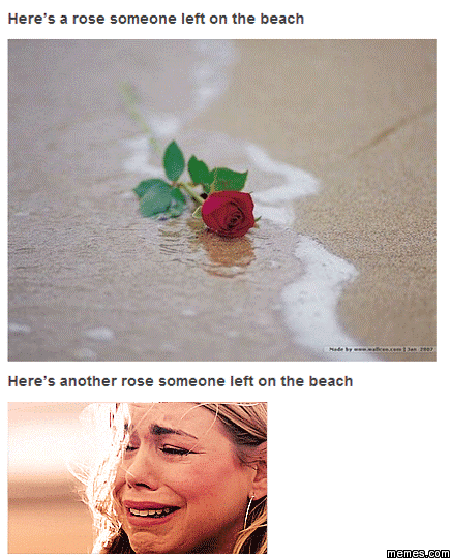
-(ugh, maybe I’m due my period or something, but the memory of David Tennant getting cut off just before he tells Rose that he loves her made me choke up a little) but it’s nice to have them on the same side for once, especially when they seemed to spent so much of last season at odds with each other.

Look, sometimes I just don’t want to criticise Doctor Who because it is, after all, my favourite show, and this episode didn’t make me want to pick it apart at the seams. I’m sure most of the plot would collapse if I took a closer look at it, but I have no intention of doing so because this episode provided everything I wanted-scares, laughs, an interesting story, and apparently next week a monster voiced by Corey Taylor. Because yeah, the big twist set up by this episode is basically resolved by clicking on the Wikipedia page. I’ll have you yet , Moffat.

Community, and the Problem with Ironic Sexism

Look, I guess I should set one thing straight here, before I begin- I don’t think Community as a show is inherently sexist. Dam Harmon, the man behind the cult-smash sitcom, has made an express effort to hire female writers and create interesting, well-rounded women characters who get just as much respect and screentime as their male counterparts. With an ensemble cast as big as Community’s in it’s heyday (seasons one through three, and I’ll hear no different), it was and still is legitimately awesome to see the strong central female cast taken as seriously as they were, as likely to be cracking the joke as the butt of it. So let’s get that out of the way.

But I was rewatching the show over the last few weeks (I’m back at university, any sort of college-based comedy is a must to float me through the next few months alive, and apparently all I write about now is sexism in sitcoms), and something jumped out at me a few times across the show’s run. And that’s it’s use of ironic (or hipster, depending on what article you read first) sexism.

Ironic sexism is basically when the writers know they’re being sexist, and the audience knows the writers are being sexist, and the joke stems from the fact that everyone is in on the fact that this would be a horrible way to treat women in real life. Let’s take a couple of examples that jumped out at me- the first was in a Christmas episode, where Annie (played by Allison Brie) sings a parody of the dumb sexy-baby-voice tunes meant to appeal to men with fetishes I’d rather not consider, presumably:

And yeah, this is a funny scene. Don’t get me wrong. I like the way they dismantled the ridiculousness of the woman forced to prance around downplaying her intelligence to further appeal to men. But it’s still Allison Brie prancing around and bending over in a little dress. We’re still being invited to objectify her, even if we are all in on the funny joke. Take a look at these scenes, which are basically the same thing twice:

Woo, we’re so enlightened that we can ogle women doing stereotypically sexy things- in an enlightened and non-sexist way! I understand what tropes they’re going after here, by presenting a stupidly overboard version of those tropes, but it’s hard to see two conventionally attractive young women straddling each other while covered in oil and see it as a breakthrough. And, of course, this kind of stuff isn’t contained to Community. It’s in advertising, where women and men are posed outrageously sexily- in a tongue-in-cheek way! It’s on social media, where people order women they disagree with to make them a sandwhich, bitch- but it’s only because they’re totally enlightened and we live in a post-sexist society anyway, right?

Look, I get that they’re trying to critique the ridiculousness of these kinds of tropes here, but is simply regurgitating a trope actually providing a critique of it? I’m genuinely asking. I think it depends n the circumstance, the intention, and lots and lots of other things, but when it comes down to it, simply producing a replica of sexism and calling it funny assumes that everyone observing it is going to understand that that’s a ridiculous or unacceptable way to treat the person in question. But, you know, that’s kind of a gamble when objectifying women in the media   (and more broadly in society) in a non-ironic way (WHY HELLO THERE GAME OF THRONES) is so completely accepted, so normalised. I know a bunch of people who see the joke in the above Community scenes, but still appreciate the chance to ogle the actresses in question, so while those scenes have successfully made the point they wanted to make, they’d sort of undermined themselves. I guess what I’m saying is that I don’t think you can critique a problematic trope while you’re adding to it, and doubly so when you’re using it as an excuse to stick two of your leading women in fantasy scenarios and outfits for the audience to gawk act. But what’s your take on it?

Scream Queens, or Ryan Murphy Fools Me Again

So, as you may know, I have something of a…troubled relationship with Ryan Murphy. The writer/director/showrunner, along with his oft-partner in crime Brad Falchuk, has produced some of my favourite and some of my least favourite television of the last decade or so. On the one hand, the turgid back end of Nip/Tuck’s run. But the other, the spritely first season of Glee. But then, everything after the first season of Glee. However, American Horror Story. And on and on into oblivion. His TV produce, as far as I’m concerned, is almost astonishingly patchy, but yet I still find myself drawn to whatever new pile of bubblegum poison he’s pumping on to my screen. No matter how ridiculous the concept, how outrageous the casting, how badly I know in my soul it’s going to go wrong, he fools me every time and I come back for more. And that’s how I found myself watching his new show Scream Queens.

Look, there’s a lot I like about Scream Queens. For one, it’s a hearty, unambiguous salute to a specific genre of horror- the teen slasher, which is one of my personal favourites (Friday the 13th REPRESENT). It’s packed full of in-jokes, gloriously violent and horrible deaths, convoluted backstories, and plenty other genre tropes that make me clap my hands together. Plus, there’s the cast, made up of my favourite actors from other Murpchuck shows: Lea Michele from Glee, Emma Roberts from American Horror Story, etc. Plus, there’s Jamie Lee Curtis (basically playing Jane Lynch’s character from Glee, gloriously)!

The plot revolves around a sorority house, led by a sociopathic president (Emma Roberts) who’s intent on keeping her house for the pretty and popular- using deadly means. Initially, the show has it’s charms- the bubblegum world studded with hideous, violent death (spray tan replaced with hydrochloric acid, head-in-the-fryer prank gone wrong, etc) is pretty great, and I actually kind of enjoyed Nick Jonas’ guest turn as the simpering suck-up to the most popular guy in school. The show seems to be having a lot of fun dismantling those cliches, even if it is done with the usual level of sledgehammer subtlety from the team behind this sequence. Skyler Samuels, as pledge Grace Gardner, really reminds me of Jane Levy in Suburgatory, with her laid-back charm that doesn’t slide into gratingly pointed territory, and the almost all-female cast look like they’re having a ball- of course, as anyone who’s even glanced at her work before, Roberts is glorious as the poisonous valley girl, while supporting cast like Abigail Breslin (as one of Roberts’ cohorts) and Lea Michele (as a socially awkward new pledge) fill out the world.

But I’ll tell you the one thing that doesn’t really work about it: the horror. Look, I get that this is a comedy series before a horror series and that’s cool: in fact, I’m hoping the heavily tongue-in-cheek take on horror might get a few more people to seek out the films they’re lampooning and then I’ll have someone to talk to this shit about. But there’s an uneasy balance at work here. The show’s main villain, the Red Devil, has a pretty cool design that suggests someone somewhere was half-taking this seriously-

Ugh, let’s be real, I would probably wear those trousers in real life.

-and it seems at times as if we’re meant to find them scary. The direct horror sequences lurch wierdly between satrical and serious, and it’s not that good. Look at something like Scream, the ultimate meta-horror. Remember that first time you saw the opening sequence and how shit-scary it was? Yeah that’s what Scream Queens needs. It needs someone who isn’t afraid to really twist the knife (if you’ll excuse the pun) and go hard on the horror, partly because it helps make everything else look so starkly, ludicrously great in comparison. Maybe I’m a horror snob (in fact, no damn maybe about it) but, for all it’s good points, Scream Queens just isn’t doing justice to it’s horror icons.

Dammit, I know I’ll probably be watching the rest of the series. He’s done it again. He always does.

Doctor Who: Tedious Adventure, Rewritten Details Impact Series

Do you remember the Matt Smith episode Rings of Akhaten from season seven (shout out to my fellow shameless Whovian nerds)? It’s a pretty average episode, but it features what is arguably Matt Smith’s finest moment out of his entire run on Doctor Who- a big speech, plopped right in the middle of the third act, where he spoke of everything he had seen, everything he had lost, everything he had to carry with him. Sure, the writing was a little cheesy, but Smith was so thoroughly ingrained in the character by that point that no-one noticed. It’s a bloody excellent scene, a reminder that past the quirky, fun sci-fi adventures, the Doctor has suffered like the rest of the universe, particularly surrounding the destruction of his home planet, Gallifrey. The acting was great, the writing was intuitive, and it felt like everyone involved with that moment understood it’s significance.

I’ll say this, for what it’s worth: I think Capaldi has the right look for the Doctor, even if the writing hasn’t been doing him many favours.

If you haven’t already figured it out, the fact that I’ve started the review for The Witch’s Familiar off by talking about a completely different episode is a bad sign. The episode, the second part to last week’s The Magician’s Apprentice (oh, by the way, my fellow Doctor Who blogger is catching up on his reviews for season 9 now, and has just posted his Magician’s Apprentice review, to be shortly followed by a vastly different take on this episode, so check that out), follows the Doctor as he tries to grapple with a dying Davros and save Missy and Clara. After the fun and rollicking adventure of last week, I had a sneaking suspicion that the follow-up wasn’t going to be as good. Sure, there are a handful of great moments mixed up in there- each and every one of Missy’s lines was a dizzying delight, to the point that I attempted to break up with my boyfriend half-way through the episode, believing it dishonest to stay with him when I was so clearly in love with Michelle Gomez. So let’s get that straight (or, in my case, very, very gay): Missy is excellent, and one of the best things to happen to the series in ages. Her take on the Master has echoes of Roger Delgado’s original series campy dastardlyness, and might even eclipse John Simm’s Tennant-era interpretation (allow me to go flog myself for blasphemy for a few years before I continue).

And don’t even get me started on Clara in this episode: no, seriously, don’t, because she did basically nothing except exist as a conduit for Missy’s humour. It’s gotten to the point now that I was praying Clara would bite it by the end of this episode, just because the show has no clue what to do with her and continues to underwrite her in every episode. Fly free, my sexy Bambi, fly free.

Her hair looks nice at that length, I guess?

But the rest of the episode…it was kind of a shrug. Muted. Meh. The Doctor’s encounters with Davros should have held a clash-of-the-Titans style seriousness to them, but seemed cheap and overwrought. Clara getting all hooked up inside a Dalek was a neat idea that seemed to lead to another “the Doctor and Clara love each other 4eva OMG” climax that I’d seen at least ten million times before. The Daleks themselves seemed…secondary, which is not really a complaint because COME UP WITH NEW VILLAINS FOR CHRIST’S SAKE, but when you set your episode on the planet of the fucking Daleks, I expect a bit more of the trundling teapots of Death. And was it just me, or did Skaro-the planet of the Daleks- seem to only be taken up by about an acre of Dalek-infested land?

Lots of dramatic looking in this episode.

One of the things that really jumped out at me was how average the writing was- I’m not sure if I haven’t already mentioned it a thousand times, but I’m reviewing New Who with another blogger, and we’re currently working our way through series one. Now, every single episode so far has a handful of brilliant lines- whether funny, emotionally resonant, or just plain spine-tingling (like this quote from the season opener), and that’s true of the series pretty much up until Capaldi’s arrival- from the Matt Smith example quoted above, to David Tennant’s goodbye to Rose, the show always had some prestige writing wrapped up in easy-to-swallow sci-fi nonsense.

Cast your mind back over Capaldi’s run: could you quote any of his lines? Pick out any really defining moments without having to grope around a bit first (I’d go with his non-discovery of Gallifrey at the end of the last season, but even that was pretty overwrought in restrospect)? The Witch’s Familiar was the first episode that I’d really put my finger on what was up with the series, and it’s lazy, unpolished writing that focuses more on amusing-but-forgettable quips over characterisation, Thinking about it, that’s one of the reasons Capaldi still doesn’t feel like the Doctor to me, despite the fact that he’s a tremendous actor who’s giving his all to this role.

UNF

But I’ll tell you the main reason this dude doesn’t feel like the Doctor. Because, with Gallifrey returned in the 50th Anniversary Special, half his angst is gone. All that seriousness that followed the Doctor around- as the man who remembered, then the man who forgot- is gone. He’s not the last of his race any more (well, he never was, because the Master existed, but you know what I mean), and that’s taken something from his character. When I first saw Day of the Doctor, I knew that Moffat had done something cataclysmic to the continuity of the show, and to the characterisation of it’s leading man, but it’s only now that I’m really noticing how shallow the Doctor seems now. Take that scene from Rings of Akhaten- it meant something because we believed that this person really had suffered, really had lost something unthinkable. But with that undone, Moffat seems to have stuck two fingers up to the brilliant work both he and The Davies had done earlier in the series making that such a central and fascinating part of the Doctor’s character, and he just doesn’t have the clout he once did.

Oh, and REPLACING THE SONIC SCREWDRIVER WITH SONIC SUNGLASSES? I’ll have my revenge in this life or the next, Moffat.

Doctor Who: Tremendously Audacious, Reviewer Delights in Series

Prior to the first episode of season nine of Doctor Who being broadcast, I went back and read my reviews for the last season because I’m a massive narcissist I needed to remind myself of the plot seeds Moffat had sewn and I sure as hell wasn’t rewatching Kill the Moon to do it. And reading the review for Deep Breath, I was reminded of how dire that episode really was-flabby, half-baked, poorly paced, and home to a couple of half-decent ideas that came to nothing. Less than nothing. Minus nothing. I could feel the first vestiges of panic begin to set in- if this episode was as bad as Deep Breath, we had a pattern on our hands, and that’s not good news. I don’t think anyone will debate me when I say that season eight as probably the weakest season of the rebooted show to date, with some quite dramatic failures in it’s midst, and the show had a lot to prove with it’s season nine opener, The Magician’s Apprentice.

And it did. Thank God, it did.

Well, not unequivocally- it wouldn’t be one of my patented Doctor Who reviews if I didn’t have a few nitpicks to take from this episode- but it covered up it’s cracks with handfuls of energy and blindingly audacious plotting. And, somehow they brought the Daleks back in such a way that didn’t make me want to punch my screen into dust, so that’s a genuine achievement, something the show hasn’t pulled off since, ooh, the very first Dalek episode in season one (side note: did you know that me and another blogger are reviewing the whole of New Who, episode by episode? You should check that out).

Okay, spoilers here, major ones, for anyone who hasn’t seen the episode. The series kicks off with the Doctor arriving to save a young boy from some nasty traps that threaten to pull him into Pan’s Labyrinth, I assume:

-but when it turns out that the little boy is none other than Davros, creator of the Daleks, he finds himself in a bit of a dilemma. Cut to a few thousand years later, and Davros is demanding the Doctor’s presence as retribution (or thanks?) for what he did or didn’t do to that little boy all those years ago. Missy and Clara get wind of the possible impending-death scenario and tag along for the ride. Yeah, that’s right- Missy AND Davros in one episode. It’s like nemesis central over here, and I love it. Matt Smith must be cursing the Gods that he didn’t get even one of them during his run. I would be.

That hair is a work of art.

Mainly because this episode was pandering directly to me, and people like me. People who are obsessively into the show, who bellow educated guesses at the screen whenever a new mystery asserts itself, people who, to whatever degree, live for the mythology of this show. New fans can probably sit this one out, as it relies so much on you already knowing the dynamics at play between the Doctor and Missy, the Doctor and Davros, the Doctor and Clara, etc, that if you don’t, this whole episode is going to fall pretty flat for you. I’m not sure if that’s a good thing or not, in terms of writing and scene-setting ability, but since I’m about as far as humanely possible from reviewing this episodes objectively, who gives a damn? I loved it, and if you love the show, you will too.

And, since you can’t have Davros without Daleks, we got plenty of the deadly kitchen implements this episode, and I was willing to forgive it. Because, after all, what other DW villains have created a master race of killer androids that were applicable to this story? It was go Davros or go home, and luckily we got treated to another episode of Terry Molloy chanelling a monstrously Shakespearean villain as the legendary father of the Daleks.

And let’s not forget about Missy, either- Michelle Gomez is beyond delicious in this episode, always carefully toeing the line of too camp, too flirty, too on-the-nose, and pulling back just before she goes too far. She’s used a lot better here than she was in Death in Heaven, packing in the one-liners (upon finding out that the Doctor considers Davros his nemesis, she declares “I’ll scratch their eye out” in what amounts to a purr) and maniacal energy into every moment on-screen. She lifts up a mediocre episode for Jenna Coleman, too, even if Clara is just someone for her to exposite at most of the time (if you haven’t heard already, Jenna Coleman is confirmed to be leaving Doctor Who, and based on that episode, that’s good news- it’s not that she’s anywhere close to bad, just that the show doesn’t seem to know what to do with her at this point).

And sure, the episode dipped over into too silly a few times during it’s run (could have done without the Doctor playing electric guitar on a tank, to be honest), and part of me is worried that a season that opens with Missy and Davros is going to be constantly living in the shadow of it’s premiere, but The Magician’s Apprentice worked. It didn’t just go big for it’s opener, it went huge, giant, galaxy-engulfing, and that alone was dazzling enough to paper over any wobbly writing or underwritten Clara scenes. The episode ends on a incongruently dark note, as the Doctor points a Dalek weapon at the boy Davros, reminding us that this isn’t just harmless teatime fodder, and I celebrate the fact that Doctor Who is back, really back, after what feels like years without it in full force.

Still, this better be the last of the Daleks we see this season. I’ll have you yet, Moffat.

Dread the Rambling Deceased

Ugh, so anyone who knows me or reads this blog will know that I have some powerfully mixed feelings towards The Walking Dead. It’s got a great first few seasons, no doubt, and some strong characters with a couple of standout performances. But the last couple of seasons have been kind of a hot mess, scrambling up motivations and character consistency to make room for hackneyed development of characters who reached their full potential three years ago and really need to die now. But it seems like all my close friends LOVE the show, so I have to sit there biting my lip whenever it comes up for fear of screaming “IT HASN’T MADE A LICK OF SENSE IN THE LAST TWO YEARS GOD FUCKING DAMMIT!” in their faces. I’m not so good at keeping friends, as you can probably guess.

Kim Dickens and Cliff Curtis, being too damn good for this show.

But anyway, I’ll admit that I was pretty excited when I heard about Fear the Walking Dead (the show, by the way, should obviously have been called The Rambling Deceased, but that’s neither here nor there), because I’m a horror fan and I like shows and movies that have the balls to go through with showing the actual apocolypse, as opposed to shifting straight into full zombie mode, via the Zombie Coma trope (hello, 28 Days Later). Also, it had Kim Dickens in it, and she’s a bloody excellent actress, and the show’s mothership had done pretty well with giving it’s female characters at least a modicum of development that didn’t revolve around them getting raped every other episode. And then I saw the premiere of Fear the Walking Dead., and all my hope was shattered.

It was almost masterful in it’s badness- how could a show with this much budget, this much talent, and this much hype be so terrible? I hooted my way through lines like “What does that make me?” “…..human”, watched through my fingers as they butchered whatever character Kim Dickens might have had buried in this mess, and  seemed to throw their fingers up at anyone who thought they might not smash through their black male cast with a machete like they had on The Walking Dead. I wanted to look away from the screen to save the people who’d made it the embarrassment of knowing someone had actually seen it. I mean, I thought it was pretty hilarious, but maybe that was just because I’m a braying television snob who can’t disengage critical brain during anything. Other people around me liked it, so I grudgingly carried on with the next couple of episodes.

And they were…better. Not amazing, not ground-breaking, but tight, well-acted, reasonably compelling TV that managed to introduce nuanced conflicts amongst the breakdown of society. It was like night and day, and it took me a while to figure out precisely why that was. I think I’ve narrowed it down to a few points, however, so stick with me, and we can try and figure out how one of the most stormingly dissapointing openings I’d ever seen has evolved into a tense zombie drama.

I’ll tell you the first thing that was wrong with that first episode for free: Frank Dillane.

Oh, whoops, no, that’s Captain Jack Sparrow, although you could be forgiven for thinking that Dillane’s bizarrely affected performance as a junkie caught in the first stages of the outbreak was an homage to Depp’s iconic pirate. He swaggers around wearing outrageous clothes, taking substances and spouting nonsense, which sounds great until you realize that the show is playing this deadly straight and they expect you to take Dillane’s wavering accent and unwatchably bad attempts at emoting seriously.

A poor man’s Johnny Depp or a rich man’s James Franco? You decide.

Setting your whole first episode- especially one that clocked in at a saggy hour in length- around this performance was a catastrophe of a mistake. Dillane makes sense as an occasionally snippy, occasionally endearing supporting character, as he’s been pitched as in the last two episodes, but front and centre he’s a disaster, especially when you have actors like Kim Dickens and Cliff Curtis listed in your main cast. Look, I know I’m really beating this over the head, but here’s an interview with him where he says that he doesn’t know what acting is. This is a travesty on par with Hayden Christensen being cast as Anakin Skywalker- so many young actors would have killed for that role, and they gave it to this guy? Grumble, grumble.

Anyway, as I said, moving the focus from him to Kim Dickens and Cliff Curtis is wise. As a pair of single parents trying to protect their families as chaos breaks out on the streets of LA, they put in a pair of sharp, direct performances that undercut the show’s occasionally schmaltzy family vibe. While the pacing was still wobbly, the script had cottoned on to the scariest part of the outbreak being the utter breakdown of society, and exploited that with lots of budget-blowing riot sequences. It felt like the first episode was groping about for some of The Walking Dead’s gruesome, sprawling, thematically heavy-handed glory, but the second two seemed to settle into their own pace of character-focused, smaller-stakes drama that works a lot better for them. I noticed that Robert Kirkman, the man behind both this series and The Walking Dead, wrote the first episode, so maybe it makes sense that it felt like such a poor shadow of it’s originator. He’s writing the finale, too, so I might have to blog about that if it’s as impressively bad as the premiere.

Oh, fuck, yeah, there’s a sister in it as well, but she’s so unbelievably underwritten I have nothing to say about her.

So, do I actually recommend this show? Yeah, go on then. Much of The Walking Dead, at least for the last couple of seasons, has been a half-hate-watching experience at best, so I didn’t expect a huge amount from a spin-off. But Fear the Walking Dead has something to it- maybe it’s the more family-focused story that seems to give the drama higher stakes, maybe it’s the fact that we’re being dragged along on what is a disorientating and well-articulated cavalcade of horror. Whatever it is, I’ll be tuning in next week, and you should consider doing so too.

Self-Harm and the Danger of One-Size-Fits-All Solutions

Obvious trigger warning for self-harm here.

So, a few months ago, I was at the Doctor’s (not that doctor, you fool, the other kind). And I was feeling like shit for reasons I honestly can’t really remember any more-everything in my life was trotting along at a good old clip, but I still desperately wanted to harm myself and I couldn’t figure out why. While in my slightly twisted opinion, there was nothing wrong with that and I should just sit on the floor listening to shitty mid-noughties pop-punk and get it over with, I knew (and still know) that when I cut myself it hurts some of the people I love the most, so I traipsed into the doctor’s, looking to talk over some of the horrible things going through my head and hopefully find some way to start tackling them. I was in and out of the appointment in ten minutes, after the doctor had referred to my “illness-inverted commas…” and handed me over the card for a website which had some helpful hints for people struggling with depression, which is not a problem I’d come to her with. She made some noises about putting me back on anti-depressants, and off I vanished back into the real world again, no better off than when I came in, but a little disgruntled at another pointless encounter about my self-harm from a person who didn’t really seem to want to listen to what I had to say about my own experiences.

Look, I know that some people who suffer from mental health problems refuse to get help from the medical profession, and if that’s their way of dealing with it, bully for them, I’m not going to try and take that away. But me? For the last two years, I’ve been about as keen as I can be in fixing what’s wrong with my brain in whatever way I can- give me pills, give me therapy, give me anything you think might make me not a little bit scary when I’m on a viscous downer. While I’ve mostly managed to get a handle on my depression and anxiety, self-harm hangs out at the back of my head like a bad dream you kind of half-remember, until suddenly it’s the only thing I can think about for two weeks straight and enter into an endless roundabout dialogue with myself about why I should do it, but then I shouldn’t do it, but then it’s my body and no-one else has any say over it, but then…and on and on and on and on. I’ve been pointed towards a bunch of ways to deal with these problems in the past, and what I’ve gleaned from a lot of these coping methods is that it’s okay to what to hurt yourself, provided you don’t inflict the results on anyone else.

If you’ve been on any self-harm advice sites in the last few years, you’ll come across a variety of tips and tricks to keep yourself from harm. Example: wrapping a rubber band around your wrist and snapping it against your skin until the urge to cut yourself goes away, or pushing your arms into a bucket of ice to fulfill the urge to feel pain on your body. Now, I get why both of these would be useful if you were just trying to kick an addiction to a specific kind of self-harm, but for me- and a bunch of people I’ve connected with, online and in real life, about these issues- it’s not about cutting, or burning, or whatever your poison of choice may be (literally poison, sometimes, but I digress). It’s about the pain aspect of it all. I might be a cutter first and foremost (ugh, such a 2006-MCR-fan word), but I will hit things until my hands bruise, scratch until I draw blood, push earrings into my fingertips, because the sensation of the pain gives me relief from feeling angry/upset/frustrated/scared/whatever. A lot of the coping methods advised are not to wean you off using physical pain to salve yourself, and that seems kind of counter-intuitive, a way for people around you to not have to deal with the physical aftermath of what you’ve done while you’re still engaging in destructive behaviour.

And, of course, I only speak for myself here, but my experience with doctors and self-harm has been pretty atrocious across the board. Most have put it down to depression or anxiety, even when I try to explain that no, that’s really, really not what this is and could I please not go back on anti-depressants when the furthest thing from what I’m actually feeling is depressed?

In the chats I’ve had with other people who engage in self-injurious behaviour (would it be too crass to refer to them as my SIBlings? It would. Glad I got that out), one thing has become evidently clear: there is no one reason behind it. It’s simplified in after-school specials as something done for control, or to express an emotion, or to feel less numb, but those are only a tiny sliver of the reasons why people like me do it. I understand why people look for common factors amongst those who self-harm, because it makes the problem easier to treat and understand, but it’s not that easy, as much as I would love it to be. I would love-love-for there to be a pill that made all of it go away, but there’s not. Because sometimes self-harm is a symptom of other problems, and sometimes it’s the problem in itself, sometimes it’s an experiment, sometimes an addiction. Whenever we try and simplify it- by offering one-size-fits-all solutions to the problem, or by not listening to a sufferer’s own personal experiences-we’re skipping out on a chance to address the real issue at the heart of the problem, whatever that may be. Mental health problems are still sitgmatized, and self-harm, as one of the most visible forms of a mental health problem, is not exempt from that list. So we need to talk about it. We need to talk about it a whole bunch, because, judging by most of the resources I’ve encountered over the years, it seems like we don’t have a fucking clue what we’re talking about.

What had been your experiences with self-harm? Is there anywhere you’ve found advice you’d want to share with other sufferers?

Doctor Who Recaps, Season One, Episode Seven: The Long Game

Look, I know why this episode exists. I get it. I do. It’s here to break up some of the intense, emotional, high-stakes drama that surrounds it- what, you’d have been happy with the survivor’s guilt and rampaging murder robot of Dalek followed on with the heart-wrenching, gut-punching emotion of Father’s Day? What kind of monster are you? Well, certainly not the Jagrafess, but I’m getting ahead of myself. Just like every week, read another take on the episode over at Red Whine. 

So yes, I understand why The Long Game falls where it does in the series, being one of the lighter, more straightforward romps of the series. It’s also the biggest wobble of the season so far, an episode that never seems quite sure of itself, lurching between body modification horror and campy Simon Pegg without much room in between. But still, this IS the best season of the rebooted Doctor Who (side note: here’s an article I wrote for one of my favourite sites to contribute to about my most-watched episodes of the original run of Doctor Who, for those who seem unable to grasp the concept that WE’RE ONLY RECAPPING THE REBOOT, COME ON NOW), and even it’s weakest episode has a lot to recommend to it.

Well, maybe not a lot, but The Long Game serves at least one important purpose, and that’s laying a lot of ground work for the finale two-parter, and, looking back, it feels more like something they threw in at the last minute to break up the heavier episode and get ahead on the exposition for the very excellent two-parter that ends this series. It just feels kind of bitty, everything from the one-episode companionship of the agonisingly dull and irritating Adam from the last episode to a handful of interesting ideas that seem to trail off into nothingness, like the awesome data cores implanted into people’s brains to allow them to absorb centuries of information in a moment. Christ, I haven’t even got on to the story yet: the Doctor, Rose, and Adam wind up on Satellite Five, a broadcast news station that provides coverage for the human empire (which is a cool concept that I’d love to see more of, because I am a history nerd and nothing you can do or say will ever change that), but it soon becomes clear that something distinctly non-human and rather Jagrafess-like (and something with distinctly dated CGI effects, but let’s not dwell on that) is the one actually running the show.

I wrote a lot last season about how Clara and Capaldi’s Doctor are a million times better as characters when they’re not together, and here it’s kind of the other way around. Rose and this Doctor require someone to bounce off of, someone with real screen presence and camaraderie – someone we’re getting to soon, I promise.

And splitting them up for much of this episode to have them run around with half-sketched in secondary characters was a mistake. But still, at least we get some top-quality Simon Pegg action, as he swans around with icicles dripping off his beard as The Editor, as he just about pulls the episode back from eye-rollingly forgettable. I’ll always dig a good, bureaucratic villain, the kind of person who hides their nastiness behind buttoned-up suits and unnaturally neat hairstyles, and Simon Pegg’s Editor is definitely one of the most entertaining iterations of the trope.

And, as I said earlier, there are a handful of tantalisingly good sci-fi ideas kicking around in the sidelines of this episode, including Annoying Adam’s lust for knowledge and the growing influence of the news media in controlling the populace, even if they do kind of get sidelined so the Doc can shout at a pile of that slimy play-goo you could order out of the back of the Beano when I were a lass.


Look, I know I’m not coming across as too enthusiastic here, but this episode is still worlds better than some of the stuff we’ve seen in the last few years of Who- it’s got something to say, an original villain, some fun cameos (OH HELLO TAMSIN GRIEG, LOVE OF MY LIFE), and a fun twist ending that I will spoil for no-one. It just has the bad luck of being trapped in an amazing run of episodes. But, taken as a singular being and not as part of the whole series, this is for sure one of the more inanely entertaining episodes since the show’s reboot, And inanely entertaining, as we all know, is my middle name.

Next week, we’ll be reviewing the heart-shattering Father’s Day through a haze of tears, before we switch over to covering season nine week-to-week. Join us, bring tissues (and not just because Jackie’s in the next episode).

Penny Dreadful: Hammer House of Porn

Do you know what there’s never enough of in the world? Campy horror. The likes of Dog Soliders or Nightmare on Elm Street (RIP Wes Craven, living on forever in my worst nightmares), the kind of touch-in-cheek, banterous fun that seems missing from decent but uber-serious scarefests like Sinister or Insidious. And I’ll tell you what reminded me of this, this honestly galling lack of campy horror: Penny Dreadful.

I caught the first seies of this Victorian-set supernatural drama last year, but somehow forgot to write about it for some reason I can’t currently remember. I liked it, loved it, even, but it sort of faded in my memory amongst stuff like Hannibal and Vikings (Vikings, though. Can we talk about the fact you’ve not been watching Vikings? I’m really personally hurt by the notion that you might not watch Vikings. Anyway). But the second series has hung around in my memory in the few weeks since I watched it, so I’ve come hear to bend your ear about it now.

Right, so the series revolves around a collection of characters, some taken from famous fictional novels (Frankenstein, his Monster, Dorian Grey, Mina Harker) and some created out of while cloth. Look, I’m going to throw this out there and say my recapping the premise will not do much to enlighten you. I know there were witches and demons and some genuinely spooky moments, but it’s all kind of lost in the glorious melee.

I’d say the cinematography is great, but you only really need to point a camera to make this face look amazing.

So, let’s talk about those characters. Timothy Dalton and Eva Green play the central duo, Vanessa Ives and Sir Malcolm Harker, a woman haunted by demons and her pseudo-father, who also happens to be a world adventurer. When Vanessa ends up in some deep water with alpha-witch Evelyn Poole (Helen McCrory), she enlists the help of her crew. That crew includes Ethan Chandler (Josh Mcdermitt- I know, I know, what the hell, right?), an American migrant who’s also an, um werewolf, and Doctor Frankenstein (Harry Treadaway), an opium-addicted re-animator with one of his own creations (Rory Kinnear) on his tail. Oh, yeah, and also Billie Piper is the reanimated corpse of an Irish prostitute. And the criminally sexy Dorian Grey is also hanging about London having tender sweaty sex with whoever That everyone? That’s everyone.

So, as you can see, the “plot” is ridiculous and everything about it is nonsense. Insane is a show which manages to hue out moments of deceptive beauty, even if they are set against the backdrop of constant baby-killing, shopping montages, and Helen McCrory poking at voodoo dolls. Take, for instance, Rory Kinnear as the monster, a creature taught to speak by reading literature. His dialogue is gorgeous, his interactions vulnerable and not-quite human and by turns downright scary.

Please be Doctor Who Rory. PUH-LEASE

But then, that’s just one member of the cast. It’s Eva Greene’s throaty-voiced, lusciously dramatic show, obviously, as she spans every human emotion you’ve ever had and then some, but Josh Mcdermitt puts in an almost criminally good performance in what should be kind of a dull role. Timothy Dalton just swaggers around proving how ridiculously good he still looks for his age, and Bille Piper gets an awesome arc that stretches her further than Rose ever did. Most of my love is reserved for Harry Treadaway, however, because that guy not only has the definition of an interesting face:

Right? RIGHT?!

-and the definition of a career-making performance. His scientific reasoning up against the those supernatural premise is good enough, but throw in an addiction, a God complex, and his doomed romantic intentions and you’ve got a character who hangs around in the back of my fantasies head.

Oh, and let’s not forget Reeve Carney as Dorain, a louche lothario who has no right to be as trouser-exploding sexy as he is. Much of the camp revolves around his Hammer House of Porn subplots, which rarely bare any weight on the actual plot but are nonetheless stupidly fun to watch. I’m not even sure if he can act, kind of like Ed Westwick in Gossip Girl, but he was definetly born to inhabit this role.

Yeah, I’m keeping it this size.

Not only this, but it looks great, has insanely sumptuous costumery, and packs in the moments of memorable camp from start to finish amongst all the deadly serious stuff. And, if this hasn’t yet convinced you of it’s camp credentials, legendary Broadway actress Patti LuPone guest-stars in a whole flashback episode as a feminist witch!

Not even lying.