The Strange Case of the Monkey-Man of New Delhi
by thethreepennyguignol
Early May, New Delhi, 2001. Over the course of the previous decade, the population in India’s capital city had grown at almost unprecedented levels, soaring from around nine million in 1992 to nearly fourteen million in 2001 – housing demands outpaced the growing population, with 18.7% living in slums. Temperatures that month spiked to sweltering highs of 42°C (108°F), leading to twenty heat-related deaths over the course of the month, and fog and haze hung heavy over the city, punctuated by the occasional thunderstorm. Rolling power cuts left residents unable to use air conditioning, and many resorted to sleeping on the roofs of their properties to alleviate the excruciating heat, especially in the more densely-populated East Delhi.
And then, on the 14th of May, something even stranger entered the mix: a so-called “man-monkey” who seemed to be targeting residents of New Delhi with vicious attacks. Police had received nearly twenty-five calls primarily from the east and north-east of the city, reporting encounters that had left many injured and many more terrified at the newfound threat residents of the city now faced. But what exactly was the Monkey-Man of New Delhi – and how did this bizarre creature serve as the centre of a mass panic in the summer of 2001 in India’s capital?
The first reports of the Monkey-Man came a few weeks before the spate of apparent attacks in New Delhi, in the neighbouring city of Ghaziabad, where residents had taken to the streets in the hopes of incapacitating the creature – but it wasn’t until May 13th that authorities became aware of the alleged threat it posed to residents. Manoj Lal, Deputy Commissioner of Police of Delhi’s eastern district, told Reuters that they had received two dozen calls regarding the Monkey-Man – “of these,” he added, “nineteen were found to have no basis. The five others had some wounds and we are trying to confirm with doctors how they may have been caused.”
The injuries varied in nature, but most were limited to scratches and abrasions of intermediate origin, which sufferers claimed had been caused by clawing or biting from a creature – the mysterious figure itself took shape via increasingly-outlandish eyewitness reports. Initially, it was described as part-man, part-monkey, around four feet tall, with a hirsute body and strong, metallic claws, but embellishments soon appeared to this description: some eyewitnesses claimed that he had glowing red eyes, and others said that he wore a reflective metal helmet. He was also often described as springing with exceptional speed and dexterity between buildings, and some believed that they had seen him using a skateboard or roller skates to make his escape from potential apprehension. On the occasions he did come face-to-face with a potential victim who confronted the creature in person, he would turn into a creature around the size of a cat and bolt into the night. Some reports noted that he had three buttons on his midsection – one to turn him into a monkey, one to give him immense strength, and one to turn him invisible. Aside from his appearance – or lack thereof – his modus operandi seemed relatively consistent – he would strike between midnight and 4am, usually on rooftops (leaving those sleeping out on their roofs at particular risk), and leave victims with scratches after he attempted to gouge them with his imposing claws.
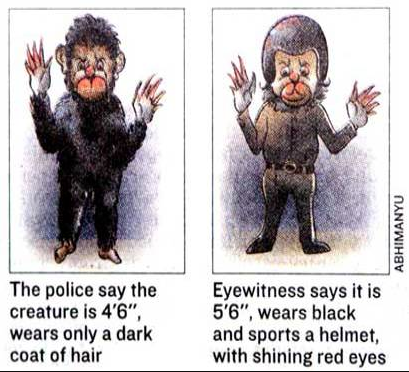
In the fortnight that followed, the police control room in Delhi would receive hundreds of calls regarding the creature – and the Monkey-Man turned from myth to an apparently very real threat in the midst of the scorching heats and rolling blackouts. Around sixty of these encounters led to injuries of varying degrees, with many acquiring their injuries not from a direct encounter with the creature itself but while fleeing in terror in the dark from a potential attack. The majority of those attacked were young men, who were more likely to be sleeping on the roofs of their properties where the Monkey-Man seemed most attuned to hunting his prey, and most of the injuries were sustained during power outages when darkness compounded existing conditions.
Panic around the Monkey-Man’s attacks grew swiftly, and became the focus of much breathless press coverage – the Times of India declared it “the main topic of conversation in shops and servants quarters with maids weeping as they trade tales of the sightings. People are sleeping in groups for greater protection. As they cry goes up in the night in one neighbourhood, people sleeping atop neighbouring houses begin screaming.” Reports of encounters with the creature filled the press – “a strange growling noise woke me at 1am,” a man in his mid-thirties told the Independent. “I could make out the hazy outline of a creature sitting on the roof. He leapt at me and ripped me with his steel claws”.
Within days, matters had grown more serious. It didn’t take long for reports of deaths associated with the Monkey-Man’s reign of terror to reach the media; an unnamed man allegedly threw himself from the roof of his house after fearing the creature was about to pose an attack, while a twenty-seven-year-old pregnant woman tumbled down the stairs to her death in a panic after she believed it had entered her house.
Despite dismissals from Manoj Kumar Lal, the deputy commisioner of police in East Delhi, who described the matter as “nothing but mass hysteria”, authorities announced a 50,000 rupee ($1,067) reward for information that might lead to its capture. Police were so overwhelmed with reports of the attacks that they ran low on vehicles to follow up on the calls, and they launched an investigation into what exactly the creature might have been. “We have consulted doctors about the bites and they said they were by some animal,” Suresh Roy, Joint Commissioner of police, told press. “The information we have is pointing towards an animal, but we checked with the local zoo and they said no animal had escaped from there”. Roy was convinced, given the large spread of the attacks across the city, that they were not being carried out by a single perpetrator but by “a number of mischief-makers who have formed a small gang”. It was also posited that the calls might be a ruse to try and ensure that power was restored to a certain area, under the belief that police would need to ensure a power supply before they came to investigate.
But the residents of the city would not take this threat lying down, and soon, citizens had created vigilante groups to patrol the streets at night in an attempt to deter further attack from the creature – armed with “wooden cudgels, daggers, field-hockey sticks, ceremonial swords and pikes made from butchers’ cleavers”, they wore whistles around their necks to alert others of a potential assault. It didn’t take long for these groups to target individuals who they believed could have been the Monkey-Man himself; on 18th May, a group of nearly 150 people pursued a van driver, dragged him from his vehicle, and beat him badly enough to leave him hospitalised with multiple fractures. Another incident saw a sadhu (wandering mystic) of short stature chased by a gang who was mistaken for the creature after being discovered performing rituals in a nearby forest, and was handed over to the police before realising his non-Monkey-Man nature was confirmed.
But there were those who maintained a sceptical stance from the off, including Sanal Edamaruku of the Indian Rationalist Society; he was quick to dismiss the sudden uptick of attacks on a mass hysteria, the Monkey-Man himself “a pure fantasy product”. Investigating some of the injuries reported to be a result of the Monkey-Man attacks, he noted that most of them were on the lower half of the body, unusual for a creature that stood several feet tall, and that the majority were relatively mild in seriousness and could be explained by accidental or deliberate self-injury (for example, explaining what appeared to be parallel claw marks as a result of the pressure of traditional jute beds on bare skin). He pointed out that the reports came concurrent to the broadcast of a popular television series depicting the extraordinary abilities of the Hindu deity Hanuman (a Vanara, part of a monkey-like humanoid group in Hindu mythology), and suggested there was some connection between the two. He also criticised the police for treating the case with such seriousness, accusing them of “officially and authoritatively confirm[ing] its existence”.
Regardless of the outlook on the case, the search for the Monkey-Man continued over the course of May 2001 with a flurry of additional reports. It was reported both locally and internationally, with more than 350 attacks reported to city police in the two weeks that it held its reign of terror over the city. But, by the end of the month, the Monkey-Man panic would come to an abrupt end – not with a bang, but with a whimper. The creature was not captured, but debunked, declared as a “mere figment of the imagination of emotionally weak people” by police sources in the final days of the month. “It was found,” these sources remarked, “many victims changed their statements on several occasions. Psychiatrists concluded most of them were hysterical and could not be relied on”.
Reports of attacks from the Monkey-Man took a sharp decline after this statement by police – or, at least, they were not approached with the same concern as they had been before. News of the groups gathered to track down the creature across the city dissipated, and coverage of the story faded. As quickly as it had started, the Monkey-Man’s reign of terror over Delhi had ended. But what exactly led the Monkey-Man panic to gain such traction in Delhi in May 2001?
There are a few factors to consider here, perhaps most significantly that this was a case of mass hysteria – a study by Satish K Verma and DK Srivastava on the matter identified the injuries reported during this incident as being most likely due to a case of social contagion rather than any material matter, with fear spreading through an already-overstretched population dealing with overheating, power outages, and crowding (a similar case, featuring a creature known as Spring-Heeled Jack, with an ability to leap inhuman distances who clawed at victims in an urban setting, took place in London in the late 1830s). Similarly, Vansath Kalal pointed out in his report on the matter that the scene had been set for such a panic by the socio-economic backdrop against which it took place, one of “low-income, high-density areas where ageing infrastructure, frequent power outages, and a weak police presence created a constant sense of vulnerability”. Frequently noted in retrospective coverage of the case is the intense press coverage that the case attracted, and it’s certainly worth noting the particular place of Indian media during this period – with the introduction of private television channels in the prior decade, competition between broadcasters had grown more intense, leading to more sensational and shocking stories gaining airtime in an attempt to keep viewers engaged.
The Monkey-Man of Delhi has since broadly faded into memory, with the brief flurry of panic around its alleged attacks fading almost as quickly as it started. But the case remains a fascinating look into the spread of belief, mass hysteria, and the cultural and economic factors that play in to these kind of beliefs. If you’d like to read other articles of mine about mysterious creatures and cultural beliefs, check out a couple below:
A History of a Modern Cryptid: The Truth (and Fiction) About the Chupacabra
This Pussy Bites Back: The History, Theory, and Reality of Vagina Dentata
If you’d like to support my blog, please consider supporting me by buying my books or dropping me a tip via my Support page.

