The Death of Undeath: True Blood
I done wrote an article about the end of True Blood, a secret pleasure of mine.
I done wrote an article about the end of True Blood, a secret pleasure of mine.
Right, before I start, I have brief plugging to do- firstly, I’ve noticed the Doctor Who articles on the Guignol have been getting tons of clicks. If you want to read more of my Doctor-Who related nonsense (which I assume is what you’re here for), I’ll be writing a beginner’s guide to Doctor Who over the next few weeks over at the excellent site Popjunk, which I’ll posting here sporadically too. And another thing- for those new to the site, hello! I run other blogs both here (that’s an interview-based site about working in the arts), and here (that’s a music blog I run with another freelance pop culture writer). Check them out because I’m a sick-ass dope writing motherfucker. We good? We’re good.
So, Torchwood. Torchwood (an anagram of Doctor Who, and a code name for the rebooted show when it was still in the early stages of production) is a spin-off from the second series of the new Who, following the exploits of periphary character Captain Jack Harkness-

Swwwwwwwwwwwwwwwwwwwwwoon.
-and his band of merry upgraded extras. Basically, each epsidoe revolves around them prancing about Cardiff solving mysteries. It’s Scooby-Doo, if the gang dry-humped in the back of the Mystery Machine at the end of every episode.
Torchwood was sold as a “grown-up” Doctor Who, packed with fluid sexuality, moderately offensive swear words, and pointed blood splatter. This is usually where I would start ripping the ever-living pish out of a show of this nature-a spin-off, a “gritty redo”, Russel T Davies….
But Torchwood is great. Well, it’s not, but that’s what makes it so eminently watchable. The acting is pretty average, with John Barrowman earning particularly criticism for his portrayal of Jack (although, honestly, he’s playing a swaggering, omnisexual intergalactic space cowboy- the part needs to be inhabited, not actually acted), but it works. The cast have strong chemistry, and Eve Myles in particular (who was scooped straight out of a season one Doctor Who episode, character name and all) toes the line of audience surrogate and plain exposition machine carefully and to great effect. I’m also a huge fan of Owen, because he looks wildly strange in a way that I find momentously attractive.

Is this crush alright? It’s not, is it? I wish I were Aunt Peggy, and he were the gin.
He’s also the focus of some of the most interesting episodes of the series, and carries them with aplomb. One character I don’t understand is Ianto- there was such a vitriolic tidal wave when he left the show, I was expecting an engaging, witty, empathetic character and instead he’s the…pale-ish tea boy? You can keep it, thanks.
So the acting is no great shakes, and the stories are often two-word epiphanies that hit the writers at three in the morning on the way back from the pub. “SEX……GAS”. “LIVING…..FILM. “PTERODACTYL….PET”. You get my drift. The villains inevitably turn out to be either preening ninnies or badly CGI’d monsters or twist endings that make me want to harm things, but you’re there to see the gang bicker and leap into action at least twice an episode, not for Moffat-ian scripts. Everything is oozing with innuendos, second base, and snappy, office-banter one-liners. The whole thing plays out like a b-movie, in that it’s well aware that it’s not going to win any awards, but it’s enthusiastic and ridiculous and a little bit knowing anyway. Although once some screenwriting genius working for Torchwood managed to blurt out “MARSTERS….BARROWMAN” and it was good. REALLY good.

To be that tacky late nineties wallpaper.
Keeping up with series eight of Doctor Who, one of the things I’ve been missing most profoundly is that sense of bright, kitschy, self-aware fun. That’s not to say every episode should feature Daleks in pom-poms and a swanny whistle, but there is- or should be, in my eyes- a light element of camp to the Whoniverse, and watching Torchwood reminded me that. I’m entirely game for serious science-fiction that makes a strong moral point (see: Miracle Day and Children of Earth, the brilliant if oft maligned miniseries detours Torchwood took after it’s first two monster-bashing seasons were over) or science-fiction that’s bright, breezy fun. And I also think that the Whoniverse is better placed than many to pull off both in tandem. But, in the midst of an all-too-serious season of Doctor Who, it’s nice to remind myself just how blase and brilliant this world can be.
Hang on, I just like this show because I think everyone’s fit, don’t I? It’s The Great British Bake-Off all over again.
I was on a bus today, idly inspecting the drizzly Turner painting that greeted me out the window. We trundled by a farm (one of the terribly posh farms, with a shop that sells local produce, which is always jam or pickle or wood carved into the shape of a swan that’s also an ornamental bread holder), and, through the rain, I could make out something. Pinned to each of the fences were a collection of large banners, each of them asking anyone who cared to notice “Fancy a Cornetto?”. A fair enough ploy for the summer, you might, think, but these banners were being battered by a stiff wind, still damp from yesterday’s day of sheet rain, in a farm as empty as the call centres in Heaven. They summed up a very British predilection to blind hope in the face of overwhelming, almost hilarious odds- someone, somewhere, had realised it was summer and gone “wouldn’t some ice-cream just be lovely this time of year?”, and put out these futile signs.
This week, my terribly British hope was eroded at again. I love Doctor Who, and I still think that it’s one of the finest TV shows ever to grace the small screen. Even after last week’s blunder of an opening (it was all summed up for in the look the consort’s brother gave me when the dire new opening credits played out: a flash of “JUST WHEN I THOUGHT IT COULDN’T GET ANY WORSE”), I was hoping that the Daleks might ground things in comfortable territory. They’re a hazing ritual for new Doctors, and a classic villain that people (not me, obviously. I hate them. They’re shit. I own a plunger, a whisk, and a fearful lack of regard for human life, and you don’t see Moffat casting me in anything) seem to love. But I didn’t like this episode.
It swung between some fun, cool parts that I did like, and some almost embarrassing exploits that made me want to take the writers over my knee. The bits I did like, first- Zawe Ashton (who is an utterly brilliant comic actress whose turn in Fresh Meat-both ludicrously funny and starkly dramatic- is one of the finest performances on TV at the moment) was brilliant as stoic but gold-hearted soldier person. We also got the first glimpse of Danny Pink, a future major player in the series and currently an ex-soldier and new teacher at Clara’s school. I’ll say that he did really well, but the writing was crass and they were lucky that at least he brought the charm- in basically his first shot, he assigns homework and asks “Any questions?”, to which some little rapscallion intones “HAVE YOU EVER KILLED A MAN.”. It was both a line and a line reading so dire that I broke down into ab-crunching laughter, and, with uni starting in two weeks, I plan to direct this question to all my lecturers as a hazing process. But: Danny Pink was good. There were also some passably funny lines, as the Matt Smith humour is dropped in favour of Capaldi’s deadpan humour (“Oh, don’t worry, you’re built like a man”). I will also recant one thing: I criticised Ben Wheatley’s direction last week, but he did a grand job on Inside the Dalek, actually managing to make them look pretty cool and briefly threatening.
Onto the bad. The story, which followed the Doctor and some compadres miniaturizing to go inside a broken Dalek that had started liking humans (let’s just not go near the premise this week, for my own sanity), was made up of two acts. It jarred terribly as it jumped from first act to third with nothing in the middle, as the Doctor staggered through awkward moral plot points and a script that was both too slow and too fast at various points. I was relatively game for a fun, silly episode that let us explore the iconic Who machine (just like Journey to the Centre of the Tardis so spectacularly failed to do last season), but the episode seemed terribly keen to stick it’s fingers down it’s throat and throw up some season-long themes.
This wasn’t an issue of it being a “dark” episode or a “fun” episode, as Who can do both almost simultaneously if it wants (See: The Empty Child/Doctor Dances, The God Complex, Blink), it was an issue of the script filling in what should have been bold, assured black and white with faded shades of grey. I’ve also noticed that Clara is starting to annoy me, and I don’t think it’s anything to do with Jenna Coleman- I think it’s just that her rambunctious energy worked best when paired with Matt Smith’s equal mania. Up against Peter Capaldi’s dour, more serious Doctor, she just comes across as a little grating and shrieky. The floating Dalek eyes I predicted last week turned out to be Dalek antibodies that killed people inside the Dalek, and I seriously don’t know if it’s better or worse.
And you know what the worst part about all of this is? I’m still looking forward to next week’s potentially excellent Robot of Sherwood. Damn you and your hopeful witchery: I’ll have you yet, Moffat.
1. The Master
Literally every time any new character is introduced to Doctor Who, people start clamouring on about how they’re finally bringing The Master back. Look: it’s not going to happen. Moffat has said that he’s leaving The Master be for the time being, and, while it might be a cunning sleight of hand, I really doubt his arch-nemesis will be returning any time soon. Don’t get me wrong, I WANT The Master to return more than I want my house to stay upright, but I refuse to get my hopes up. Why would he refer to the Doctor as his boyfriend? Why is he guarding the gates of heaven? Is Philip Glenister there too? Tellingly, the main “clue” fans are basing this theory on is the name “Missy”- Mistress is a female version of Master, and the shortened version for that is MISSY. GET IT? DO YOU FUCKING GET IT?! THEY’RE BRINGING THE MASTER BACK, YOU GUYS!
(on second thoughts, I will look like the biggest arse ever if this turns out to be right).
Likelihood: 4/10. Never rule anything out in Moffat-land, but just rewatch the John Simm episodes if you’re that desperate.
2. The Rani
Another character who fans have a permanent, hopeful hard-on over, I actually think this would be the coolest option on the list. She’s a character from the original series, a foe of the sixth and seventh doctors, and, most interestingly, a renegade, female timelord and scientific mastermind. With the return of Gallifrey (and presumable restoration of the timelords) at the end of Day of the Doctor, it would be the perfect time to re-introduce the villainess, originally played by Kate Mara. Evil as they day is long, several fans have pointed out that the garden she appeared in vaguely resembled a Tardis.

It sort of resembles a Tardis with Rani in it, if you imagine the fountain is a centre console while standing on your head and screaming “I NEVER GOT OVER 1985!”
If I were Steven Moffat- and long have I dreamt of the day- I would be tripping over myself to bring The Rani back, especially as a foe for a new Doctor. So that probably means it’s not going to happen, because Moffat NEVER LISTENS TO ME.
Likelihood: 5/10. More a pipe dream, but an awesome bit of potential.
3. Evil Doctor
The idea of the Doctor having several different sides that can form their own individual personalities and sometimes actually break free of him was explored a couple of times in the Matt Smith era (see: Nightmare in Silver and Amy’s Choice), and this lady seems to know rather a lot about the Doc. She’s also Scottish, like his new reiteration, and comments that she’ll keep the accent as she likes it so much. I wish this theory were less plausible as it’s so ridiculous and already brilliant, but this is a strong contender.
Likelihood: 6/10. Because why the fuck not.
4. Clara
We already know that Clara was sent spiralling into the Doctor’s timestream at the end of The Name of the Doctor, and found echoes of herself across the universe. Is it possible that this is one who broke free and went mad? With the seemingly pretty sudden departure of Jenna Coleman at the end of the season (strongly rumoured to be true), this could provide a way for everyone to tie up the Clara plot without requiring sexy Bambi on-set, as well as allowing the Doctor to seal the deal with their relationship without coming across like a creepy uncle. Fans have pointed out that she’s also wearing clothes similar to Clara’s from a few episodes back, though they may have forgotten the budget cuts. There was a lot of talk in the first episode of the burgeoning relationship between Matt Smith’s Doctor and Clara, with specific reference to the fact that he wasn’t her boyfriend. Did an obsessive and insane Clara turn into Missy? I bloody hope so.
Likelihood:8/10. Moffat loves to screw around with timelines and has previous for setting characters at different places along the same story, so this mad- Clara idea would be a fun way to wrap up her plot as well as provide EMOTION and DEPTH and AN EXCUSE TO BUGGER AROUND WITH TIMELINES AGAIN.
5. The Tardis
Sigh. Ever since The Tardis turned into a lady in that one episode, which seemed like a clever, quirky one-off to me, everyone seems to point at the screen shouting “Tardis! TAAAARRDDDDIIIIIISISISISISISISSSS!” whenever a mysterious woman appears on the show (every other episode). I wouldn’t loathe this outcome, but I would be pretty bored by it. It would explain the madness and the reference to the Doctor as her boyfriend, but Moffat either likes to a) fiendishly forshadow his big reveals or b) pull them straight out the blue. This is somewhere in between, and therefore doesn’t fit the bill.
Likelihood: 3/10. Snore.
6. River Song
You come back here, you little shit-
Do you know how long I’ve waited? After a bland Christmas special (which was somewhat of a misnomer) and the promise of a new, darker, older, more Scottish Doctor, eight months sailed by in an agonising trill of teasers and Coleman. By the time last night came around, I was practically sick with excitement- here, we had the introduction of a potentially game-changing Doctor, handled by one of the most experienced and competent showrunners in the industry. This, as I declared several minutes before starting the episode, could not go wrong.
As I’m sure you can guess, it swiftly did. The episode wasn’t a complete write-off, to be fair- I chuckled at a few of the less ham-fisted jokes, and appreciated a magnificent Matt Smith cameo that only made me pine for him more- but overall, I was left, not just dissapointed, but fuming by the Doctor Who season eight opener, Deep Breath. Indulge me for a moment, would you?
Infuriation Point 1: The Plot was Sloppy
Let’s cast our eye back over some wonderful DW episodes of yesteryear- Blink, The Empty Child two-parter, The God Complex. These are all episodes that are utterly airtight. You can watch these and watch these and watch these and not find one slip-up in the writing, one loophole that the characters presumably missed. Within half an hour of Deep Breath ending, me and the Consort had successfully picked obvious holes all over the plot (for example, the title was taken from the idea that the villains were unable to sense living creatures of they were holding their breath. So the central characters just stood very, very still at a climatic moment, holding their breath and waiting for the Doctor to come through, instead of running as far away from the monsters as they could while they were under their radar, which has been established as possible earlier in the episode). The episode would have made a very passable forty-minute mid-series romp, but it flagged hugely in it’s almost eighty-minute runtime. I don’t want to pick holes in Doctor Who, but if the writing is as slapdash as this was, I have to. Moffat has written some of the hands-down best episodes of the series ever, but that doesn’t give him a free pass to oversee episodes that both a) pointlessly reuse pretty good villains from six years ago that everyone sort of forgot about or b) contain a plot with the structural integrity of a skyscraper made of trifle.
Infuriation Point 2: Strax, Vastra, Jenny
I discussed in a review for The Crimson Horror last season that Strax, Madame Vastra, and Jenny were great characters who would, in the great Doctor Who tradition, be overused until we were sick of the sight of them (see: The Ood, The Daleks, Martha, etc). And I’ve been proved right against my will here, as they twirled into a room in tight leather brandishing swords and suspended by ribbons without a hint of a tongue anywhere near a cheek. Vastra came off as kind of patronising, and the heeeeee-larious Sontarans-don’t-get-people-LOL jokes are getting pretty boring. More to the point, I would have much preferred Capaldi’s opening episode to be about him and Clara, as opposed to wasting scenes with Clara nipping at tertiary characters.
Infuriation Point 3: Capaldi
Right, let’s be clear here: I thought Peter Capaldi was EXCELLENT in this episode. He was funny, charming, and extremely likeable. And my gripe with this new Doctor might be just mine, but it’s this: he didn’t seem like the Doctor. He didn’t have that mania or that sense of two thousand years of history or that ability to make it look as if his brain was about to burst with thought even when he was saying nothing at all. Whether or not this was a stylistic choice to depict his confusion after regeneration I don’t know, but I’ll be keen to see if this changes as the series goes on. I wonder, too, if the fact that every other Doctor I’ve seen I’ve been coming to with next to no prior knowledge of, while Capaldi inhabited one of the most iconic comedy roles of the decade has something to do with my inability to see him as a timelord. I did catch myself willing him on to declare something the “FUCKING OMNISHAMBLES” more than once.
Miscellaneous
Ben Wheately, an indie film director who helmed this episode, managed to make it look actively sloppy a few times. I didn’t like the utterly pointless re-use of old villains, especially not when you have a brand-new Doctor to play with. The ending suggested a rehash of the dreaded River Song plot, which I am minus okay with. There was no mention of Gallifrey, despite the fact they brought it back in the 50th Anniversary Special to great fanfare. The Scottish jokes (“You all sound ENGLISH!”) were pointless and, frankly, can we keep the independence campaign out of a kid’s teatime show?
With all that said, there was a lot to recommend to this seventy-six minutes of television. A nod to the Doctor’s moral ambiguity with a jumped/pushed question mark, a few meta nods to the fact that Peter Capaldi was in the series before, and some musing on the nature of the Doctor’s relationship with Clara (which apparently a lot of people hated but I utterly adored) that was pulled off with tenderness and subtlety. There’s enough here to go on to tempt me back, dammit, and it looks like, as Capaldi, Clara and the new improved Tardis, I’ll be back next week.
But hang on: did I spot some Daleks “done in a new way” (floating Dalek eyes???!?!??!??!?!) yet again in next week’s teaser? I’ll have you yet, Moffat.
I came home from a night out a few weeks ago, drunk, suffering from what my social group colorfully refers to as the “drunchies”. On the way home, I had picked up a tactical loaf of bread, some cheese, and some delicious pickle. Sloppy, drunk, fancy cheese on toast was on, son. I got home, assembled my pieces of toast with magnificent stacks of cheese, lashings of pickle, a positive monument to all things good. I whacked it in the grill and promptly forgot about it. By the time I remembered, my towering temple of dairy was black and my toast was cinders. It was heartbreaking. Seeing something with so much potential, so many chances and possibilities to be great, is never right. And that brings me neatly onto my topic of the day- Smash.
Smash was pitched to me as a kind of West-Wing-On-Broadway affair, a behind-the-scenes dramedy about putting on a Broadway show. A kind of grown-up Glee with bonafide stars and original songs. It sounded like the perfect show for me.
And I’ll give it it’s due; I watched both series. But I don’t think I’ve even got space in this review to tell you everything that was wrong about this show. And I have an unlimited wordcount. The whole thing reeks of unrealized potential. Take Jack Davenport, playing wankery director Derek, a man a penchant for sleeping with his leading ladies. Cliché as fuck, certainly, but possibly offering a chance to explore the people behind the people. As it was, Davenport swaggered around dreaming of his bit part in Pirates of the Caribbean.
And he was probably the best character in the show. Anjelica Houston, Tom Borle, the magnificent Broadway actress Megan Hilty….carried to the four winds by a rearing, tri-headed beast of bad writing, no characterization, and unenthusiastic performances. Of course, credit must go to leading lady Katherine MacPhee. An American Idol contestant, she can sort of sing if you squint your ears a bit, but sadly often resembles a child’s crude drawing of happy/sad faces sellotaped onto a bollard. Chick can’t act.
Many of the writers spoke out about the apparently tyrannical rule of showrunner and creator Theresa Rebeck, claiming she was insistent on carrying dull, unimportant storylines to their sorry conclusion despite attempts at intervention. This theory would hold up better had she not been replaced in the second series, which promptly proved itself to be more boring than the first and, disquietingly, apparently co-opting on a real-life tragedy. The first series at least succeeded in inflating the camp (often with a laborious foot-pump, but still) to an enjoyable level on occasion, but the second became a stream of non-sensical plots and characters who were surely the last, festering pieces of shit to be picked off the wall.
The show did occasionally prove itself brilliant to Broadway nerds like me (hashtag watchedthetonyawards) particularly with the staged song numbers like the one below.
That’s Megan Hilty singing as Marilyn Monroe on the set of Some Like It Hot.
And that’s what made it even more frustrating. In different hands, with different writers and a rejigged cast, this could have been a catty, clever, campy jewel. The Smash we’re left with is a desolate wasteland of humorless, questionable, often dull television. But on the horizon, there are distant sparkles of West End glitter. And the perfect slice of cheese on toast.
In between recaps, my computer broke, I watched Orphan Black, and I dyed my hair purple. Now, on with the chapter!
The last chapter ended with Grey saving Ana from the terrifying bicycle of death and her imploring him (internally, of course-anything else wouldn’t be ladylike) to kiss her. He doesn’t kiss her.

I’ve been looking for an excuse to use this gif for EVER.
She just about dies on the spot, curses the fact she thought someone like Christian Fancydick would be interested in some lithe, artful, dark-haired pimple like her, and leaves. She sobs in her garage like a pussy. Eventually she makes her way to the apartment and Kate tries to convince her that a rich guy like Grey might be into a pale, big-eyed, well-off kid like her. Ana decides he rejected her because he was too good-looking, as there’s no way it had anything to do with her being a shallow, bitchy tea-bore.
Ana takes her final exams (0h yeah, remember college?) and arrives home to find Kate brandishing a package for her. Kate is far too useful. I’m beginning to think that she’s actually a plant by Ana’s parents to make sure she doesn’t starve or set herself on fire. Either way, the package is some first-edition books from AN UNKNOWN SENDER. The UNKNOWN SENDER has highlighted some passage from Tess of the D’urbevilles where a hero warns the heroine off him. This shite makes Jumanji look like Se7en.
Ana and her pals go out to get drunk like normal students, but because Ana’s a lightweight and has probably never woken up from a nap underneath three cubicles in the lady’s bathroom on her eighteenth birthday, she thinks it’s a grand idea to call Grey. Upon realising she’s drunk and somehow sensing that Jose is flirting with her, Grey declares that he’s on his way to pick her up. Wait, what?
So this guy has had a coffee with her, rejected her, and now he’s so utterly terrfied for her safety that he has to come to Portland to pick her up from hanging out with her friends and roomate? Tits to that. I’ve had close friends suggest bringing a rowdy night to a close answered with bottle hugging and pouting. If someone tried to pick me up from a party for no good reason I would break them into shards to match their empty glass heart.
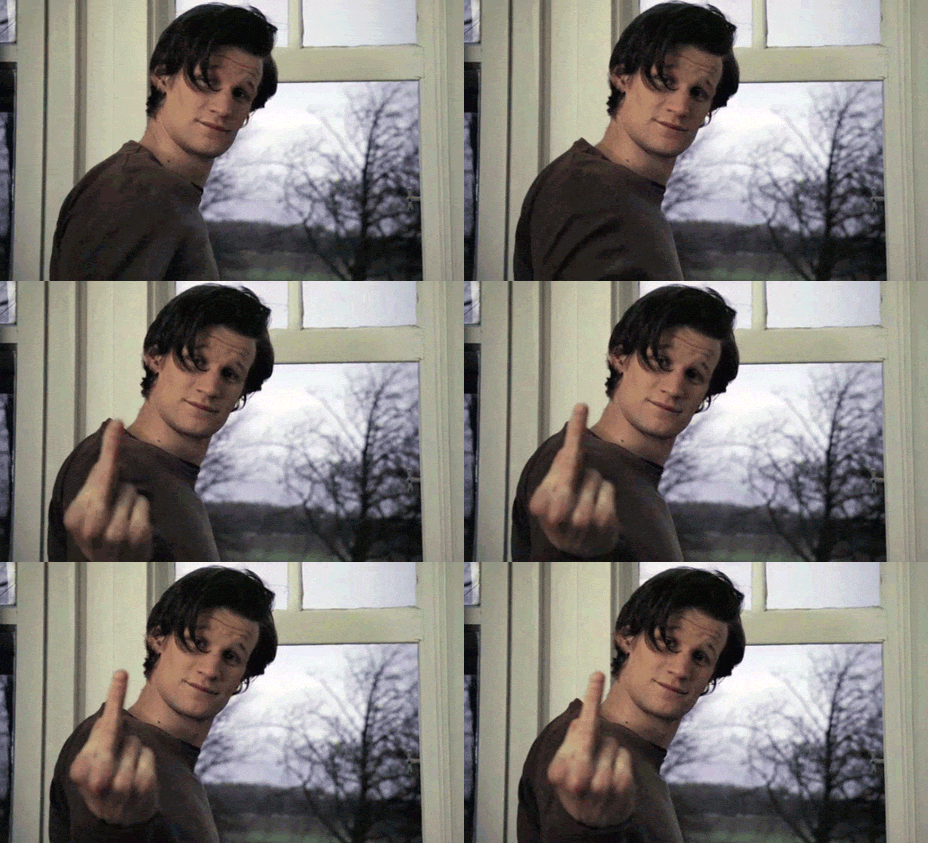
A close personal friend of mine was slagging off Matt Smith last week. He looked upon his last dawn.
Ana goes outside to get some fresh air and Jose starts forcibly trying to get off with her. Come on, Jose, man, I liked you! Why did you have to go and make Grey seem like the better alternative? And seriously man, no means fucking no. Calling her “darling” in Spanish doesn’t make you less of a prick.
But thank absoloute fuckery, because Grey is here to pick Ana up. Ana vomits at Jose’s feet, some shite occurs to fill up page space (seriously, Ana just vomits some more in excruciating detail. Next time someone tells you they think Fifty Shades is really hot, assume they’re talking about this vomiting scene, and refuse to let it go until they slice the book into sashimi rolls for your bitter enjoyment) Grey sweeps her off to the hotel he’s staying in. Because going back to the hotel room of a man you know has strange feelings for you and also purchases murder paraphernalia while drunk is the best desicion ever made ever the end.
But we don’t get to find out how bad of a desicion it was until next time! Hold on in there, folks!
You know the feeling when someone is telling you a joke, and you don’t find it that funny? So the person explains and expands on that joke even more, just because it’s so inconcievable to them that you wouldn’t find this funny? And you try to make it clear that you understnd the joke perfectly well but you just don’t think it’s funny, and then they get all het up and start retelling you bits of the joke over and over again and rolling their eyes at you and calling you humourless becuse DAMMIT THIS JOKE IS BRILLIANT?
That’s sort of what the experience of seeing Guardians of the Galaxy was like for me. Don’t get me wrong, there were some parts of it I really liked-there’s a Christ-Pratt-shaped soft spot in my soul, and bizarrely the talking tree monster, Groot, was my favourite character-but if it becomes clear within the first few minutes of a movie that you and the filmmakers aren’t on the same page, you’re in for a bumpy ride. Here’s what my key problem with the film came down to: I didn’t think the wisecracking raccoon Rocket was funny. And the writers and directors thought he was a HOOT. So much so that they asided a few characters with much more comic potential to allow Rocket to go through all the lines in the trailer while they envisioned the audience literally scrambling for breath between the belly laughs. Now, it’s not all their fault that I hated Rocket-wisecracking animals, with the exception of Donkey from Shrek, make me cringe- but surely you have to prepare for the possibility that you’ve misjudged how funny a particular character is? But no. The people behind Guardians of the Galaxy thought he was a scream, and weren’t interested in the opinions of anyone who thought otherwise.
And there were more things that pissed me off about the movie too. Karen Gillan’s Nebula was solely there to provide reaction shots and a couple of mediocre fight scenes, bearing no immediatley apparent impact on the plot. The entire third act appeared to be the best part of the Phantom Menace shoved together into twenty-five minutes. Michael Rooker’s role consisted entirely of swishing his coat back threateningly to reveal a magic arrow thing and gnashing his pointy teeth, which is a woeful underuse of an excellent character actor and one of the most handsome men on earth (all right, I digress).
Guardians had it’s charm, but it wore pretty thin after two hours of weird plotting and attempts at emotional climax. And I am terribly sorry if you loved this film and what to break me into pieces after this review, because I can see all the things to like in there. They were just eclipsed by that fucking Rocket.
I’ve had several glasses of wine tonight.
1. Doctor Who
Philosophising,
Blue box, Fez, Fucking Daleks,
Tits and Teeth in Space.
2. Celebrity Masterchef
Gregg and John T Flirt
Over Pudding and Beef by
Those no longer known.
3. Breaking Bad
Well, is it really
As superb as they always
Say that it is? Yes.
4. America’s Next Top Model
Angular dormice
Vie for decreasing prizes,
Tyra must be God.
5. The Walking Dead
CAAAAAAAAA
AAAAAAAAAAAAARRRRRRR
LLLLLLLLLL
 The Cutprice Guignol