The Cutprice Guignol

The Ninth Year: The Haunting of Swill House

Doctor Who: Turpitudinous Arsehole Re-Defines Insomnia Symptons

(Yes, so I cheated a bit with the title this week. Look, those things are hard, alright?) Ever since I heard about this week’s episode of Doctor Who, I’ve been quietly pumped about it. Starring Reece Shearsmith (always in my heart for the screamingly funny and occasionally powerfully disturbing League of Gentlemen) and written by Mark Gatiss (writer of a bunch of DW episodes, the most recent being Robot of Sherwood which I will defend unto the grave, and also, you know, Mark Gatiss), the episode came with a found-footage horror twist and a big fat Macbeth reference in the title, Sleep No More (I don’t think it’s ever come up before, but I consider Macbeth pretty much the greatest thing ever written and have the scene from which this episode’s title is taken pinned up in my kitchen) looked like it was going to be, at the very least, a memorable episode.

I’m just the sort of dick who’d throw all that at you just to say that I thought Sleep No More was a load of pish, but I actually loved it to pieces. Following a crew on an abandoned spaceship, the Doctor and Clara soon turn up and figure out that the reason for the spaceship’s deserted status is the mysterious Morpheus pods that are gaining popularity across the universe, inventions that streamline the sleep process into five minutes. Sounds awesome! Until they realize that the pods hyper-sleep settings have created sentient monsters out of sleep dust-pretty much what happens to me when I don’t get enough shut-eye.

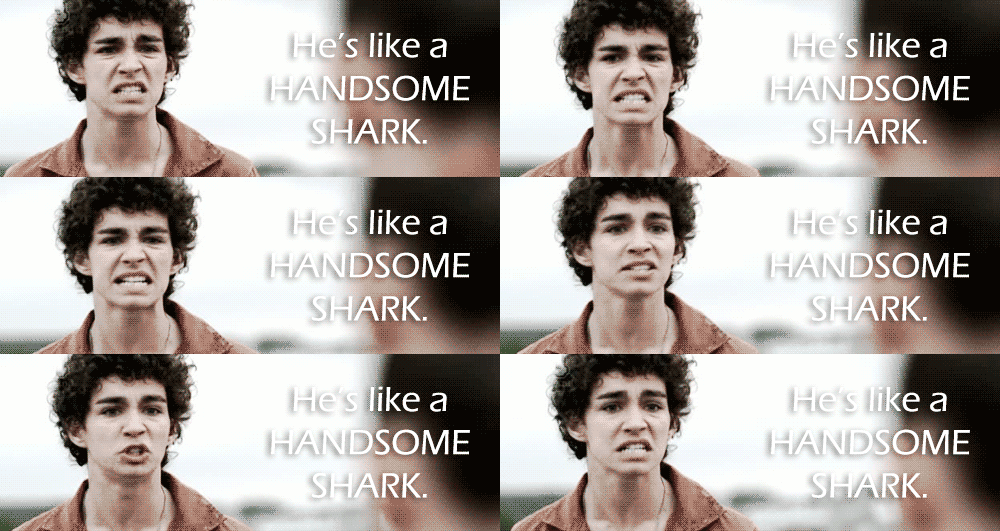
I mean, I suffer from insomnia pretty badly and can confirm this is exactly what I look like on five minutes sleep.

Which is, yes, a hilariously silly idea, but one that’s played straight to great effect. This morning, when I was planning this review and thinking about what I was going to talk about and what I would have to leave out, it was nearly impossible because so much of this episode’s strength lay in the little details- the fact that a drunken ship’s crew had reprogrammed a door for a joke, forcing a doomed soldier to sing a silly tune into it to make it open, the jolly, old-school and utterly sinister announcement lady who introduced the Morpheus pod to us, the bickering over whether or not the creation of a dumb grunt soldier was ethical or not. Gatiss has always been good at little additions that make the universe his stories are set in feel like a real place with real connections to wider world, and that really helped fill in a convincing backdrop for this episodes scares.

And boy howdy, I’m not kidding about those scares. I try to measure Doctor Who’s scariness off how long it would have kept me awake when I was ten, and I don’t think I’d have slept for a month after this outing (also known as the Empty Child effect). I don’t know how well this episode would have worked without the found footage conceit, but that’s irrelevant because it was. It subscribed gleefully to all the genre tropes it could get it’s sandy little hands on, from the dramatic cutaways to the wobbly cameras obscuring  the approaching villains, and the ending revealing a secret hidden in the choppy footage. As a horror fan till the end of my days, I liked this, and I liked it a lot, even if I can understand other viewers seeing it as a gimmick or a grasping flail for originality, as it totally was.

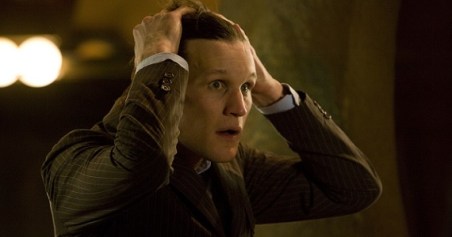
Ugh, just looking at this gives me the squicks. Partly because it’s obscuring Reece Shearsmith’s lovely face (entry number #67843987 on Lou’s Weird Crush list)

The episode squeezed in a few good jump-scares, as well as some legitimately gruesome effects that made me cringe a little bit even now. I said in the Under the Lake review that what made the monsters so frightening was their corporeal-ness, the fact that they didn’t just finish you with a zap of death or blast from their whisk or whatever. And the same went for this episode. The creatures were present and very, very real, and served as an actual threat to our leading cast- munching them up whole, smashing their way through doors, and generally being a lot more threatening than the usual Who villain. Speaking of villains, Reece Shearmsith deserves a nod for his role as Rassmussen, the man behind the Morpheus pods and instigator of a plan so fiendishly evil it’ll tie you to the railroad tracks while twirling it’s moustache before you’ve had a chance to say “Wait, weren’t you in League of Gentlemen?”.

I think what I liked most about Sleep No More (aside from trying to figure out the connections to Macbeth beyond the title and the line quoted in the middle of the episode- maybe the theme of ambition? Or looking like the innocent flower but being the serpent under it? Ooh, I’m going to have fun with this one for weeks, I can tell) was the fact that it was driven by story, first and foremost.

I always love a slightly decrepit-looking future, too, and Mark Gatiss always does them so well.

Think about it: this season we’ve had the Magician’s Apprentice two-parter, which was really a bunch of loosely connected character vignettes (for the Doctor, for Davros, for Missy), Under the Lake and Before the Flood, which were focused on exploring the fiendish time-bending the Doctor can get up to, the Girl who Died which, well, introduced us to Ashildr (who’s back next week) and a whole new low for the series, and then the Zygon two-parter which apparently revolved around that speech which I am now convinced lasted at least seven hours. Sleep No More- with no back end to tie it all together- had forty-five minutes to tell a tight, smart, scary story, and it succeeded. It was driven by plot first and foremost, and it’s breakneck pace-occasionally a little too breakneck, to the detriment of the tertiary characters-didn’t let up for a moment of navel-gazing or laboured character points. And for that, I give Sleep No More a firm pass, and strongly recommend it if you’ve been drifting away from this season a little bit.

But what’s this I hear about the Cybermen next week? I’ll have you yet, Moffat.

Feminism in Time and Space, Part Two: Sexuality and Representation

I swear to God I am rubbing my hands together right now, because this is a topic I’ve wanted to get to for a long, long time: Steven Moffat’s dealings with LGBTQ representation on Doctor Who. Now, I’ve written loads before about bisexual representation (or lack of it) on TV, and it’s something I always look out for in new shows, because bisexual characters-that is, characters who identify as bisexual and aren’t reduced down to their sluttiness, greediness, or, um, lying-ness-are pretty thin on the ground. But Steven Moffat has plenty of characters that don’t fit on either end of the binary, so let’s take a look, shall we?

While this is going to be about Doctor Who for the most part, I’d like to touch on a couple of his other shows that are relevant to this discussion. The first is Coupling, a so-so sitcom following a fictionalised version of Steven Moffat meeting a fictionalised version of his wife. They have a recurring group of friends, one of whom not-Steven is dating at the start of the series- when he tries to break up with her, she tells him she’s bisexual to titillate him into staying. Her “bisexuality” is played for laughs throughout the series, and then, in the final episode, someone shows her some naked ladies, she’s utterly horrified, and her ruse is shattered.

No relevant pictures for that paragraph, but just LOOK at how early-noughties this title card is.

And then, of course, there’s A Scandal in Belgravia, the Sherlock adaptation of the superb Conan Doyle story A Scandal in Bohemia. In the original tale, Irene Adler becomes the only person to outsmart Sherlock and gets away scott-free. In this version, she’s a dominatrix who spends a good chunk of her screentime naked, and she identifies as a lesbian. Despite that, however- despite the fact she says she’s only attracted to women- Steven Moffat’s self-insert  Sherlock is just so sexy and charming and clever that she falls in love with him and gives the whole game away. How they managed to write a story more regressive than one penned over a hundred years ago is beyond me, but there it is. Not to mention the hi-larious running joke of people assuming Sherlock and Watson are a couple, which Watson must quickly and vehemently deny lest those strangers think he likes men, rue the day.

So, you know, the problems I’m talking about here are not limited to Doctor Who. Far from it. But let’s get into the nitty-gritty of representation in the series.

Bring back Donna 2K15

Firstly, Steven Moffat has confirmed that both the Doctor and River Song are “happily bi”, which is cool, and I’m pleased to hear someone actually use the term for once (even if he did follow that up by saying that bisexuals didn’t need representation because they were having “FAR TOO MUCH FUN” and were to “BUSY!!” to watch TV, but let’s skim by that for now). But the fact is that, watching the show, the references he points to as proving their bisexuality- such as an offhand comment from River about fancying everyone in the crew except one, and her making reference to kissing Cleopatra- are always kind of…brushed over? Sure, the Doctor kisses men once or twice during the series, but it’s never as much more than a joke. Neither River nor the Doctor actually find themselves seriously attracted to a person of the same sex without it being breezed past with a barely-audible “No homo though” every time it comes up. Steven Moffat had to confirm their sexuality outside the show, which proves that what he’s doing inside the show is, at the very most, leaving people confused (but I’m sure they’ll make their mind up when they just meet the right episode and settle down, huh?).

And let’s talk about Clara, who has, on a couple of occasions made reference to being attracted to women. The first time, she’s Oswyn, and comments on her crush on a girl, only to quickly dismiss it as a phase; earlier this season, she spoke about Jane Austen being a “fantastic kisser” (right, sure, give Shakespeare his own episode but relegate Austen down to off-screen kissy-kissy faces). Some people have deduced from this that Clara bisexual, and they’re welcome to this interpretation, but to me it feels like a gross kind of pandering- sure, we’ll mention these things, but we’ll never talk about them again, see how the impacted Clara, let alone actually get an episode dedicated to them. Amy flirts with another version of herself, but it’s mostly shown to be a massive turn-on for her male partner Rory. Again, it’s there, but it feels more like a punchline that an actual attempt at representation.

To be fair, I’m bisexual and I’m SUPER into myself so maybe this is accurate.

I’d be doing a disservice if I didn’t make mention of Madame Vastra and Jenny, an openly lesbian couple who join the Doctor on some of his adventures. Broadly, this is obviously good news, as having a long-term loving gay relationship on a show like Doctor Who is excellent for representation. But then again, let’s not forget that the show paints them as generally bickering, with Vastra’s straying eye and Jenny’s still-servant status. And, of course, the fact that the show had Jenny forcibly kissed by the Doctor (who knew she was both gay and in a relationship) before she shared an on-screen smooch with her partner. So, sexual assault comes before lesbian kisses. Good to know where the hierarchy is.

Look, I tried to find a picture of their first kiss but the search just returned a lot of fanart porn and frankly I’m just not up to sifting through it today.

Look, in some ways, I really appreciate that the show is trying to depict non-binary sexuality, and I think they have succeeded before. Even though Captain Jack Harkness (who appeared for the first time in a Moffat episode, but was created by Russel T Davies) kind of fits the hyper-slutty mould for bisexual characters on TV, he’s probably one of my favourite non-binary characters ever because he’s funny and brave and a bit of a sleaze (I worship at his altar in this review of Torchwood, if anyone cares). But since then, the show has treated non-binary characters like a novelty, who’s straightness is the only aspect of their sexuality worth exploring or even seriously discussing. And, considering we’ve got the whole of time and space to explore, I’d happily chop in another Dalek episode for one that actually took a look at the wide range of sexualities Moffat promises us are on his show.

What We Want from the TV Star Trek Reboot

No, not THAT Star Trek reboot.

Doctor Who: Talky and Repetitive, Dour Instalment Struggles

I spent a long time trying to put my finger on the correct word to sum up this episode- over-written? Pointed? Conducted with all the subtlety of a beating with a rusty spade? But the word I’m going with is laboured, because that’s what this episode was. Not necessarily awful, but The Zygon Inversion (which DIDN’T involve ant Zygons getting turned inside out by killer gas, boo!) felt as if it had a whole lot of episode to fill with a scant amount of plot.

The Doctor attempts to maintain the ceasefire between the Zygons and the humans as a the leader of the revolutionary Zygons, who also happens to be in Clara’s body, does everything s/he can to start a war. In order to do this, s/he needs to get hold of Osgood’s box-whoops, no the Osgood box, which will determine the fate of the earthbound Zygons. And in between those plot points, there’s lots and lots of….talking.

Kate was there, and she was…pretty fine, I guess.

Don’t get me wrong, I love a good talky episode of Who as much of the next person (the sublime Boom Town springs immediately to mind). But, well, I think the Robot Devil can put it better than I ever could-

Over and over again, Peter Harness and Steven Moffat (co-credited as writing this script) seemed too busy jumping to the next forced joke or clunky moral plot point to have anyone express anything without having to have it underlined a thousand times by someone else. And, like The Woman Who Lived a few weeks back, everything seemed curiously repetitive, especially the climactic scene between Kate, Zygella and the Doctor. The Doctor’s giant, dramatic speech-which felt like it went on for at least 75% of the episode- wavered between Peter Capaldi managing to just pull it back into watchable, and repeating the same point over and over and over and over again to the point of brain-implosion. A point which barely even stands anymore, since the events of Day of the Doctor (I get why he was keen to stop the war from happening, but is it really fair to invoke the “I CARRY AROUND THE SCREAMS OF A MILLION PEOPLE I MURDERED” when you, um, didn’t actually murder them?).

THE THRILLING CLIMAX

Add to that a handful of annoying plotholes-if Kate could shoot the Zygon dead, why didn’t the armed U.N.I.T soldiers do that last episode? If there are only 20 million Zygons on Earth and they can be easily killed with firearms, the war really isn’t going to pose that much of a problem, is it? If the Doctor has had to diffuse situations like this one before, as implied by the “last fifteen times” line, why don’t they just remove the Zygons from Earth? And the biggest one of all: why the fucking Christ would U.N.I.T agree to settle Zygons on Earth after they TRIED TO TAKE IT OVER?- and this script was pretty awful, especially compared to last week’s tight, exciting thriller. It just didn’t have much to work with, with most of the plot being dealt with (and swiftly forgotten) last episode.

There were a couple of good scenes, that said- I’m coming round to Osgood(s) in a big way, as Ingrid Oliver managed to balance the charm and quirk with the sense of duty really nicely and was just generally really watchable. The other set of doubles in the episode- the two Claras- were not quite as good, despite a very cool scene where Evil!Clara tries to figure out the location of the Osgood box and the two of them have a bit of a mental joust. I really didn’t care for Jenna Coleman in this episode, who looked for a lot of the runtime as if she was phoning it in with one foot out the door, which is a shame but fits pretty well with the patchy nature of the writing for her character(s) since the start of this season.

One thing that did strike me about this episode, and this series by extension, is the problems they seem to have balancing fun with serious. The Zygon Inversion had a lot of stuff to say about the pointlessness of war (with a weirdly out-of-place reference to the Glorious Revolution, for what it’s worth), but the only way it could get it’s point across was through repetition ad finitum and Peter Capaldi doing that awful game show voice. The show has shown over and over again that it can balance rollicking fun with serious moral points (David Tennant’s first proper episode New Earth springs to mind), but the last couple of seasons have lurched awkwardly between stilted jokes and overly serious moralilty without taking the time to fit the two together. There hasn’t been a really outrightly fun episode this season- Under the Lake had it’s moments, as did The Woman Who Lived, but both revolved around heavy central ideas-and I feel like the show is starting to get a little bogged down in it’s seriousness. That all said, next week is a found footage episode with Reese Shearsmith in it, and therefore was created expressly for me!

AND the Zygons still look like demon Mr Blobbys. I’ll have you yet, Moffar.

Please Let Me Enjoy Football in Peace

I really, really, really like football. I have done as long as I can remember. So many memories from my teen years revolve around the sport-whether getting up at ungodly hours of the morning to watch Match of the Day (I had a mug that played the theme song and everything! It broke after about two weeks and I would occasionally wake up to the jaunty refrain echoing off the walls of the house as it malfunctioned), playing in my school’s team (I was defence, because it’s impossible to get anything past my ego), or heading down to the pub to watch the World Cup with my usually uninterested friends caught up in the excitement of the tournament, it’s always been part of my life. I’m sure there are a bunch of people rolling their eyes right now because, yes, football is pointless and stupid and everyone is overpaid and at the end of the day it essentially means nothing. But it entertains me, and I like pottering around on a Saturday afternoon listening to whatever matches BBC have deemed acceptable to broadcast this week.

But in the last couple of months or so, I’ve had the growing feeling that I’m not….welcome in the football world. I’m not the first to say this, and I won’t be the last, but sometimes I just want to enjoy my football in peace. And by that, I mean without having to justify or prove my interest in it.

I put off writing this article for ages and ages, because there are surely far more important things to concern myself with than whether or not some bloke at the pub thinks I’m only there because I’m trying to impress my boyfriend. But then, twice in two days at university this week, a couple of my tutors made offhand comments about women not being interested in sports. And that’s certainly not the most offensive assumption that I’ve heard about my gender, but it’s still sexism and is still worth talking about, especially when it’s so alright to crack wise about it even in apparently neutral positions of authority.

I could easily list a hundred instances where someone has challenged my interest in football, but you’ve heard them all before: chatting to a guy in the smoking area during half-time and having him ask what team my boyfriend supported, and being surprised when I replied “the same team as me”; having a bloke demand to know the scores of the last three matches my team played in to “prove” I followed the sport; being told, through jokes and quips and outright statements, that women who like sports are an anomaly who are either faking it to impress a guy or unable to possibly comprehend the passion that “real” fans (read: men) have for it. I  spoke to my boyfriend-who is just as big an anorak about football as I am- if he’d had similar responses when he’d mentioned his love of the sport, and the answer was a firm no.

And that is, of course, not to mention the actually game itself- fans making sexist jokes about the inclusion of women in the Fifa 16 game, Manchester United fans screaming abuse at a female doctor earlier this year, Andy Grey and Richard Keys joking about how a senior lineswoman would need to offside rule explained to her, etc, etc, ad finitum.  Women are not welcomed to the sport the way men are, and that’s just stupid.

I’m sure there are a few football fans reading this and thinking “I don’t care/am happy to see anyone get into football, regardless of gender!”. And you’re golden- this isn’t aimed at you. But, to all those people who hear that a woman likes or is involved with football and feel the need to interrogate her or get her to justify her interest, stop. Stop it. Stop it forever. We’re starting to sea the tide turn-very slowly- on women involved in football, whether that’s on the pitch or in the stands, and every time you demand a woman prove her love for the sport based on whatever arbitrary standards you’ve come up with, you’re pushing in the wrong direction. All I want is to be able to enjoy the sport I love in peace. And if one more person tries, unasked, to explain to offside rule to me, I won’t be responsible for my actions.

A Wanker’s Literary Reaction: Ash vs Evil Dead

So, I have a somewhat scandalous admission to make: I’m not that huge a fan of the Evil Dead series. I know, I know, I can hear you yelling at me now- “I thought you said you were a fan of horror!”. And I am. It’s just that, for whatever reason, Sam Raimi’s seminal video nasties never quite smashed their way to the same level of obsession that, say Friday the 13th or Nightmare on Elm Street or, um, Final Destination (look, I’m SORRY) did in my head. Which is not to say that I don’t get it- I do. They’re great, and Raimi revolutionised indie horror with his innovative gore and balls-to-the-wall sense of fun. But I was coming to the reboot of this series without too much preciousness about the original movies on my mind, is what I’m saying.

That all said, I was pretty pumped for the premiere of Ash vs Evil Dead this Halloween (which I spent dressed as a genderswapped Beetlejuice or Wednesday Addams, depending what day you found me, so everyone else needs to up their constume game). After the catastrophic TV “re-imagining” of classic horrors like Rosemary’s Baby, this one seemed to have something that set it apart from the pack-namely, the involvement of the original directors and and the always-welcome presence of Bruce Campbell.

And I mean always welcome in the most literal sense possible. If he was to walk through my front door right now, I’d be like “hey, Bruce, let me pour you a glass of brandy and we can talk about setting the wedding date”. Did I mention that I love Bruce Campbell? Because I LOVE Bruce Campbell. He’s the greatest bad actor there ever was, and he’s probably the most iconic part of the original Evil Dead franchise, mainly because he looks like he’s having more fun than perhaps anyone else has ever had in front of camera (except me in my sex tape, but that’s another matter).

I’ll be honest, I’d probably let him finger me even with the chainsaw hand. Is that awful? That’s awful, I’m sorry.

And that’s the one thing that stands out above all else in the season premiere of Ash vs Evil Dead- just how much FUN everyone seems to be having. Utilising as many of the same visual tricks as the original movies (as well as keeping the Deadites looking the same as they always did, thankfully), there’s no part of this episode that didn’t make me grin. From the superbly executed horror sequences (the one in the haunted house that was lit by a spinning torch was legitimately inspired, and really worked) to the dumb humour to the batshit crazy action scenes, this show knows how to balance it’s horror and comedy perfectly. I wrote about Scream Queens a few weeks back, a show which pretty much failed to strike a comfortable balance between the two, and I was struggling to think of a TV show that actually did- until this came along.

COOL

I guess what I like most about it is that it isn’t attempting to come up with gritty new takes on old-school horror. It’s just having fun bringing the goofy, funny, scary, super-violent feel of the original movies to the small screen, with a bit more space to develop characters and plot. While we’ve certainly seen some great horror over the last few years- from Cabin in the Woods to The Babadook to The Visit– it’s been a long time since something with such an obvious B-movie quality has broken through to the mainstream. I’ve missed seeing someone having genuine outright fun with the genre, and in that respect alone, Ash vs Evil Dead has me on board as a viewer, just to see where they can take this next.

Doctor Who: Testy Allegorical Radicals Destroy Interplanetary Security

I think alien invasion episodes are the bread-and-butter of the Doctor Who universe (outside of a thousand stories set in Victorian London, that is). From subversive takes like the Empty Child to straight invasion episode like, um, The Christmas Invasion, it seems as if Earth is never free from the intergalactic scourges who want to take over the planet. Maybe the real estate is cheap or something.

Sonic Sunglasses: Here to stay, it seems.

Either way, I’ve always enjoyed alien invasion episodes because there’s something inherently cool about seeing a world I know completely changed by whatever alien race is after us this week. They usually fall into a pretty predictable formula, but one that never grows old- U.N.I.T figures out aliens are invading, they ring up the Doctor, and they launch a counter-strike against Earth’s new visitors. The use of the ever-welcome U.N.I.T saves them the bother of expanding on one-episode tertiary characters and lets the focus fall entirely on the plot, and, in the Capaldi years, the Doctor gets to ponce around in an plane and play at be being president of Earth. As a die-hard sci-fi fan at heart, it’s always fun when the show flexes it’s science fiction muscles, and this week’s episode proved that the show still has plenty of straight-up alien invasion romps left in it yet.

After a seriously wobbly two-parter, this season seems to have settled down a bit with The Zygon Invasion. It’s not a mind-buggeringly amazing outing or anything, but it just about holds it’s nerve, as a peace treaty with the Zygons falls to pieces and U.N.I.T braces itself to save the world once again. Aside from the fact the entire premise for the episode is based on a plot hole- why would they try to integrate the Zygons into the human race, after they’d tried to invade the planet twice already?- it’s difficult to fault this week’s tight, globe-trotting adventure, one that speaks to writer Peter Harness’ comfort within old-style Doctor Who stories.

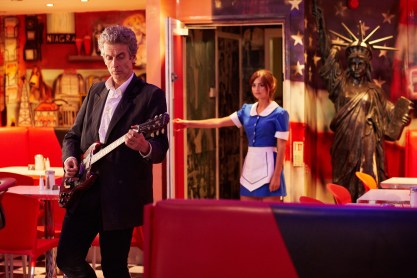
Jenna Coleman gets her first really notable performance of the season-seriously, this is the most relevant she’s been to the plot in about a year-and reminds me why I did love her so much all those distant seasons ago. And Capaldi looks like he’s having a ball prancing around the world on U.N.I.T’s arm, even though someone in the screenwriting team obviously REALLY LIKES the guitar gag and just doesn’t want to let it die. And I’ll never turn down a chance to hang out with Kate Lethbridge-Stewart and company- even Osgood, who I’ve never really understood the fuss around, was interesting this episode, and provided another candidate for the Hybrid mentioned a few episodes back (it’s going to be Clara, isn’t it? It’s ALWAYS Clara).

ALWAYS

The Zygons, still looking like the most menacing play-doh models in history, are always a welcome villain because of their shape-shifting abilities (which I’d successfully forgotten about, because my brain is full of more important things like how to imitate Evan Peters Vincent Price voice in this season of American Horror Story and when I next need to go buy cat food). The show managed to eke some legitimate pathos out of the Zygons torturing people with the images of their own family (even if no-one in UNIT is allowed to shoot a fun, apparently), and it’s always fun to have retro villains lumbering around the modern Who universe. The Zygons were an obvious allegory for immigration, which sort of half-worked and half-didn’t.

Osgood(s)

On the one hand, there was a legitimate point to be made about the way we other people who we perceive as different and our quickness to write every member of a certain cultural group off based on the actions of a few. On the other hand, if your allegory for immigrants is violent alien invaders attempting to take over the world and destroy those who’ve hosted them, you might need to go back to the drawing board, because you’ve got a bit of the True Bloods about you. It’s nice to see Doctor Who attempt to take on real-world problems, especially after last season’s  disastrous IF YOU TAKE MEDICATION FOR MENTAL HEALTH DISORDERS YOU’RE KILLING THE EARTH, but it definitely could have done with a little more work.

I’d like to introduce you all to my wife

But that aside, this was a good episode. I don’t want to spend too long picking it apart at the seams because it all rests on how next week’s The Zygon Inversion (if that ISN’T a reference to the solution that can turn Zygons inside out, then I officially quit the show) sticks or doesn’t stick the landing. Either way, it’s nice to have Doctor Who feeling a bit more settled- packed with sharp humour, exciting action, and bastard alien overlords, The Zygon Invasion proved that we don’t need fiendishly complex paradoxes to come up with a good story, we just need a hearty embrace of all things old-school.

But what’s this: no teaser for next week? I’ll have you yet, Moffat.

Doctor Who: Tenuous Alliance Reduces Domesticated Interstellar Scoundrels

So, yeah, this review is up a couple of days late. Not because I was dreading the episode or anything (if the current run of one part of every two-hander being great is to be considered a pattern, I actually had something to look forward to), but because I kept finding better things to do like watching The Clone Wars (DID YOU SEE THE NEW STAR WARS TRAILER? HNNNNG) and drinking beer and browsing through another host of adulatory new reviews. But I finally dragged myself on to iPlayer today, and got around to watching The Woman Who Lived, the second part of the story started in last week’s The Girl Who Died.

Now, by no means am I taking back anything I said in last week’s review, even though apparently the entire critical world disagreed with me (as well as a bunch of people on Twitter). And this week’s episode certainly wasn’t brilliant. But, in comparison, I didn’t mind The Woman Who Lived half as much as it’s predecessor.

The Doctor- sans Clara for all but the last two minutes of the episode- bumps into Ashildr as they’re both tracking an alien artifact. The once-idealistic Ahildr has rechristened herself as the cold, distant Lady Me, and she relates the story of her 800-year life to the Doctor as they blunder through a bunch of silly medieval subplots.

I say this a lot, it seems, but the tone was all over the place in this episode. The difference between this week’s episode and last week’s episode, however, was that some of the scenes actually worked. Some of the emotional notes they hit-such as Ashildr explaining the source of her new name- were strong, and yes, the humour all came off like a sub-par Blackadder episode (You know that joke about the woman highwayman doing a really convincing male voice in third season of Blackadder? I don’t know if this episode was homaging that or straight-up ripping it off, but it was there alright), but the fact that it was loose and didn’t take itself too seriously eked a few laughs out of me.

Eyebrows on fleek. For medieval Britain, that is.

I think Maisie Williams makes a lot more sense in this incarnation, too- I was blown away by her performance or anything, but she had the difficult task of playing a character who was actually meant to be on the Doctor’s level and she pulled it off. The naif of last week is long gone, and I hope they keep it that way. There was also a line in there about her being sick of people assuming she just wanted a husband, which is ironic as Steven Moffat have said that all women want exactly that. I’ll take this as an apology (speaking of Steven Moffat and his questionable ideas about women, I’m writing a four-part mini blog series about feminism in Moffat’s era of Doctor Who. Check it out!).

(and I don’t know where to put this, but I was under the impression that Ashildr, when the Doctor turned her immortal was a child- hence The Girl Who Lived, etc. In this episode she’s shown to have had children and be receptive to the romantic interests of grown men. Now, the episode went to great lengths to show how intellectually evolved Ashildr was and obviously she has actually been around for hundreds of years, so it wasn’t skeevy in that sense, but rather seeing blokes demanding kisses from somebody we were only last week meant to see as an innocent child kind of ooked me out a bit. There’s a reason Edward from Twilight wasn’t twelve, you know?)

And, in another round of Doctor Who Recaps Bingo, the Doctor was without Clara for this episode and man, was he good. Capaldi worked well having a new kind of energy to bounce off of, and sure, I could have done without yet another cringey scene of him playing the guitar, but it was overall a good episode for the Doctor. I think not having to cram in pointless Clara scenes just to give Jenna Coleman something to do really helped them flesh out their world a bit, too, and I liked that.

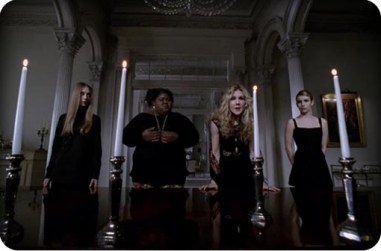
But this episode was ridiculous. Don’t believe me? Take a look at the big villains:

The women on the far right and far left sum up my reactions exactly.

It’s fucking ridiculous, and don’t you dare try to tell me otherwise. And their plan? To open a gate to the underworld and unleash it’s minions on Earth. Maybe I’ve been playing too much Age of Mythology recently (NO SUCH THING) but that sounds strangely close to the plot of a shitty video game. Also, the episode seemed to revel in underlining the major beats for each scene- seriously, take a shot for every time Ashildr jauntily declares “This is MY robbery!” in the first scene, or every time she tells the Doctor “You made me!” or every time he explains why she can’t be her companion, or…yeah, you get it. Even the emotional scenes in this episode were big and goofy, but I’m much more willing to give the show a bit of leeway if it’s tongue is clearly in it’s cheek. I want to stress that this episode wasn’t a classic or anything, but it was almost just a relief to see the show steady itself after last week’s sad swanny whistle.

If I can say one good thing about this episode, it’s that it’s warmed me to the idea of Maisie Williams returning, which she almost definitely will in the near future (calling it: Minister of War mentioned in Under the Lake). I didn’t think she was groundbreakingly amazing in this episode, and she’s yet another recurring female character who the Doctor has connected with as a child before leaving her to wait for him the rest of her life (Amy Pond, Clara Oswald, Reinette de Pompadour, River Song, to an extent), but I like the idea of a sort of morally ambiguous character who understands the Doctor’s plight better than most people he spends time with.

But are you explaining away Osgood’s return next week with “TWINS”? I’ll have you yet, Moffat.

Inhumanity, Bisexuality, and American Horror Story: Hotel

So, I wrote about the season premiere of American Horror Story: Hotel a couple of weeks ago. And I stand by everything I said in that review– it’s tasteless, pointless, and plain horrible. That said, I couldn’t help but enjoy the last couple of weeks- after a wobbly third and fourth season (come on, fight me), it seems that they’re finally re-stabilising their balance in how to tell a coherent, season-long story. Also, Evan Peters plays a Vincent Price-esque serial killer and Angela Basset is a B-movie star from the seventies. It’s a hoot, and while I’m still sort of braced at the start of every episode for something that will undermine the good work they’ve done so far, I’ll take what I can get. Oh, spoilers, by the way.

But oh, when did a Ryan Murphy show ever get off that easily in this blog? One of the things that I did notice about this season, and something that crops up across all kinds of TV all the freakin’ time, is the problematic way they frame bisexuality and especially non-hereto sexual activity. So, let’s take a look at all the plots so far that have involved bisexuality in some form or another:

  1. In the first episode, the Countess and Donovan invite another couple to their bed, where they then brutally murder them and drink their blood.
  2. The Countess and Ramona Royale are shown to be in a relationship, one that ends with the Countess shooting Ramona’s new (male, for what it’s worth) lover dead. It’s also interesting to note here that, despite the fact that the Countess and Ramona were together for years, Ramona describes her relationship with her new man (who’s only shown in two scenes, one of which he is dead for much of) as much more significant and passionate.
  3. Tristan (in a relationship with a woman at the time) seduces Will Drake with the express purpose of murdering him.
  4. Tristan picks up a gay guy on Tinder, and apparently seems to enjoy making out with him, then murders him.

I think it would be missing a big ol’ point in AHS to ignore the fact that sex is bad for everyone on this show. I think there’s maybe one (?) fully consummated, consensual bit of love-making in the series five-year run and that ends with her being abducted by aliens (man, season two was crazy). And the straight sex (nor indeed the straight characters) in this season hasn’t exactly been a glowing bastion against which I will measure all my sexual encounters-it’s been unfulfilling, creepy, or just plain depressing. But when the first three episodes of your show feature four characters whose non-mono-sexuality connects directly to their inhuman and murderous natures, there’s a bit of a problem there.

And we’re what, four episodes in? Maybe I wouldn’t have my ears quite so pricked for this particular trope, but it seems like it’s been everywhere in the last few years. The tacit connection drawn between being interested in more than one gender and being in some way inhuman or, at the very least, deeply unpleasant, appears in a whole bunch of shows- off the top of my head, Buffy the Vampire Slayer (where the vampires are almost all bisexual, but the lead cast members CAN’T EVEN CONSIDER THE POSSIBILITY OF IT), True Blood (same again), the murderous and immortal Dorian Grey in Penny Dreadful, Lee Garner in Mad Men, Crowley in Supernatural, Frank Underwood in House of Cards, June Stahl in Sons of Anarchy, the female HG Wells in Warehouse 13….oh, and that’s not forgetting Ryan Murphy’s own inimitable addition to the genre, were the only long-running bisexual characters in his show Nip/Tuck were incestuous siblings, one of whom was the murderer/rapist Carver.

I’m glad for bisexual representation on TV (doubly so when they actually call it bisexuality, but that’s another story), but there comes a point when show after show after show after show depicts bisexuality as something that goes hand-in-hand with a depraved, often downright evil nature, when I feel like I have a right to object. Christ, the vampires = bisexual trope is so pervasive that I sometimes wonder if I’m actually a bloodsucking minion of the undead (on a side note, while I can appreciate the metaphor for gay rights in the vampires in True Blood, when you think about it even a little bit it’s hilariously badly conceived and offensive). I’m not demanding that everyone who shows bisexual proclivities HAS TO be a bastion of all that’s good and pure in the world, just that they’re not always vampires (or otherwise evil).

Sure, any person who identifies with any sexuality can be evil or good or anywhere in between, but when the depictions of bisexual people so often seem to equate an interest in both genders with a callous, cold, or otherwise inhumane nature, it gets a bit…on the nose. We get it, you think we’re all off having drunken, dimly-lit sex orgies that you’re not invited to and you’re jealous- but don’t take it out on our TV representations.

Feminism in Time and Space, Part One: Amy, Rory, and Gender Roles

I don’t think it will come as a shock to anyone to discover that I’m a huge fan of Doctor Who. And, for a long time, I’ve been studiously avoiding reconciling my adoration (which, to be fair, is pretty swiftly waning) of the classic sci-fi series with my views on feminism and gender roles on TV. But I think it’s time.

It’s no secret that Steven Moffat is pretty sexist-Christ, every time he opens his mouth he seems to blurt out something else that alienates a big chunk of his fanbase. Aside from the complete lack of female writers and directors for the first three years of his stint as DW showrunner, he’s come out with such classic hits as “women are out there hunting for husbands” and “women are needy”, and “there’s a huge lack of respect for anything male”, and- fuck it, just read this article, it sums it up pretty nicely. And that’s infuriating for me, not just because he’s disparaging my entire gender, but because he’s the man behind a show I love. Now, it’s becoming more and more clear that the man REALLY behind the show I love(d) is Russel T Davies, but I can’t avoid the fact that, if I want to engage with Doctor Who (which I do), I have to engage with his shitty notions of gender roles, too.

So, as a companion series to my reviews of season nine of Doctor Who, I’ve decided to take a look at the representations of gender, sexuality, and especially women in Moffat’s era of Doctor Who. I was planning one giant article, but so much of his work on the show is so awful in such a myriad of different ways that I want to be able to focus on just one bit at a time. And this week, I’m starting with his first set of companions, Amy Pond and Rory Williams.

I think it’s important to look at these two as a couple and as individuals, because a lot of their characterisation centres on the adherence to and subversion of gender roles. Let’s start with Rory, a trainee nurse who’s beaten Amy down over a number of years to ackowledge his romantic feelings for her and also return them (see: every time he throws a hissy fit when she doesn’t refer to him as her boyfriend). I really love Arthur Darvill, who plays Rory, but there’s no arguing with the fact that he’s a perfect example of the Nice Guy (TM) trope in fiction. While Amy and Rory do build a solid, semi-believable relationship across the course of the series, it seems to spring mostly from Rory’s wearing-down of her defences as opposed to any mutual feelings on her part. Rory can only offer Amy a very ordinary life, while the Doctor can offer her…well, the entire universe, really. His feelings of not being good enough are understandable, but they often manifest themselves as trying to force Amy to choose between him or the Doctor, even though it’s not his desicion to make.

And she chooses him. Eventually. And that brings us on to their relationship as a couple-it’s clear that the show tried to subvert gender roles by making Amy the more adventurous and curious of the two (good), but failed by simply foisting the negative gender tropes on to the opposite sex (bad). For instance, Amy is the more aggressive of the two- she slaps Rory, throws shoes at him, and generally doesn’t treat him with much compassion, which is played off as a joke because she’s a woman and we expect the men to be….aggressive? Hitting their romantic partners? A negative trait isn’t funny just because the “wrong” gender has it. Amy is still straight-up physically hurting her husband/boyfriend to keep him in line. Flip the genders and it would be unthinkable in a Saturday night kids show.

Similarly, Rory is consistently portrayed as the more “feminine” of the two- firstly, there’s his job as a nurse, then there’s the fact that he’s referred to as “Mr Pond” after he and Amy get married, then there’s his jealousy, his insecurity, etc, etc, etc. Again, these are played off as a joke, because apparently it’s so impossible to get our heads around the idea of a man being or doing any of those things. This is a subversion of the usual manly-bloke stereotype (hello Mickey from season one), but those traits are shown to make Rory less of a man, as the show is often quick to point out through other character’s jokes about his masculinity. As opposed to, you know, just being a human who’s capable of the full range of emotions, occupations, and decisions.

It’s worth noting that one of the only times in the series’ run when he refers to Amy as “Mrs Williams” is when he comes to rescue her from her then-damselled state, all dressed up as a soldier and exhibiting traditionally masculine traits that are usually absent from his character’s development. Because only when he’s being a stereotypical dude can he really claim ownership over his wife. His wife, who has at this stage had a pregnancy forced on her and has ended up with nothing to do but sit about waiting to be saved by one of the men in her life. Because gender roles.

And that brings us to Amy. Wow, Amy. The first in a string of Moffat women who fall in love with the Doctor as children and spend their whole lives pining for him to come back (I count…what, four off the top of my head?), Amy is outwardly a traditionally spunky female sidekick- she’s smart, quick-witted, and brave. But 99% of her characterisation revolves around the two men in her life (Rory and the Doctor). Her entire arc is, notoriously, as “The Girl who Waited”- the woman who put her life on hold for a man she wouldn’t see for decades. We hear next to nothing about the life she had without the Doctor, and what little we do get almost all revolves around, you guessed it, Rory. Her character is defined by the push and pull of the…ugh…love triangle that surrounds her, not as an individual outside of the men she loves.

Then, of course, there’s the fact that she’s constantly, CONSTANTLY sexualised. Moffat said of the casting of Karen Gillan “And I thought, ‘well she’s really good. It’s just a shame she’s so wee and dumpy’…When she was about to come through to the auditions I nipped out for a minute and I saw Karen walking on the corridor towards me and I realised she was 5’11, slim and gorgeous and I thought ‘Oh, oh that’ll probably work.’”.

And boy howdy, does he make the most of his “slim, gorgeous” leading lady. She’s introduced in her work clothes-her job being a kissogram, obviously, and her work clothes being a skimpy police uniform- and proceeds to hang out in teeny-tiny short skirts for the rest of the series. Now, there’s nothing wrong with a woman wearing a short skirt if she’s making the decision to do so, but, considering that the writing and directing staff was entirely male at the time, it wasn’t a woman making the decision to do so. It’s a show making the choice to have one of their main female characters constantly sexualised, both by the show and by the characters in it (the Doctor refers to her as “The Legs”, Rory peers up her skirt without her knowledge, various characters comment on her attire, etc. Fuck, the first time we see her as an adult the camera pans up her bare legs).

Women dressed up all sexy-like isn’t a problem in and of itself, but when it becomes something that she’s defined by, that’s really not great. It’s…ooky, especially because the show so clearly wants us to see Amy as a character to look up to, but fails to make much of her outside of either her looks or her relationships with the men in her life. This is a recurring theme in Moffat’s women, as we’ll take a look at later in this series. Christ, the Doctor even asks Rory’s permission before he hugs Amy, because God forbid another man touch his women, right?

Moffat described Amy Pond and her intended influence in a particularly telling way: “A generation of little girls will want to be her. And a generation of little boys will want them to be her too.” For one, I really hope there are no little girls sitting at home thinking that the best they can do is sit around waiting for a man to make their life exciting, and doubly hope that a generation of little boys aren’t expecting women to define themselves based on their relationships to them.

Because there’s so much great writing on the subject of sexism in Doctor Who across the internet, and because, I can’t possibly hit all the sexism bases with any level of coherence in a single essay, I’m going to round up every article with a few awesome links that expand on the subject of each of these essays.

This article takes a look at the problematic elements of Amy’s mystical pregnancy arc and how the show undermined her initially strong character.

This compares the casting of Freema Aygeman and Martha to the casting of Karen Gillan and Amy.

This author writes about the objectification of Amy and how it undermines her character.