Christine Recaps: Part One
by thethreepennyguignol
Well, my dearest and most darling-est blog readers: it’s time to dip, once again, into the Stephen King literary pit once more.
And take that description in the good nature it’s intended, because I love Stephen King. And I loved writing about his first novel, Carrie, a few years ago; it’s one of the most enjoyable jaunts I’ve taken on the Guignol, and ever since I finished it, I’ve been pondering on what book of King’s I want to take on next. There are loads of his books I love (and, yes, there was a part of me that wanted to dedicate the rest of my time on this mortal coil to an in-depth, chapter-by-chapter analysis of the extended edition of The Stand, just to better point out all the ways that fucking awful TV show screwed it up), but I wanted something that served as a sort of counterpoint to Carrie, his teenage girl horror, something I could compare it to as part of this deep-dive.
And there are a few King books and stories that deal with teenage boys (perhaps most famously Rage), but only one that jumped out to me right off the bat: Christine. The 1983 novel, about a malevolent car that takes hold of an unsuspecting teenage boy, is one that I’ve always had a huge soft spot for – amongst most of the other King fans I know, it’s not a book I hear brought up often as one of his best, but for me, it’s always stood out. A meditation on death, sex, obsession, desire, and good, old-fashioned car enthusiasm, I think King captured something really special here, something memorable and genuinely unsettling.
Or, at least, that’s what I thought when I read it fifteen years ago, as a teenage non-boy myself. As with Carrie, I’m really interested to see how Christine stands up as a novel about adolescence now that I am not quite so much of an adolescent myself. And, more than anything, to take a deep-dive into a book I really love – Carrie, for all that I admire aspects of it, was not generally a brilliant reading experience, and I couldn’t let the only King recap project I did on this blog be something I didn’t like that much, could I? So, I dug out my dad’s old copy of Christine…
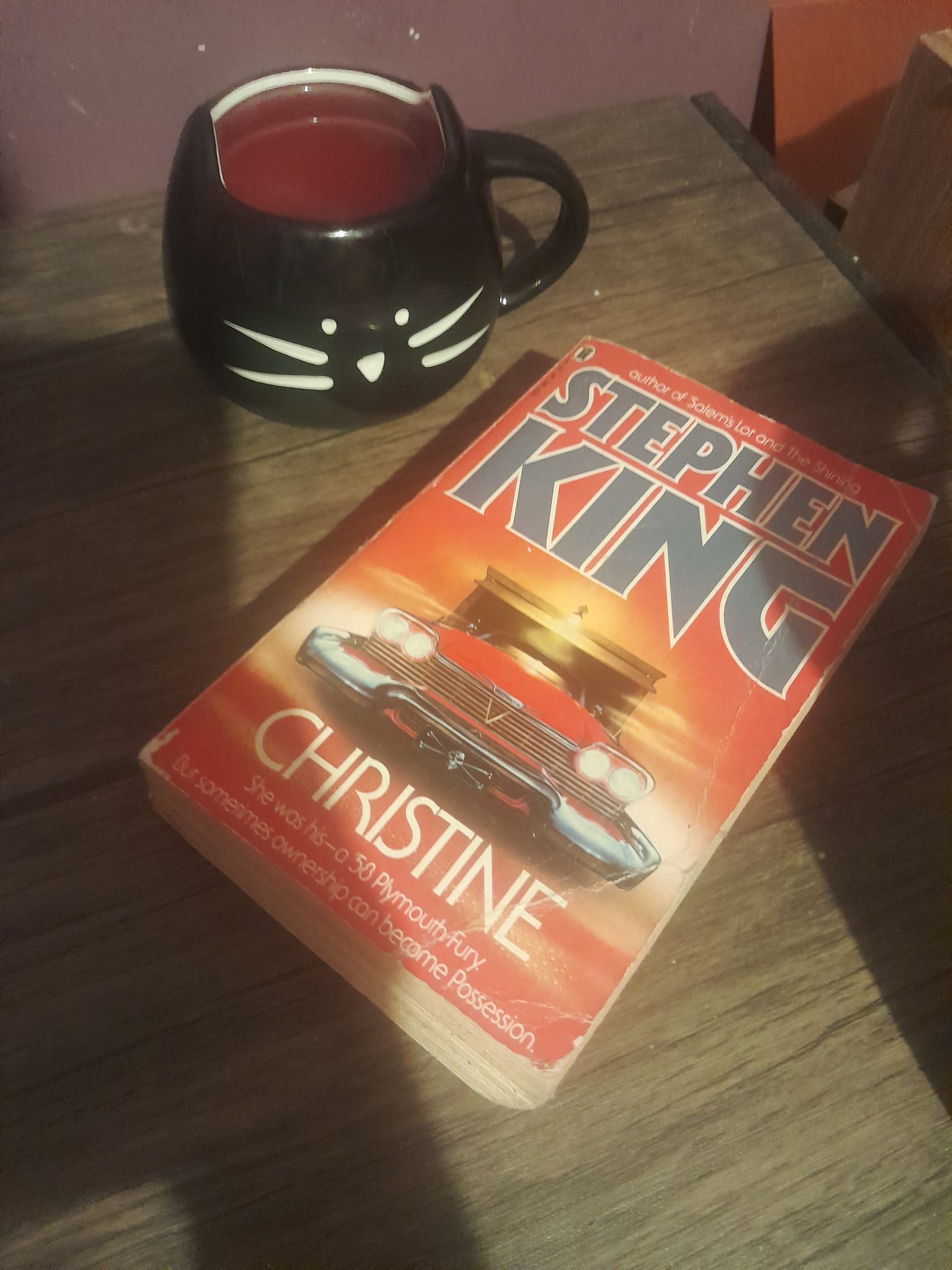
…and I began a new look at one of Stephen King’s novels. Let’s get into this, shall we?
(A quick note: because Christine has about fifty chapters, not including the prologue and epilogue, I’m not going to be breaking these recaps down by chapter – I’ll be including a few in every post, for the sake of this series not going on for the next several years)
Christine opens with a hell of a sentence: “This is the story of a lover’s triangle, I suppose you’d say – Arnie Cunningham, Leigh Cabot, and, of course, Christine”. It’s a perfect set-up for this story, because that’s exactly what it is: a story about love, the kind of insane, teenage love that is a kind of all-consuming horror in real life, let alone when you throw a possessed car into the mix. And, interestingly, despite the mention of Leigh and Christine in this first sentence, most of the prologue is dedicated to our current narrator, Dennis, describing his love for Arnie. Not that he calls it that, of course – no, at twenty-two, he reflects on their lifelong friendship in blunter terms, about how his presence deterred the worst of the bullying aimed at Arnie in high school, how Arnie was otherwise a prime-issue Loser with a capital L. How he taught Arnie to swim, and fed him greens to “build up that scrawny bod a little”, and how he liked Arnie for his curious mind and constant questions. While Christine and Leigh are the obvious romantic and sexual interests in this book, this relationship with Dennis is a hugely important (and less easily-defined) one too, and it’s telling that the book opens with it.
Christine is broken up into sections, and this first one, from Dennis’ point of view, is called Teenage Car Songs. I truly do love this as a framing device – we’ll get two more sections in the rest of the book, Teenage Love Songs and Teenage Death Songs – and the song lyrics studded through the text, that perfect distillation of overwhelming teenage emotion. For fun, I’m going to be linking the songs that open each chapter as they come up, just in case, like me, you never had a chance to sit down and listen to them all: we’re starting here, with Somethin’ Else by Eddie Cochrane.
And that teenage emotion gets going soon, as Arnie insists that Dennis pull his car over so Arnie can get a better look at the red 1958 Plymouth Fury for sale on the side of the road. This is, of course, our introduction to Christine:
“She was a bad joke, and what Arnie saw in her that day I’ll never know. The left side of her windscreen was a snarled spiderweb of cracks. The right rear deck was bashed in, and an ugly nest of rust had grown in the paint-scraped valley. The back bumper was askew, the boot-lid was ajar, and stuffing was bleeding out through several long tears in the seat covers, both front and back…”
I just love this description of her – it’s simple and doesn’t feel too obviously supernatural in terms of a car description, but there’s just enough visceral imagery to underline how off this thing is.
Dennis pulls over for Arnie to get a better look at the car, and Arnie’s already enamoured; the owner of the car, Roland LeBay, soon approaches to figure out what they’re here for. Now, Roland himself an army veteran with physical disabilities, is one of the reasons I wanted to get into this book, because he’s one of my favourite of King’s human villains – just a profoundly cruel, nasty man, who was in this sort of symbiotically rotting relationship with Christine where they both seemed to feed off each other’s awfulness.
And if you don’t think this book isn’t fundamentally about car-fucking, let me introduce you to this, right here on page 11:
“”Brand-new, she was. Had the smell of a brand-new car, and that’s about the best smell in the world.
He considered.
“Except maybe for pussy””.
I do love that King just comes out and says it this early on in the book; there’s this lecherous description earlier in Christine’s introduction about cars waiting under sheets to be showed off to potential buyers, talk of Christine’s “great lines”. And, in much the same way that desire will come between the boys in future, Arnie’s desire for Christine causes trouble for them here, as Dennis tries to stop his friend getting ripped off for such a broken-down vehicle. Roland storms off and refuses to engage with the sale if Dennis has anything more to say about the matter – eventually, Dennis sates him by lending him some money as a deposit, and LeBay promises to hold the car for Arnie until the next day.
Dennis hands over the money because, as he explains, he hasn’t got anything to spend it on: “I had no social life at all. Lately I hadn’t even been assaulting the ramparts of my cheerleader girlfriend to the style of which she had become accustomed.” A couple of things: firstly, as a teenage girlfriend who once had my ramparts assaulted, I can tell you that what she’d become accustomed to was bad sex. But, more importantly, this is a really interesting comparison point to how he describes Arnie later in the same page: “God gives everyone one good feature, I think, and with Arnie, it was his eyes. Behind the glasses that usually obscured them, they were a fine and intelligent gray, the colour of clouds on an overcast Autumn day”. We don’t even get his girlfriend’s name, just some strangely aggressive and generic comments referring to her body – Arnie gets a downright evocative description here, almost tender. I’m not saying that Stephen King neccessarily intended for it to be explicitly intended read in a romantic way, but it’s an interesting point of comparison to me. Close friendships in your teens can take on a kind of intimacy that’s slippery in definition, and that’s one of the aspects of this book I find most compelling.
Roland gives the car’s name, Christine, and we’re on to chapter two, opening with Yakety Yak by The Coasters:
And we get a little description of Libertyville, where this story takes place. Nobody does a small town in fiction like Stephen King, and Libertyville doesn’t play an enormous part in this story, but the description of it as “not ritzy, but brainy, at least” is so perfect and conjures up a very specific image of this suburban town that I understood instantly.
Dennis drives Arnie home, where we meet his parents, Michael and Regina; “university people” to the core, according to Dennis, wannabe vegetarians with the kelp quiche to match. When they discover that Arnie has purchased a car, an argument breaks out – and, for the first time in Dennis’ recollection, Arnie stands up for himself, and angrily, with “a monstrous overkill of bitterness and acrimony”. This early on, Christine is already causing trouble for Arnie, and he’s already going to bat for her – and not unreasonably, either.
“”You wanted me in college courses, I’m there.” He looked at his mother. “You wanted me in the chess club instead of the school band, okay, I’m there too. I’ve managed to get through seventeen years without embarrassing you in front of the bridge club or landing in jail….I’m telling you, I’m going to have this. This one thing”.
This is such a good statement of intent from Arnie as a character – Christine is an act of rebellion for him, a way to stand up against his parents and their expectations of him; while his adoration for her isn’t entirely natural, it makes sense from a teenage perspective, a brilliant blurring of the lines between the paranormal and the personal. It’s a forbidden love affair already.
Next song up: Hot Rod Lincoln, by Charlie Ryan (a banger):
Dennis expects Arnie to back down to his parents, but, the next morning, he comes to pick him up for school as usual and finds him in good spirits (making a reference to Jeeves and Wooster, no less). In the car, we get some prime foreshadowing for LeBay’s actions, as Arnie muses on the purpose of parenthood:
“I think that part of being a parent is trying to kill your kids…as soon as you have a kid, you know for sure that you’re going to die. When you have a kid, you see your own gravestone.”
Parenthood and ownership – and the overlaps between the two – are a major theme in Christine, as is, you know, parents murdering their kids, literally and metaphorically. Arnie’s talking somewhere between the two, even though his parents have come around on him owning Christine, if not driving her. It’s that typical teenage overstatement that feels profoundly real in the moment, and proof of how attached he’s already become to this car and the potential she offers him: trying to keep him from her is akin to murder.
And murder is just where we’re going with Christine, but we’ll get to that! I’m super excited about getting into the rest of this book with you, and am hoping to get out a couple of new entries into this series a month, should you want to join me on a read- or listen-a-long. Where does Christine stand in your Stephen King rankings? How does it stand up to some of his other classics? Let me know in the comments below!
If you enjoyed this article and want to see more stuff like it, you can support me on Patreon to help keep this blog running and keep my very demanding little cat in treaties, and me out of her clutches for another month yet, or consider checking out my fiction work!
 The Cutprice Guignol