“Believe It or Not, I Am Shaken by This”: The 1983 Cabbage Patch Kids Riots
by thethreepennyguignol
As Christmas drew close in the winter of 1983, there was only one toy that thousands of children across the USA wanted to wake up to under their tree: a Cabbage Patch Kid. But just how far would their parents be willing to go to make that happen?
The now-iconic toy originally started life in the hands of Kentucky artist Martha Nelson Thomas, who began working on designs for a new type of doll while she was in college in the early 1970s. While other dolls on the market during this period were made from vinyl and plastic, Nelson Thomas combined cloth bodies with a soft-sculptured plastic head, styling her creations with a birth certificate which would allow them to be “adopted” by friends and family.
When Xavier Roberts, a Georgia gift shop owner, stumbled across Nelson Thomas’ unique designs, he purchased a few to sell in his store – but a dispute between the two regarding pricing led to Roberts to tweak the designs on Nelson Thomas’ creations just enough to dodge any copyright disputes, and he set about “adopting” them out for a hefty price under the name “Little People”. Demand soon grew for the dolls, and Roberts licensed the dolls for exclusive manufacture and distribution with Coleco, a brand originated in 1932 who had been struggling with diversifying their market reach after a flubbed attempt to enter the emerging video gaming sphere.
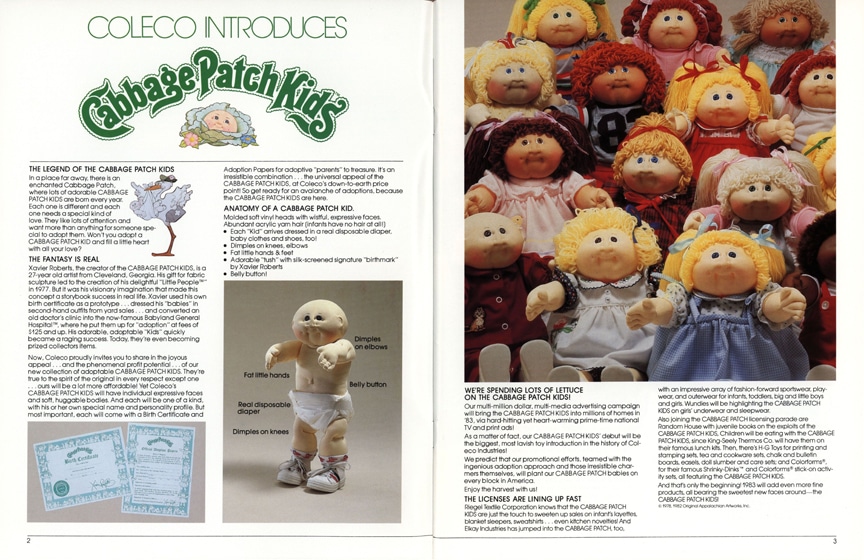
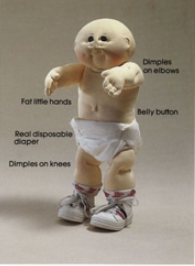
And, by summer 1983, after a promising early release in February, the revamped Cabbage Patch Kids were ready to hit the proverbial shelves – or, at least, the fictional adoption centres that Coleco invented to promote them in a huge marketing push.. Coleco boasted of unique, affordable dolls with “individual expressive faces” and “his or her own special name and personality profile”, with each doll replete with adoption papers for “parents” to treasure. Roberts had rather creatively re-imagined himself in the box blurb for the dolls as a curious ten-year-old boy who had “discovered the Cabbage Patch Kids….behind a waterfall into a magical Cabbage Patch, where he found the Cabbage Patch babies being born”. They had fat little hands, for God’s sake – these kids didn’t stand a chance against the onslaught of cuteness that was heading in their direction. Just look at this useful diagram!
At the Boston Children’s Museum in June, Coleco launched the Cabbage Patch Kids to enormous success. The exact alchemy that led to the dolls being such a smash hit is hard to quantify, though there are a few obvious factors: they were relatively cheap, at around $26 apiece, and the gimmick of the adoption papers served to distinguish them from other toys on the market at the time. Psychologists had a few different theories as to the toy’s popularity, with Dr Joyce Brothers suggesting that their less-conventionally-cute features were comforting to children who perhaps felt similarly about themselves, while Dr Bruce Axelrod put forth the idea that the adoption paper gimmick allowed children to “act out” the fantasy of having been adopted that was so common in children in the Cabbage Patch Kids’ target audience. Paule Rancort, a toy industry veteran who saw the release of the dolls in the 1980s, remarked on the unique designs and faces as a potentially attractive selling point to young girls -“…you’ll have your own doll that looks like you,” she said. “That’s probably why every little girl was looking to find a doll that looks like them”.
Whatever the confluence of circumstances that came together to allow Cabbage Patch Kids such a warm welcome to the marketplace, Coleco was soon looking down the barrel of one of the most successful toy launches of all time. Stocks for Coleco surged from $6.87 to $36.75 per share. The demand for the dolls so outstripped their expectations that they eventually pulled all advertising to try and keep from being oversold (well, that, and a slap on the wrist from the consumer affairs department of New York’s Nassau County warning them about advertising dolls that were not currently available in stores) and Coleco were soon chartering planes from Hong Kong to try and keep up with newfound sales. But, as the Christmas season drew close, the frenzy for Cabbage Patch Kids would reveal itself in all its feral, frantic, festive ferocity across the USA and Canada.
The first rumblings of trouble came in November, around Thanksgiving, when family members and friends started trying to secure the in-demand doll for their children. Stores usually stocked a few hundred units of the doll at any given time, but, with thousands swarming shops, they sold out quickly, some putting up signs announcing that they had specifically sold out of Cabbage Patch Kids to get ahead of the complaints. If you were lucky, you could find a few scattered accessories – a a pacifier here, a sleep sack there – but competition for the toys themselves soon became heated. Bonnie Jefferies, a hapless shopper interviewed in a CFPL-TV spot on November 25th, described the scenes at a store in Ontario – “The door opened and everyone headed here. I couldn’t believe it — people yelling, screaming, knocking over merchandise, boxes flying, people crying…”.
A few stores did their best to mitigate the surge in demand, some handed out tickets to waiting shoppers to allow an allocated amount to purchase Cabbage Patch Dolls within the stores’ purview. On the ground, a few customers bartered for a doll suitable for their purposes, with a Florida woman bartering her red-haired girl doll for a blond-haired boy (of the Cabbage Patch Kid variety, of course).
But things didn’t get any less frantic in the weeks to come. A pregnant woman was allegedly trampled in the rush to score one of the forty dolls put on sale at a New Jersey store, while, elsewhere in the state, another woman was elbowed in the face until nearly unconscious. In North Miami Beach, Florida, a 150-strong crowd knocked down a seventy-five-year-old man in the struggle to land one of the toys. A report from Pennsylvania on 28th November showed a crowd of around 1000 people at a local Wilkes-Barre, who had gathered to storm the store on its opening, which one woman suffering a broken leg in the crush. The store owner, brandishing a metal baseball bat, attempted to get the attention of a crowd of Cabbage Patch-hungry shoppers while customers scrambled over merchandise stands and boxes for the much-lusted-after dolls flew through the air.
Two DJs in Milwaukee joked on-air that a B-29 bomber would drop supplies of Cabbage Patch Kids to County Stadium for anyone holding a catcher’s mitt and an American Express card, and at least a dozen people reportedly turned out in sub-zero temperatures in the hopes of collecting their accesorizable aid parcels. In mid-December, the Cabbage Patch Kid was featured on the front page of Newsweek under the headline “The Cabbage Patch Craze – Marketing a Christmas Fad”.
In some ways, these images of people going absolutely ballistic for a trendy consumer product is relatively familiar to us now – iconic images of Black Friday sales descending into pandemonium are so ubiquitous now as to have served as endless fodder for comedy, even stretching into the horror genre in the last few years. But, in 1983, this kind of demand was unprecedented; the parameters and management for such clashes between consumer and purveyor were unheard of, at least at these levels and across so much of the country. A reporter for CFPL-TV remarked, only half-joking, as he stood before a frantic crowd snatching up a freshly-stocked display of the dolls, “believe it or not, I am shaken by this. I have never seen anything like this in my whole life”.
By the end of 1983, somewhere in the realm of 3 million Cabbage Patch Kids had been sold and the dolls had commanded a domineering spot at the top of the toy pyramid for the time being. It’s hard to say exactly how many children across the USA and Canada woke up to their much-wished-for doll on Christmas morning 1983, but the profits would no doubt have served as a sizeable Christmas gift for Soleco et al. One blogger, whose grandfather had been present at the Zayre’s store where the iconic baseball-bat-wielding footage later emerged from, reflected on the event in 2012 – “after all of the trouble my family went to for this oh-so-perfect Christmas gift for me, would you believe that I never played with it?”.
The Cabbage Patch Kid, now solidified in popular culture, would go on to maintain its place as one of the top-selling toys in America and Canada in the decades to come. Though perhaps as enduring a cultural legacy is that of single-minded frenzy for a specific toy – the 1996 clashes over Tickle Me Elmo that led to a trampling, the Hatchimals craze in 2016 that left customers paying almost twice the asking price for the new toy, the petty (and not-so-petty) crime inspired by the pursuit of Beanie Babies in the late 1990s and early 2000s, to name just a few.
But the riots that defined their first year on the market would remain one of their most iconic and impactful marks on the world of toys, a testament to what a good marketing campaign and a particularly hectic holiday season can bring out in consumers – though not an entirely positive one. If you’ve got memories of these riots, or recollections of other toy-centric crazes that I haven’t discussed here, I would love to hear about them in the comments below!
If you’d like to support my blog, please consider supporting me on Patreon or dropping me a tip via my Support page. You can check out my other longform writing right here!
Additional Sources
 The Cutprice Guignol